 Katie Sims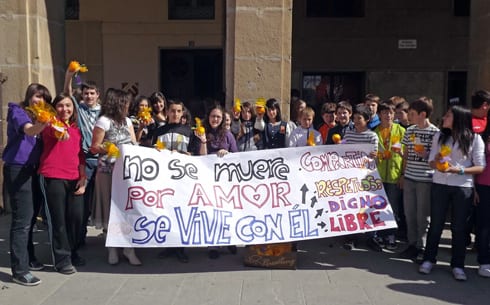
TU media naranja: your other half, your better half, your soul mate.
The origin of this Spanish saying comes from ancient Greek legend. The myth described by Aristophanes in Plato’s The Banquet tells the story of how human beings used to be round, in the shape of oranges, with two faces on the same head. They had four arms and legs and rolled around in perfect harmony; the human race in its most perfect form. There were three types of oranges: man/man, woman/woman and woman/man.
Drenched in their vanity of completeness, they approached the Gods, believing them to be their equals. Zeus punished their arrogance, separating them with a bolt of lightning. Human beings, split in two and alone, were condemned to spend their lives searching endlessly for their other half, their media naranja. Only once they had found their partner were they complete, enlacing themselves so strongly, they would never let go.
The human race never questioned its limits again.
The idea of being somebody’s media naranja initially strikes you as something innocent, maybe sweet, but with young people entering into their first romantic relationships, the sad search for your soul mate becomes a daily obsession. The worry is a dangerous decent into dependency and unhealthy relationships. So an initiative in a secondary school in Tafalla, Navarra, wanted to teach people that you are not a media naranja, you are a whole orange, one independent person and the belief that you are not complete without that person is only a myth.
The social discussion group at Instituto Sancho III el Mayor has been teaching this new way of thinking to their adolescents in hope of preventing bad choices and habits in their future relationships. Being something I really believe in, I went along to watch the parade and help give out our full complete oranges to the public of Tafalla.
The shock of free oranges and over-enthusiastic youngsters offering wisdom to the older generations of Tafalla, docile with their shopping on market day, did cause quite a stir. Even the local press were there taking photos. As the youngsters ran through the square, excited by their freedom and by what they had learnt, they took on their role and communicated their message with pride. The banner read: “Don’t die for love. Live in dignity, with freedom, sharing and respect.”
Tied around the oranges was this, by John Lennon:
They made us believe that each one of us is half of an orange, and that life only makes sense when you find the other half. They did not tell us that we were born as a whole, and that no-one deserves to carry the great responsibility of completing what is missing in us on his shoulders.
Now, as whole oranges, the young people of Tafalla are ready to tackle the world of relationships and falling in love.