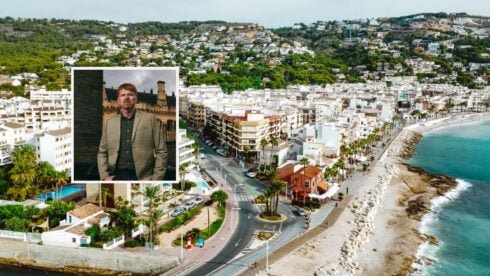

 One of the longest serving foreign correspondents in Spain, Giles Tremlett delivers an almost daily slice of Iberian news to the pages of The Guardian. LISA TILLEY spoke to him about his best-selling, insightful new book Ghosts of Spain
HE has spent most of the last two decades covering events around Spain for the anglosajón market. As well as visiting every corner of the country from Asturias to Andalucia, Giles Tremlett’s beat includes the Maghreb and Portugal, where he has spent a lot of time over the last few months covering the disappearance of four-year-old Madeleine McCann.
On the road for much of the year, is this a problem for his family? How does his wife cope, being married to the ever-transient foreign correspondent?
“Reasonably well, I assume,” he says, before adding: “I sometimes say that a correspondent’s job is a bit like being a homicide detective in one of those crappy American series. It always seems to be the mother-in-law’s birthday when someone kills the mayor’s daughter.”
His humour is delivered in an arid, deadpan tone – and his voice is more dry and serious than I expected.
Giles arrived in Spain during the early 1980s; when he started working for The Times and the now-defunct European, before donning The Guardian Madrid correspondent’s cap in 2000.
We are speaking on a rare break at his second home in the Sierra de Gredos, a mountainous swathe of Castilla y León, which he describes as “beautiful.”
“I spend as much time as I can here,” he explains. “But not a lot.”
The conversation shifts swiftly from his boys, aged 11 and 9 (“They love it here in Spain. They’re little Madrileños, who speak Spanish among themselves and English with their parents.”) to the state of Spanish corruption.
But mostly he likes talking about Spanish attitudes and culture. He feels he has really got under the skin over his time spent here . . .and this is quickly obvious on reading his book Ghosts of Spain, which has garnered rave reviews in the British press.
Take respected fellow British writer about Spain Paul Preston’s review in the Times Literary Supplement. “It is perceptive, affectionate, critical and amusing by turns, whether it be on the noise levels of Spanish cities, on the verbal incontinence of Spanish men once they get talking, on the absence of road rage, on the oddities of parenthood in Spain, on the exclusion of men from obstetrics wards where dictatorial doctors hold sway, imposing Caesarean births to suit their golf schedules. The list is endless and well worth pursuing in this excellent book.”
Many years in the making, the book found its hook on Spain’s blackest day for well over a decade, that of the Madrid bombings on March 11, 2004. It was the day that many of the themes of the book finally collided: Eta, Spain’s Moorish past, political deception and the clash of the two Spains. I wondered whether – amid all the carnage – Giles suddenly realised that this was his peg?
“It all came together much later,” he explains. “The day certainly crystallised all those issues, but at the time we were all running around like madmen counting the dead and trying to work out who did it. But within a week or two came the collision between the variety of Spanish issues.”
These issues are still very much alive today, he believes, and anyone who thought that the troubled history of the civil war and dictator Franco were now buried under Spain’s modern European image should think again.
As Giles explains Spain is still democratising, resolving its civil war issues, exorcising its dictatorship and removing what he calls the “cloak of silence.”
“These are quite momentous times,” he says. “I think we are living through a further period of change after the massive changes of the transition. [That period] was an exception; the idea of there being consensus on so many things was exceptional. Now we are finding a more natural Spain – a Spain full of differences. We are now back to reality; the transition created a very safe environment in which to go back to some very old arguments.”
He continues: “In Spain, so much is about history; but one mistake is to think that history started in 1936, which it didn’t. The Civil War was the result of other things, and Spain had other civil wars in the 19th century. On the other hand, certain sections of the right like to blame the Republic; a version of history starting in 1931. Well, that’s also not true.”
Moving forward to a more recent conflict, in the book it seems Giles almost wants to classify Eta as one of Spain’s ghosts so optimistic was he that nationalist terrorism was all but over. Since then, the “ceasefire” has ended and the spectre of Eta has raised its head again.
Was this a surprise?
“Well I won’t say I was surprised but I was upset, if you know what I mean. I like to think that this is another phase in Eta’s death throes really. The era of nationalist terrorism is disappearing, certainly in Europe, which does make Eta feel like a dinosaur of the past.”
He also addresses some of the ghosts of modern day Spain, the ghosts of corruption and white envelopes full of cash, of the terror being wreaked on the environment. Where are these issues heading and will Spain be destroyed in a short time, as some believe?
“When I devoted a chapter to corruption I was worried that people would say: ‘you’re exaggerating’ because at that time there had been no Operation Malaya and the whole Marbella corruption scandal had not been exposed, nor had the chain reaction begun.
“Now progress is happening, because it’s being debated around the country and it’s reaching court houses. The problem is that corruption is shared to the degree that, while your mayor might take a cut of the building project, everyone else is employed on the building site. I’m now in a village where people voted out the only mayor in Spain who had urbanismo powers taken out of his hands for refusing to give licences.”
Now inevitably, he explains, the large urbanización that he opposed is going to get the go-ahead to be built. “That’s not corruption, that’s democracy; that’s the choice that people have made. But I actually think the Spanish environment will be saved by an economic downturn eventually.”
We move on to talking about the cultural differences between the UK and Spain, and how conditions here are more favourable for journalists: “Everyone in Spain has something to say for themselves. There’s an absence of blushing violets. The Spanish speak at huge length and that’s a wonderful thing for journalists.”
I wonder whether he finds the cultural corruption, enchufe (the practise of being literally being plugged in to a job by a well-placed contact) at odds with his own ethics?
“What is weird for other people has become normality for me. But Spain is still a place where if you work hard you can get ahead. The more shocking thing is the number of people whose idea of success is to become a funcionario, a job-for-life bureaucrat. That’s more a way of stymieing people’s creative and industrious virtues than anything else I can think of.”
It turns out that Giles is attending to his own creative virtues and stepping off the correspondent’s treadmill for a while: “I’m taking some time off from The Guardian to write a biography of Catherine of Aragon,” he explains.
It seems like a surprising diversion. Catherine of Aragon, the daughter of the Catholic Monarchs – Fernando and Isabel – who married into English society and therefore must have lived in a kind of cultural exile, ending up neither Spanish nor anglosajón. On closer inspection, it seems a natural step for Giles Tremlett to become her biographer.
Ghosts of Spain is published by Faber&Faber
Click here to read more News from The Olive Press.