

FALLING ill away from home – especially in a foreign country where you may not speak the language – can be a daunting experience.
For expats and international residents living in Spain, deciding whether to visit A&E at night can therefore feel particularly uncertain, especially when symptoms initially appear mild or access to regular healthcare services is limited outside normal hours.
However, specialists at Quirónsalud Marbella International Hospital warn that delaying medical attention overnight may be risky in certain situations.
“At night, many patients hesitate before going to A&E, often hoping that their symptoms will improve on their own over time”, explains the Head of A&E, Dr Esther Hurtado.
Fatigue, uncertainty and reduced access to other healthcare services during these hours lead many people to postpone seeking medical attention until the following morning.
READ MORE: EXCLUSIVE: Raw dog food blamed in Spain expat pet tragedy that sparked €20,000 vet bill
“This is something we see very frequently. Many patients initially try to cope with their symptoms at home for hours, especially at night, thinking it is something minor or that it will resolve on its own”, adds Dr. Hurtado.
The nighttime setting also affects how symptoms are perceived, often intensifying feelings of uncertainty and vulnerability.
In some cases, delays in seeking care mean patients arrive at the hospital with more advanced conditions or a greater perception of severity, which may ultimately affect their clinical outcomes.
From the A&E department, specialists emphasise the importance of recognising warning signs and not postponing medical assessment when potentially serious symptoms are present.
READ MORE: Spain expands breast cancer screening programme to more than three million extra women
“In emergency care, we strongly emphasise that early consultation in the presence of potentially serious symptoms can make a significant difference in patient outcomes”, the specialist adds.
Key warning signs include intense chest pain or pressure, difficulty breathing, sudden loss of strength, speech disturbances, loss of consciousness, or persistent high fever accompanied by general deterioration.
Other concerning symptoms include significant bleeding, severe abdominal pain, major trauma, seizures, or any sudden change in neurological status or level of consciousness.
Emergency care is available 24 hours a day, with clinical activity varying during the night, when more acute and unpredictable cases tend to predominate.
READ MORE: Health alert as bacteria-contaminated Spanish olives are distributed to the EU
“At night, emergency cases are generally less ‘scheduled’ and more unpredictable. We predominantly see acute conditions that patients perceive as serious or that cannot wait”, explains the Head of Emergency Medicine.
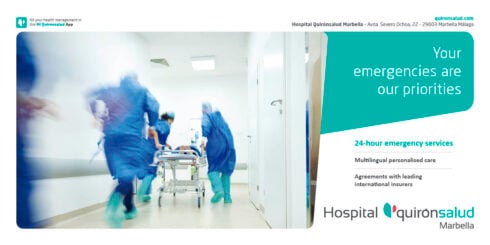
Quirónsalud Marbella International Hospital provides a fully operational 24-hour A&E service, including General Emergency Care, Paediatric Emergency Services and Gynaecological Emergency Care, ensuring specialised and continuous care tailored to each patient’s needs.
Beyond the clinical aspects, the hospital also highlights the human dimension of emergency care, particularly at night, when patients often arrive in more emotionally vulnerable states.
“Most patients do not come to A&E out of convenience, but because they are experiencing fear, pain or uncertainty. In those moments, the role of the healthcare team is to support, assess and act with the utmost urgency”, concludes the Head of the Emergency Department at Quirónsalud Marbella Hospital.
Quirónsalud in Andalucia
Quirónsalud currently operates eight hospitals across Andalucia, located in Malaga, Marbella, Los Barrios (Cadiz), three in Seville (Sagrado Corazon, Infanta Luisa and Materno-Infantil), as well as in Cordoba and Huelva.
In addition, the group runs two ambulatory surgical centres in Seville and Malaga, along with 22 specialised medical and diagnostic centres, making it the leading private healthcare provider in the region.
About Quirónsalud
Quirónsalud is the leading healthcare group in Spain and, together with its parent company Fresenius Helios, also the largest in Europe.
In addition to its operations in Spain, Quirónsalud has a strong presence in Latin America.
The group employs more than 50,000 professionals across over 180 healthcare facilities, including 57 hospitals with more than 8,000 beds.
It is equipped with state-of-the-art technology and supported by a highly specialised team of internationally recognised professionals.
READ MORE: Health alert as measles outbreak doubles to eight confirmed cases in Murcia
Its network includes some of Spain’s most renowned hospitals, such as Fundacion Jimenez Diaz University Hospital, Centro Medico Teknon, Ruber Internacional, Quirónsalud Madrid University Hospital, Quirónsalud Barcelona Hospital, Dexeus University Hospital, Policlinica Gipuzkoa, General de Catalunya University Hospital and Quirónsalud Sagrado Corazon Hospital, among others.
Quirónsalud is also strongly committed to medical education and research. Eleven of its hospitals are university-affiliated, and it operates leading research centres such as the Fundacion Jimenez Diaz Health Research Institute, accredited by the Spanish Ministry of Science and Innovation.
In addition, its healthcare services are organised into cross-disciplinary units and networks that enable the sharing of expertise across centres and facilitate the translation of research into clinical practice.
The group is currently involved in numerous research projects throughout Spain, with many of its facilities leading innovation in specialties such as oncology, cardiology, endocrinology, gynaecology and neurology.
For more information, please visit www.quironsalud.com/marbella or call +34 952 774 200
Click here to read more Health News from The Olive Press.