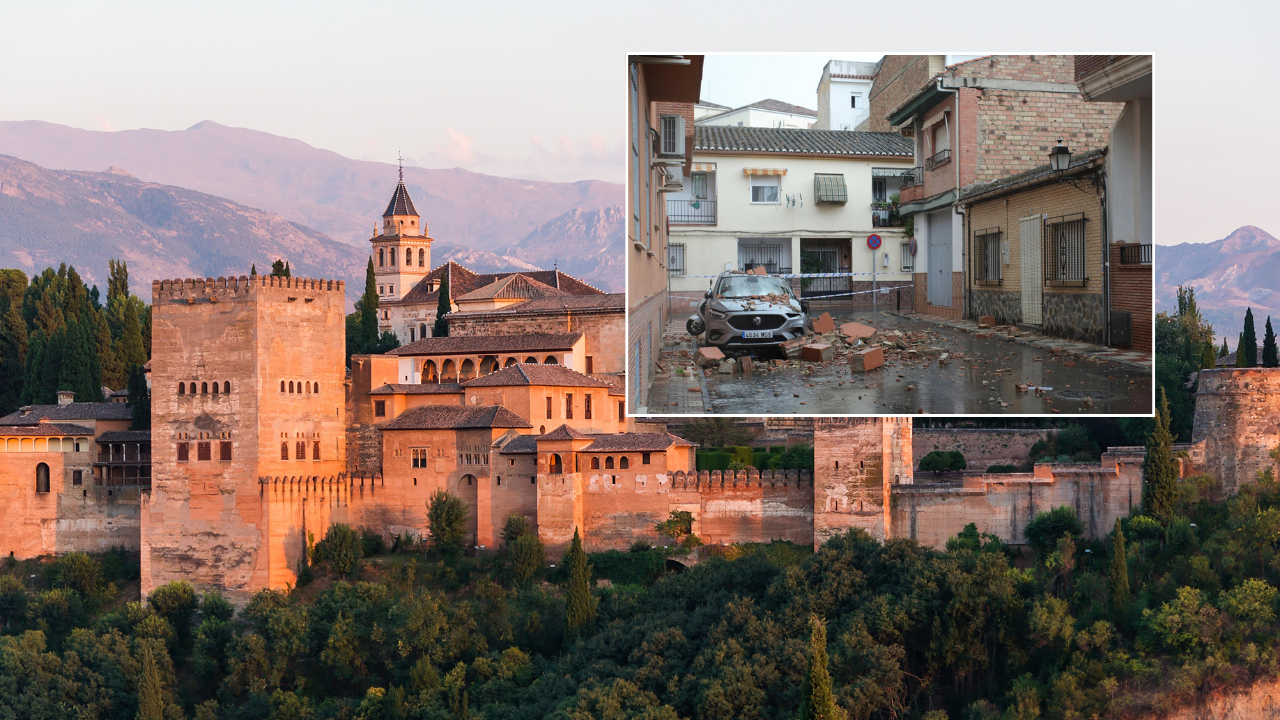
RESIDENTS in Granada were abruptly awoken in the early hours of Saturday after a powerful earthquake shook the city, sending terrified locals fleeing into the streets and causing damage to buildings and vehicles.
The magnitude-5 tremor – later downgraded to 4.8 by the National Geographic Institute (IGN) – struck shortly after 1am, with its epicentre located in Alhendin, south-west of Granada.
The rumble was felt across much of Andalucia and as far away as Madrid, while more than 200 calls were made to emergency services.
No injuries have been reported, although falling debris damaged cars and buildings and several people had to be rescued from lifts.
READ MORE: Panic in Granada as magnitude-5 earthquake shakes city, damages homes and sends residents fleeing
The quake was then followed by a series of aftershocks, prompting some residents to spend their night outside their homes amid fears that further tremors could follow.
But while an earthquake of this ilk is more than enough to give hardened locals a fright, Granada is no stranger to seismic activity.
In fact, the Granada Basin is one of the most seismically active areas in the Iberian Peninsula, with frequent shallow earthquakes of low to moderate magnitude.
Why does Andalucia shake so much?
The answer, as you would expect, lies deep beneath the ground.
Southern Spain, including the Costa del Sol, sits close to the complex and still-active boundary between the African and Eurasian tectonic plates.
The two plates are continuing to converge at around 5mm a year, according to experts, creating enormous stresses that are released occasionally through a network of faults running beneath the region.
The resulting seismic activity is particularly pronounced along the Betic mountain range, which stretches across much of Andalucia.
Around Granada, active faults cut through the intramountain basins surrounding the city, producing the shallow tremors often felt by locals and expats.
Most of these earthquakes are relatively small, however, and serious destructive events remain rare, although the region has experienced some major earthquakes throughout history.
That includes a magnitude-7.8 earthquake in 1954 and a magnitude-6.3 quake in 2010.
But these tremors caused no damage and no casualties because their epicentres were located at extreme depths of more than 600km below the earth’s crust, which will undoubtedly reassure anxious locals.
Click here to read more Spain News from The Olive Press.