
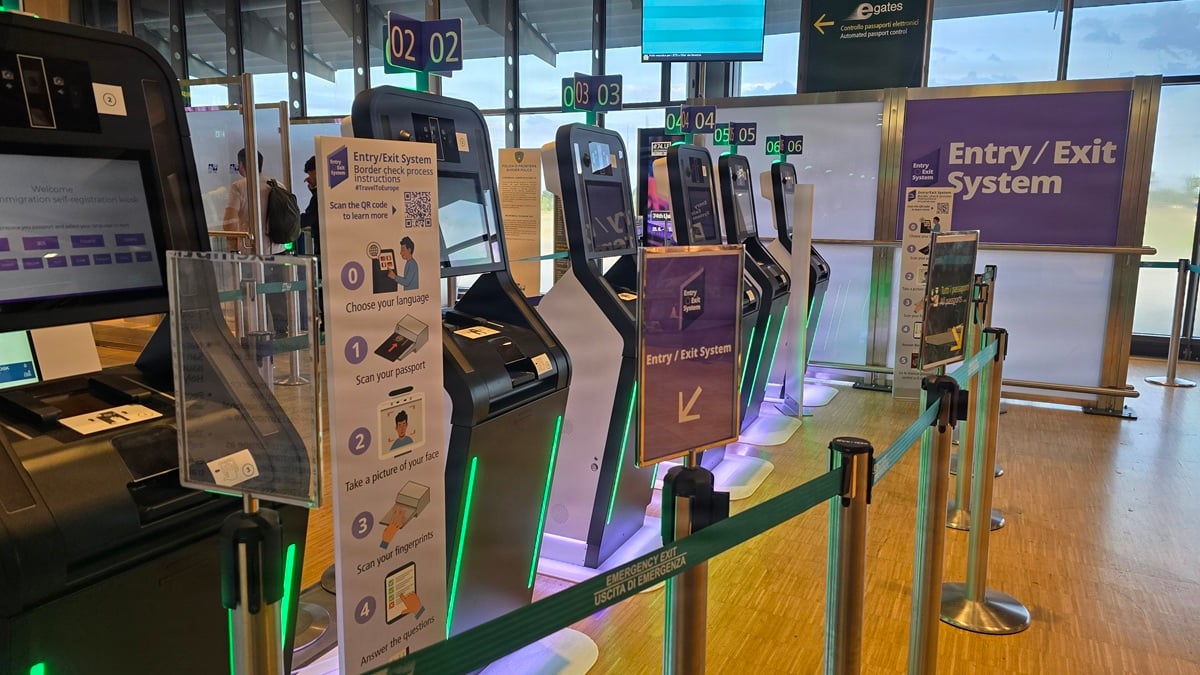
BRITISH travellers to Spain could face longer airport queues from next week following a major change to the EU’s Entry/Exit (EES) digital border control system.
The EES, which replaces passport stamps for non-EU travellers, caused widespread disruption after its rollout in April as passengers queued for hours to receive face and fingerprint scans.
Under a temporary relief system, EU member states have been allowed to pause EES biometric checks for up to six hours during ‘exceptional circumstances,’ including when queues grow too long.
However, from 7 September, EU states including Spain will no longer be able to temporarily switch off the system at their airports, with experts warning of renewed travel disruption across Europe.
Jurgen Himmelmann, co-founder and CEO of travel portal Global Work & Travel, said: “Until now, authorities have had additional flexibility to ease biometric checks when queues became excessive.
“If that flexibility disappears, the real concern is what happens when there is nowhere for the queue to go. We’ve already seen reports of missed connections increasing under EES, so this isn’t simply a theoretical problem ahead of Monday.”
The change comes amid reports that missed flight connections have doubled since the border system was introduced, with some airlines experiencing an even greater increase in affected passengers.
On 7 July, nine EU countries wrote to Brussels asking officials to extend the EES pause system past the September deadline.
Though Spain did not sign the letter, its airports have repeatedly resorted to the pause system between April and July to avoid lengthy queues.
Despite these appeals, European airports are now preparing for potential delays as the 7 September deadline approaches.
“For British travellers, I’d be particularly cautious about tight connections, airports where passport control comes late in the journey, and return flights where you need to clear an external Schengen border before reaching the gate,” Himmelmann said.
He added that passengers should leave considerably more time than usual, but warned that simply arriving several hours early does not eliminate the risk of missing a flight.
“Getting to the airport early is sensible, but there is a limit to how much control that gives you,” he said.
“Bag-drop desks may not be open four hours before departure, and once you’re in a passport-control queue, you can’t simply skip ahead because your flight is boarding.
“I’d avoid planning a journey around the minimum connection time over the next few weeks.
“A connection that looks perfectly reasonable on paper can become uncomfortable very quickly if you lose an hour or more at the border.”
Travel experts are also warning holidaymakers not to count on airlines for compensation if long border queues cause them to miss a flight.
Because passport control is strictly out of the airlines’ hands, standard rules on refunds and payouts simply will not apply.
“If an airline delays your flight, there are established passenger rights. If your aircraft leaves on time but you’re stuck at passport control, the situation can be very different,” Himmelmann said.
“Check your travel insurance before leaving, particularly the wording around missed departures and missed connections.
“Don’t assume that having insurance automatically means an EES-related delay will be covered.”
Click here to read more Olive Press Travel News from The Olive Press.