

ANTICIPATION for Grand Theft Auto VI has inadvertently become an unlikely yardstick revealing the true wealth gap among European countries.
The hotly awaited latest edition of the popular video game series has exposed Spaniards as having the second-lowest international purchasing power in all of Western Europe.
Rockstar Games’ new release goes on sale tomorrow for PlayStation 5 and Xbox Series X|S, with the standard edition priced at €79.99 in Spain.
But such is the heavy outlay for Spanish salarymen, who earned a median wage of €11.01 an hour before tax in 2022 according to Eurostat, that shops such as MediaMarkt and Carrefour are letting buyers split the cost into three interest-free payments.
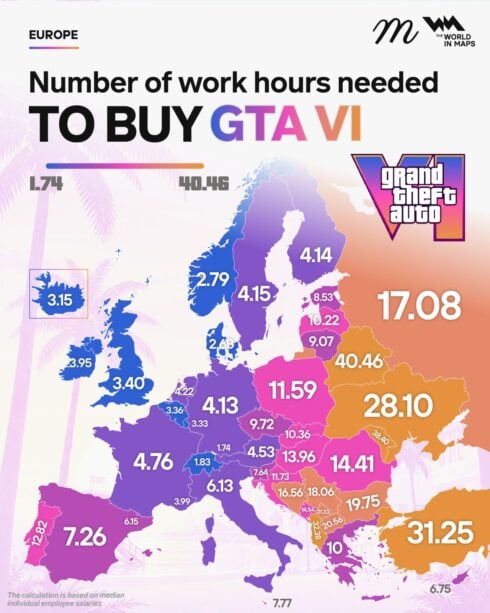
A new map from the World in Maps – viewed more than 2.6 million times on X – has worked out how long the typical worker in each European country must toil to earn that price.
The figures are based on median pay from 2022 (rather than average pay), which is the midpoint at which half of employees earn more and half earn less. A Spanish worker needs seven hours and 16 minutes, almost a full working day.
A British worker, by contrast, earns the game in three hours and 24 minutes, according to World in Maps – barely a morning’s work.
However, it’s worth noting that the UK’s own figures dispute these numbers, which calculate that a British worker earns the game in around four and-a-half hours, according to Olive Press calculations using Office for National Statistics (ONS) figures for the same year.
It means the typical Brit earns roughly 50% more than the typical Spaniard, not double as the map suggests, with median pay of £14.79 (€17.34) an hour in 2022 against €11.01 in Spain.
Among the 15 countries that made up the EU before its eastward expansion to incorporate former communist countries in 2004, Britain included, only Portugal and Greece fare worse than Spain.
The map is a back-of-an-envelope estimate rather than official data, but it puts a familiar price tag on a long-running problem: Spain’s economic growth is surging past its neighbours while the wages paid to its people trail behind.
A full day’s work in Spain, a morning in Britain
The price map sketches a sharp line across the continent, with workers in the wealthy north earning the game in a few hours while workers in parts of eastern Europe need the best part of a working week.
Swiss employees come out near the top, earning it in an hour and 50 minutes with a median pay of €37.64 per hour – almost four times as much as Spaniards.
Germans need just over four hours (€18.94), around three fewer than Spaniards, and most of north-western Europe sits somewhere between two and a half and four and a half hours.
Italy, the other big economy of Europe’s south, comes in at just over six hours (€12.89), meaning an Italian worker gets there roughly an hour sooner than a Spanish one.
Portugal is the outlier in the west at almost 13 hours, earning a median of just €6.23 per hour – more than five hours longer than across the border in Spain.
However, the map’s figures are based on pay before tax, and the picture shifts once income tax and social security contributions come off the payslip.
The biggest change is in Germany, where tax and social security swallow around a third of a typical worker’s pay, stretching their four hours to six and a half.”
Spaniards, who keep around 81%, need almost nine hours, while Italians, who keep around 76%, need just over eight.
Irish workers just over five and the Portuguese almost 17. Brits take a similar share home to Spaniards, so the gap between the two barely moves.
Italians, who keep around 77%, need almost eight hours, edging closer to Spain, while Irish workers still need less than five and the Portuguese almost 16.
A video game exposes Spain’s wage problem
The comparison stings because a blockbuster game is sold at much the same price across the developed world, so the only real variable is how much people earn.
Because while the typical Brit earns about 52% more than the typical Spaniard, that is before living costs are factored in.
For everyday life in Spain, it is a different story. Prices for households were 9% below the EU average last year, according to Eurostat.
The discount is biggest where local wages shape the bill, with restaurants and hotels 15% cheaper than the EU average, while phones, computers and similar equipment are only 4% cheaper.
In other words, a Spanish salary stretches a long way at the bar but not very far at the electronics shop.
Once local prices are factored in, the gap with Britain narrows sharply, as Eurostat’s measure of material living standards, which adjusts for what things cost in each country, put Spain 8% below the EU average in 2025 and the UK 8% above it.
That leaves Britons consuming around 17% more per head in real terms, rather than the twofold gap the GTA map suggests. But for global products priced the same everywhere, Spaniards feel the full force of lower pay.
Spanish pay is also more bunched at the bottom than the headline average suggests, with half of all employees earning less than €24,497 gross in 2024, according to the National Statistics Institute (INE).
That is well below the €29,540 average, which a smaller number of high earners pulls upwards.
While the single most common salary in Spain, also known as the mode, was just €16,520 in 24 (it will rise to €18,004 gross per year from January 2027).
Hospitality, the industry so many coastal towns depend on, is the worst-paid sector of all, with an average salary of €17,653.
In Britain the gap at the top is wider, with the median employee earning around €41,100 in the year to April 2026 and the average around €51,500, a quarter higher, according to the UK Office for National Statistics (ONS).
The body doesn’t publish data on the most common salary in the UK, but using proxy figures it can be determined that it was around €26,800 in 2024.
It calls the median its preferred measure because it is ‘less affected by changes in the relatively small number of very high earners’.
Spain also has the second-highest unemployment rate in the EU, at 10.3% in September behind only Finland, against an EU average of 6.2%, according to Eurostat.
And all of this comes even as Spain’s economy grew 2.7% in the year to the third quarter, more than double the eurozone’s 1.3%.
The European Commission’s autumn forecast, published on Tuesday, also pointed to ‘weak productivity growth’, the slow rise in the value each worker produces, warning that combined with rising wages it could push Spain’s labour costs up faster than in the rest of the eurozone.
The same forecast expects Spanish inflation to average 3.9% this year, driven by energy prices, eating into whatever pay rises workers manage to win.
How Spain would fare across the Atlantic
A companion map for the Americas uses a different yardstick, the minimum wage, and shows even starker divides.
Workers on Argentina’s minimum wage need 82 hours to buy the game, more than two full working weeks, while in Venezuela it takes more than 6,300 hours, roughly three years of full-time work.
READ MORE: Spain’s state pension and minimum wage to rise before the end of the year – but after the election
Spain’s own minimum wage, set by the government at €1,221 a month over 14 payments for 2026, adds up to €17,094 a year.
Spread over a 40-hour week, that comes to roughly €8.20 an hour, meaning a Spaniard on the minimum wage would need just under 10 hours of work to buy GTA VI, by Olive Press calculations.
That still puts Spain’s lowest-paid workers ahead of minimum-wage earners in the United States, who need 11 hours.
How long it takes to earn GTA VI across Europe
Hours of work needed to buy the standard edition at median pay, according to The World in Maps and Maven Mapping (selected countries).
| Country | Hours of work |
|---|---|
| Switzerland | 1.83 |
| Denmark | 2.68 |
| Norway | 2.79 |
| Belgium | 3.36 |
| United Kingdom | 3.40 |
| Ireland | 3.95 |
| Germany | 4.13 |
| Sweden | 4.15 |
| Netherlands | 4.22 |
| France | 4.76 |
| Italy | 6.13 |
| Spain | 7.26 |
| Greece | 10 |
| Poland | 11.59 |
| Portugal | 12.82 |
| Romania | 14.41 |
| Ukraine | 28.10 |
| Belarus | 40.46 |
Click here to read more Business & Finance News from The Olive Press.