
FOCUSING today on just one date – January 15 – we’ve dug up three Spanish personalities who you may find mildly diverting!
1. MANOLO EL DEL BOMBO born January 15, 1949
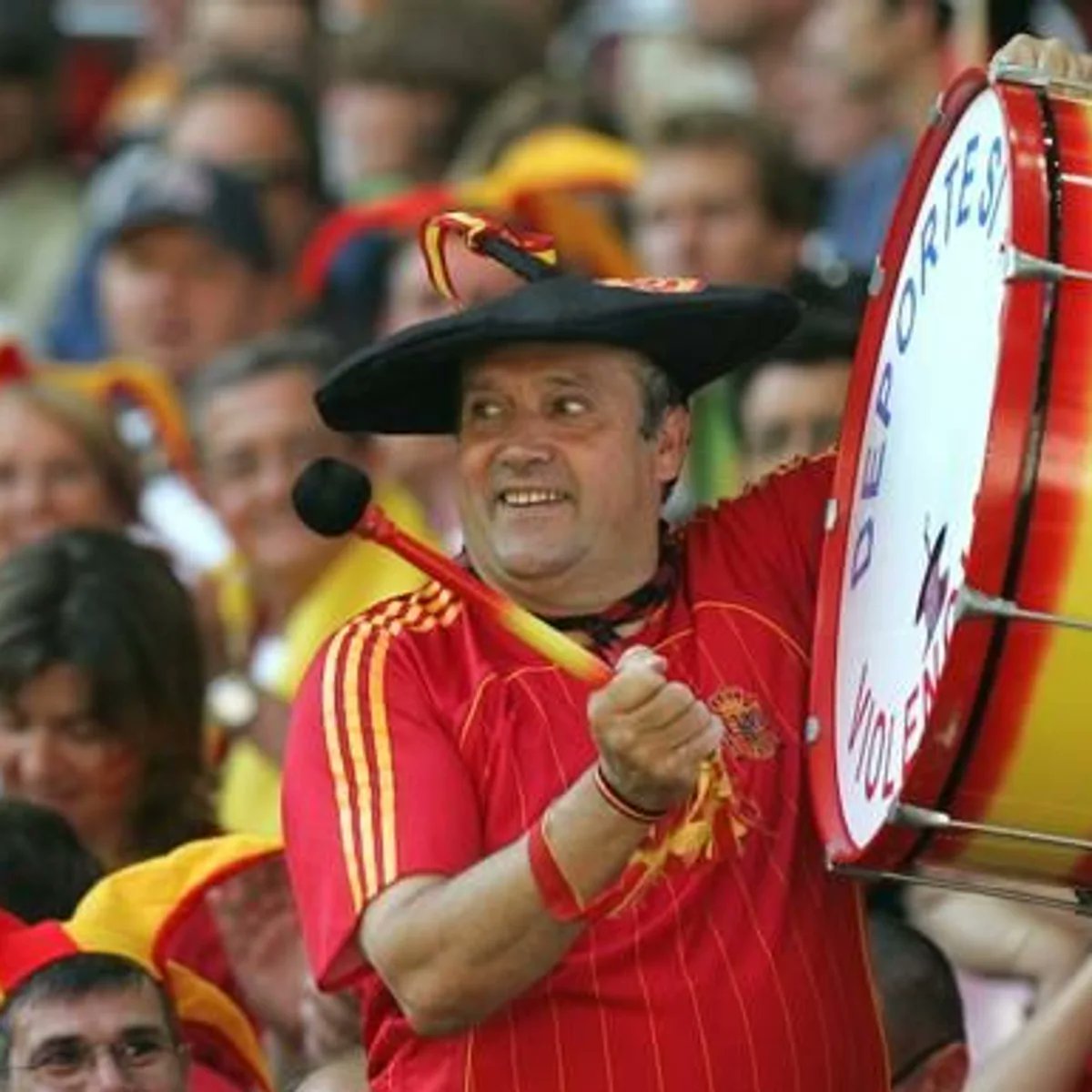
There are a lot of soccer fans in Spain, but there was only ever one “El del Bombo”. Manolo went everywhere with the Spanish national side, and took his bass drum with him (and if he had any free time, he also turned out to support his beloved Valencia CF).
Manuel Cáceres Artesero was born 77 years ago in Ciudad Real, and, sadly, passed away in May 2025. Before settling on the east coast, he had lived for some years in Huesca, so he certainly knew his way around Spain.
Though his name may not be familiar to you, you’ve probably seen him during televised World Cup games, wearing his trade mark “number 12” Spain shirt and his outsized “boina”, the beret favoured by the Basques.
Unfortunately, “El del Bombo” missed a few games, though through no fault of his own. In 2010, Spain played Paraguay in the World Cup (Spain, of course, went on to collect the trophy), but Manolo was stuck in his South African hotel room, down with a bout of pneumonia.
His drum was banned from the 2018 finals in Russia, so Manuel boycotted the tournament!
2. FRANCISCO GOYA started painting the Church of San Antonio de la Florida (Madrid) on January 15, 1798
The church is a royal chapel which, today, is open as a museum. Goya was in his fifties when he accepted the king’s commission to decorate the inside of the church’s dome.
Saint Antony of Padua is depicted in a masterpiece of perspective, raising a man from the dead. The miracle also had the useful side effect
of acquitting the man’s father, who stood accused of murdering his own son.
Goya lived well into his eighties. When he died in Bordeaux in the year 1828, the Spanish king ordered that his body be returned to Madrid, to be interred in the surroundings which he had so ably beautified.
The Spanish consul in France was thoroughly embarrassed to learn that Goya’s head was missing! He nervously advised the palace, using the new-fangled telegraph.
“Send Goya, head or no head!” came the peremptory reply over the wire.
So now the artist (still headless) lies in the church, reunited with his marvellous art work.
San Antonio is also famous as the church to visit if you are a single woman, looking for a husband. Not that there are loads of aimless hunks hanging around – the idea is, you pray to Saint Antony, and he arranges it all for you.
3. IÑAKI URDANGARÍN, born in Zumárraga (Basque Provinces), 15 January, 1968
On the way up, life must have seemed very easy to Iñaki Urdangarin. But what’s that thing they say about pride and falls?
At the age of 18 he opted to be a professional handball player. He was signed by Barcelona, and quickly made his way onto the Spanish national team.
He found himself chosen to represent Spain at the 1992 and 1996 Olympic Games. When the 2000 Olympics came around, he was 32 years old – and the team captain.
The following year, after retiring from playing, he was appointed to Spain’s Olympic Committee, and made a director of various companies, including a non-profit organisation named “Nóos”.
Oh, by the way – he was also lucky in love.
In 1997, he married the Infanta Cristina, daughter of the Spanish king.
Now a working businessman, Urdangarin travelled around Spain, meeting local and regional politicians, and persuading them to buy sports facilities which would be installed by Nóos.
Except that the facilities, though paid for, never materialised.
Six million euros simply vanished.
In December 2011, the Spanish Anti-Corruption Bureau tracked down vast sums of money that Urdangarin had stashed in Belize and the UK.
He was found guilty of fraud, and sentenced to five years in prison.
What many Spanish people find hard to forgive is that he involved his wife – and therefore the royal family – in his schemes.
Cristina, needless to say, divorced him.
And handball is a silly sport, anyway.
Click here to read more La Cultura News from The Olive Press.