
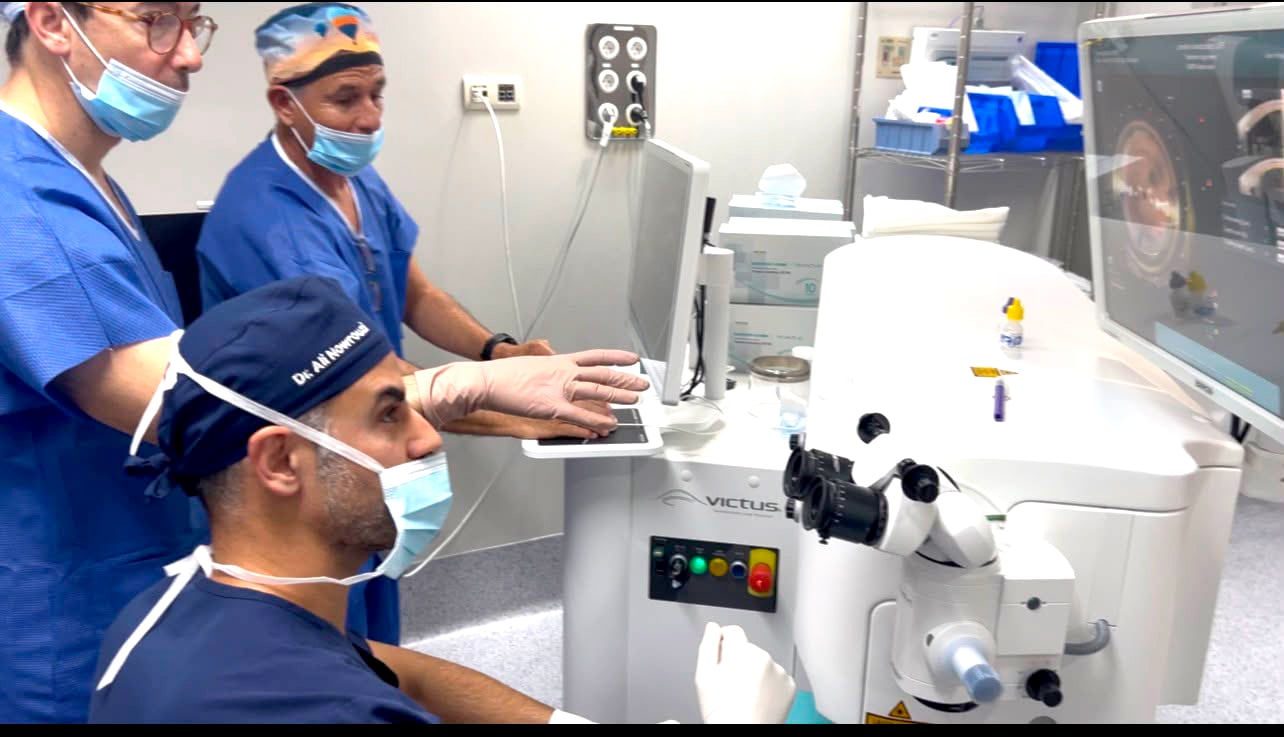
The Ophthalmology Department in Quirónsalud has introduced a new treatment that combines tiny pieces of donated corneal tissue with a procedure called corneal cross-linking. Together, they help improve vision, stop the condition from getting worse, and preserve the patient’s own cornea.
The hospital in Marbella has added this innovative technique for the treatment of keratoconus, an eye condition that causes the cornea to thin and bulge, and other corneal disorders to its range of services.
This technique combines a state-of-the-art femtosecond laser with the implantation of segments of donor human corneal tissue, thereby reinforcing the hospital’s commitment to innovation and highly specialised ophthalmology.
The introduction of this technique to the hospital’s Ophthalmology Department is led by Dr. Ali Nowrouzi, a specialist in the cornea and refractive surgery. The ophthalmologist holds the European FEBOS-CR accreditation (Fellow of the European Board of Ophthalmology – Cornea and Refractive Surgery), a highly specialised subspecialisation held by only a small number of specialists in Europe.
Keratoconus is a progressive condition in which the cornea thins and takes on an irregular conical shape. As a result, irregular myopia and astigmatism develop, causing blurred vision, image distortion, halos, glare and difficulties with everyday activities such as driving, reading or working at a computer screen.
“Keratoconus no longer necessarily means losing your sight or eventually needing a cornea transplant,” explains Dr. Nowrouzi. “Thanks to early diagnosis, personalised treatment planning and innovative technologies combined with cross-linking, we can stabilise the condition and significantly improve the visual quality of many patients”.
A biological alternative to synthetic intracorneal segments
This new technique represents a step forward in the treatment of keratoconus. The technique, known as Femto-CAIRS (Femtosecond Laser-Assisted Corneal Allogenic Intrastromal Ring Segments), uses a high-precision femtosecond laser to create a channel within the cornea into which segments of human donor corneal tissue are implanted, rather than the traditional synthetic intracorneal segments.
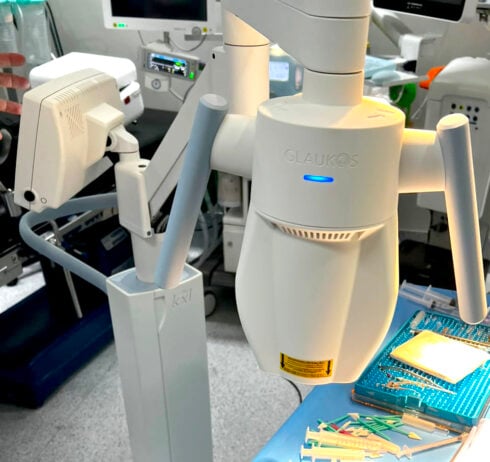
“This difference offers significant advantages, as allogeneic tissue integrates biologically in a much more natural way, better preserves corneal biomechanics and reduces the risk of complications associated with synthetic implants, such as extrusion, migration or intolerance”, Dr. Nowrouzi explains.
Furthermore, the technique allows the cornea to be remodelled in a more physiological manner and offers a new therapeutic alternative for patients with moderate to advanced keratoconus.
A comprehensive approach to improving vision and stabilising the condition
At Quirónsalud Marbella Hospital, this state-of-the-art femtosecond laser is combined with the corneal cross-linking technique, which strengthens collagen fibres through a process of photoactivation using riboflavin and ultraviolet light.
Whilst this procedure improves the shape of the cornea, reduces irregular astigmatism and optimises visual quality, cross-linking helps to stabilise the condition and slow its progression.
According to Dr. Nowrouzi, this strategy makes it possible ‘not only to improve the patient’s vision, but also to preserve the corneal structure in the long term and reduce the likelihood of needing a corneal transplant in the future’.
As the specialist explains, the treatment is primarily indicated for patients with moderate or advanced progressive keratoconus and other selected corneal ectasias who have a sufficiently transparent cornea and for whom the aim is to improve visual quality whilst preserving the corneal tissue.
The expected benefits include a significant reduction in irregular astigmatism, greater regularisation of the corneal surface, improved visual acuity and greater tolerance to wearing spectacles or contact lenses.
Each case requires an individualised assessment using advanced diagnostic tests, including corneal topography and tomography, anterior segment OCT and biomechanical analysis of the cornea, which enable the most appropriate treatment strategy to be determined for each patient.
Innovation in the service of patients
The introduction of this innovative technique reinforces Quirónsalud Marbella Hospital’s commitment to adopting technologies backed by international scientific evidence and offering high-precision treatments for corneal conditions, thereby expanding the range of treatment options available to patients with keratoconus.
“My recommendation is that anyone experiencing progressive blurred vision, frequent changes in prescription or irregular astigmatism should seek an assessment from a cornea specialist. The earlier keratoconus is detected, the greater the chances of maintaining excellent vision and avoiding more invasive treatments in the future”, concludes Dr. Nowrouzi.
Quirónsalud in Andalusia

The Quirónsalud Group in Andalusia currently operates eight hospitals located in the cities of Málaga, Marbella, Los Barrios (Cádiz), three in Seville (Sagrado Corazón, Infanta Luisa and Materno-Infantil), Córdoba and Huelva, as well as two surgical day hospitals in Seville and Málaga and 22 specialist and diagnostic medical centres; this positions it as the leading private hospital group in this autonomous community.
About Quirónsalud
Quirónsalud is the leading healthcare group in Spain and, together with its parent company Fresenius-Helios, also in Europe. In addition to its operations in Spain, Quirónsalud also has a presence in Latin America.
Together, the group employs over 55,000 professionals across more than 180 healthcare centres, including 57 hospitals with over 8,000 beds.
It utilises state-of-the-art technology and boasts a large team of highly specialised professionals of international renown. Its centres include the Fundación Jiménez Díaz University Hospital, Teknon Medical Centre, Ruber Internacional, Quirónsalud Pozuelo University Hospital, Quirónsalud Barcelona Hospital, Dexeus University Hospital, Policlínica Gipuzkoa, General University Hospital of Catalonia, Quirónsalud Sagrado Corazón Hospital, etc.
The Group is committed to promoting teaching (fourteen of its hospitals are university hospitals) and medical and scientific research (it operates the FJD Institute for Health Research, accredited by the Ministry of Science and Innovation).
Furthermore, its healthcare service is organised into cross-disciplinary units and networks that enable the Group to make the most of the experience accumulated across its various centres and to facilitate the clinical application of its research.
Quirónsalud is currently carrying out a wide range of research projects throughout Spain, and many of its centres are at the forefront of this field, pioneering work in various specialities such as oncology, cardiology, endocrinology, gynaecology and neurology, amongst others.
For more information, please visit
https://www.quironsalud.com/marbella or call +34 952 774 200
Click here to read more Marbella News from The Olive Press.