
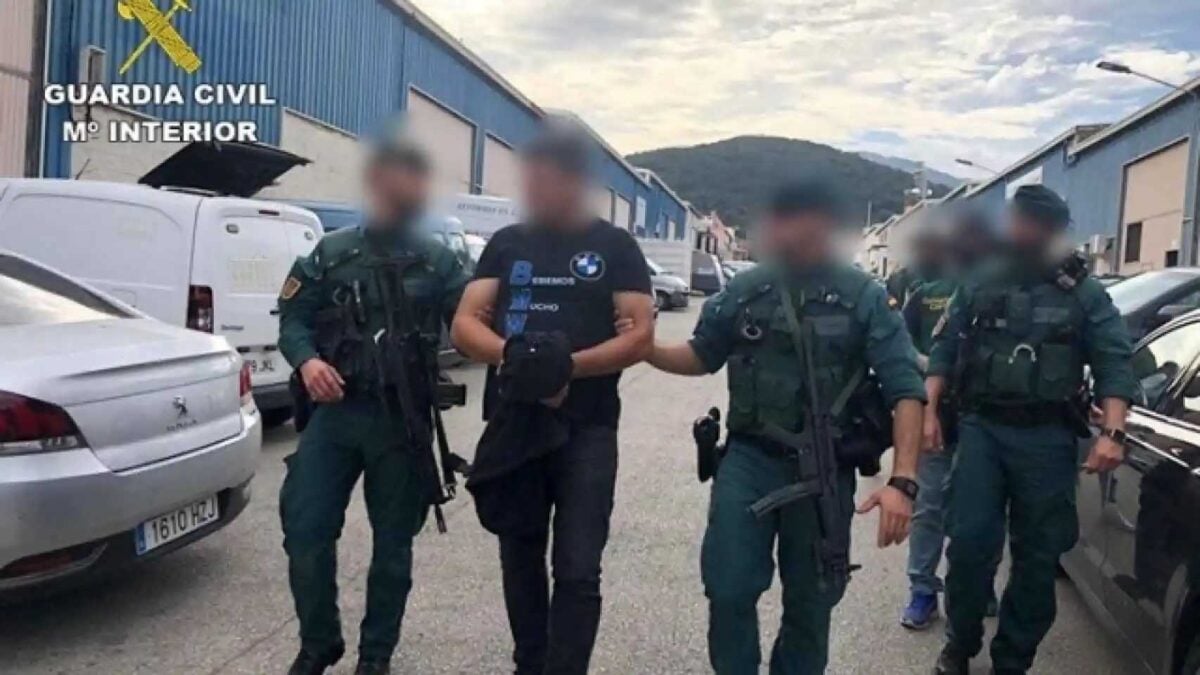
A MOVIE will surely one day be made about the exploits of Spain’s famous anti-narco unit.
If not Hollywood, then certainly Netflix, it would virtually write itself. Not only did it end on a cliffhanger, it’s perfectly poised for a sequel.
The legendary OCON-Sur hunted down drug traffickers in the Campo de Gibraltar using courage and brawn straight from an 80s action flick.
Led by a suitably rugged leading man, Commander David Oliva, the exploits of the Guardia Civil premiere narco busters became legend, dismantling notorious drug clans and muzzling the trafficker scourge in one of Spain’s poorest regions.
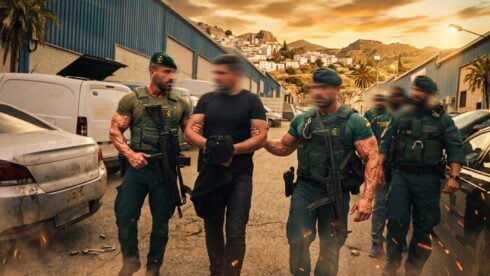
But it was disbanded suddenly in 2022 at the height of its success, and nobody in government has ever given a satisfactory explanation as to why.
But after a number of years of a resurgent, heavily-armed narco threat expanding up and down the coast of southern Spain, the stage is set for the sequel.
Andalucia president Juanma Moreno has written an open letter to Pedro Sanchez, the Spanish prime minister, calling for its return.
DEMANDING A SEQUEL
Moreno’s letter was published on August 23, and it did not mince its words.
‘Andalucia has become a base of operations’ for drug clans and trafficking networks, he wrote, adding that traffickers are no longer confined to one stretch of coast.
“We are no longer talking about one particular area, but the entire coastline and part of the interior,” he wrote.
His central demand: bring back OCON-Sur, the elite Guardia Civil unit scrapped four years ago.
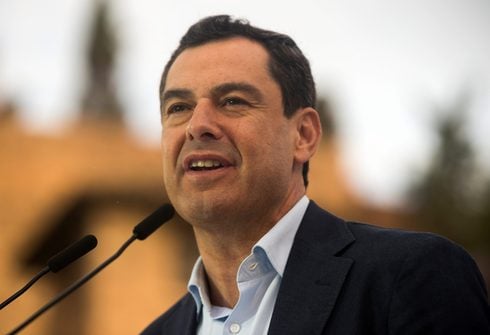
“Time and events have shown that dismantling OCON-Sur was a mistake which, unfortunately, is having serious consequences for our officers and citizens,” Moreno wrote.
But the government wasted no time in rebuffing the demand.
Pedro Fernandez, the central government’s delegate in Andalucia, dismissed the request as ‘a display of ignorance, lack of understanding and contempt’ for the security forces, pointing to €190 million invested in the region’s anti-drug programme since 2018.
What he did not do was explain why the one unit with a proven record of results was the one taken off the board in the first place.
THE UNIT THAT BROKE THE NARCOS’ BACKS
To understand why that silence leaves a conspicuous echo, we need to go back to 2018.
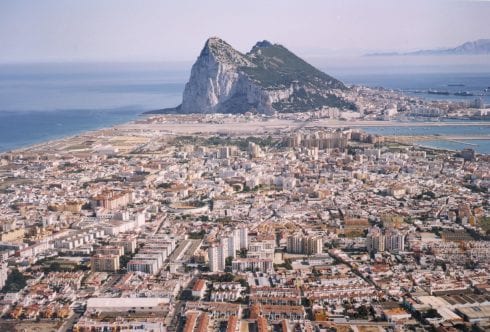
Guardia Civil officials were calling La Linea de la Concepcion, the border town beside Gibraltar, ‘la pequena Medellin‘, comparing its hash clans to the cartels of Colombia and Mexico because of how they organised themselves.
That February, roughly twenty masked men in SUVs stormed the emergency room at La Linea’s hospital and pulled a wounded trafficker, Samuel Crespo, out from under police guard, an assault one officer on the scene described simply as something that ‘could only happen in La Linea’.
Spain’s Interior Ministry set up the Organo de Coordinacion contra el Narcotrafico en el Sur — OCON-Sur for short — as a dedicated, roughly 150-strong Guardia Civil task force built to hit organised drug trafficking around Algeciras, a port city on the Strait of Gibraltar, and the wider Campo de Gibraltar region facing the British territory.
Over the next four years it made close to 20,000 arrests and seized more than 1,400 tonnes of drugs, including 676 tonnes of hashish in 2021 alone, the highest annual haul in eighteen years.
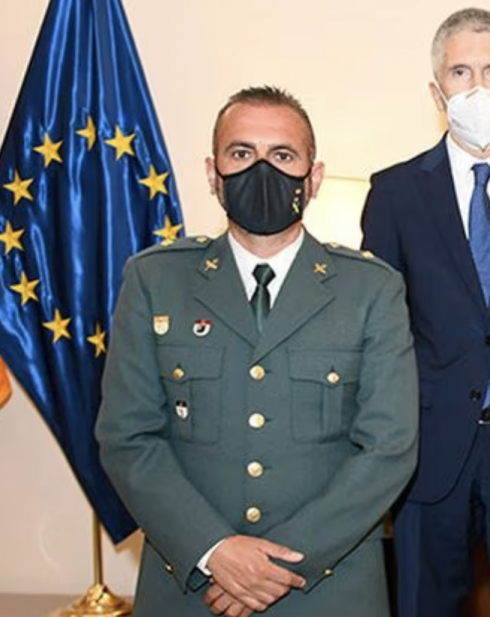
Its commander for that entire run was David Oliva, an officer from Algeciras who in 2021 was personally awarded the National Drug Plan’s Medal of Merit by Interior Minister Fernando Grande-Marlaska.
He also, according to Guardia Civil sources, had a price on his head: posters reportedly went up in La Linea de la Concepcion, the border town beside Gibraltar, offering €400,000 to whoever killed him.
While the unit formed too late to take credit for taking down notorious drug lord the Messi of Hashish – real name Abdellah El Haj Sadek – OCON-Sur did lead the charge against the successor clan, los Castañas, which led to the largest narco-trafficking -trial in Spanish history.
THE SUDDEN ENDING
Then, on September 12, 2022, the unit simply stopped existing.
The Interior Ministry’s line was that OCON-Sur had ‘fulfilled its mission’ and that its agents would be folded into each Andalucian command’s existing organised crime and anti-drug teams.
Nobody bothered to tell the unit itself. A farewell lunch held on August 31 made no mention that the group was about to be dissolved.
Nobody told the money men either – six months earlier the government had committed €35.3 million to extend the region’s special security plan through the end of 2023, a pledge the Guardia Civil’s own officers’ association called out as a direct contradiction of the closure.
Indeed, nobody even told Spain’s own state prosecutors.
Alvaro Garcia Ortiz, Spain’s Attorney General, confirmed on February 13, 2024, that the Interior Ministry dismantled OCON-Sur ‘surprisingly and without prior communication’ to prosecutors, the specialist anti-drug Fiscalia, or the courts.
Asked directly whether Marlaska had made a mistake, Garcia Ortiz would not say: “I cannot make that assertion.”
Word of the closure triggered something close to a mutiny – when it emerged Oliva might not stay in command, almost every agent in the unit requested a transfer rather than serve under someone else.
THE OFFICIAL VERSION
By then, Oliva already had a problem the public didn’t know about.
Guardia Civil Internal Affairs had opened a secret investigation into him in 2021, the same year he collected his medal, over suspected leaks from narco investigations.
Prosecutors now accuse Oliva of bribery and revealing official secrets, alleging he pressured an Internal Affairs lieutenant, David Bernal, to find out whether he was under investigation in exchange for arranging Bernal a coveted transfer into OCON-Sur.
Between them, investigators say, the pair accessed 2,204 classified files.
A second officer, Lieutenant Javier Israel Fuentes, faces a separate allegation: a lifelong friendship with David Verdejo Ariza, leader of the Ariza clan, a drug-trafficking family based in Bolonia, a village near Tarifa, the southernmost town on mainland Europe.
Investigators allege Fuentes stood as godfather at Verdejo’s son’s baptism and travelled abroad with him, and that the clan fed OCON-Sur intelligence on rival gangs in exchange for protection.
Prosecutors are seeking six and a half years in prison for Oliva when the case reaches a jury trial at Madrid’s regional court, expected this autumn.
THE PHOTOS THAT CAME FROM GOOGLE
But upon closer inspection, the official line didn’t entirely add up.
Oliva has always maintained he has been framed; that the case against him was fabricated by the very traffickers he took down desperate to get rid of him.
In January 2025 a Madrid court agreed to hear his own formal complaint alleging exactly that.
Then, on February 12, 2025, seven Policia Nacional officers who had been named as having personally surveilled Oliva and his deputy told a Madrid judge they had done no such thing.
They denied observing either man meet members of the criminal Ariza clan, and denied taking the photographs used to support that claim.
A defence expert analysis went further, finding that the photographs used against Oliva had in fact been pulled from Google.
The Policia Nacional inspector who ordered the original surveillance was questioned by the same court ten days earlier and denied fabricating anything, though he did not answer questions put by Oliva’s own defence team.
Nobody has ever gone on record, inside the ministry or the Guardia Civil, as the person who actually decided to shut the unit down.
Three unconfirmed theories now circulate for why OCON-Sur actually died.
The first is what the evidence increasingly supports: that narcos infiltrated the intelligence used against Oliva to get a commander who was hurting them removed from the board.
The second is more serious still: a radio programme named one particular prosecutor who allegedly ordered its closure, for reasons that remain to be investigated.
The third: some OCON-Sur members have suggested, anonymously, that pressure from a foreign government – they point to Morocco – played a role in the unit’s closure, though they offer no evidence beyond the suspicion itself.
THE BODY COUNT SINCE
Whatever the truth of the case against Oliva, the consequences of losing his unit has been counted in the lives of serving Guardia Civil officers and civilians.
On February 9, 2024, a trafficker known as Karim EB deliberately rammed a Guardia Civil patrol boat with his narco speedboat in Barbate, a fishing town on the Cadiz coast, killing officers David Perez, 43, and Miguel Angel Gomez, 39.
Two more officers were killed off Huelva on May 8, 2026, in a high-speed pursuit involving another narco speedboat.
On August 22 this year, a narco gang opened fire on a Guardia Civil patrol boat, also off Huelva.
Five days before that, a pregnant woman, her mother and a teenager were shot dead in Isla Cristina, a town on the Huelva coast – one of the killings Moreno cited directly in his letter as evidence the violence has spread inland.
THE NUMBERS THE GOVERNMENT WON’T PUBLISH
A report by the Asociacion Unificada de Guardias Civiles (AUGC), the Guardia Civil’s own officers’ association, crossing official drug and crime statistics with real staffing numbers, adds hard data to the argument.
Drug-trafficking arrests fell 15% in Andalucia in the two years after OCON-Sur’s closure, while rising 5.6% in the rest of Spain, a 20.6 percentage-point swing the association says marks a clear change in trend.
Andalucia has lost 11.16 points of national arrest share, and stands 34.8% below its 2021 peak.
The six provinces covered by the region’s special security plan – Cadiz, Huelva, Malaga, Almeria, Granada and Sevilla – hold 17.8% of the Guardia Civil’s national workforce, yet handle 61.7% of all drugs seized in Spain, while producing only 21.8% of the arrests.
In Huelva alone, each arrest intercepts an average of 216 kilos of drugs, thirteen times the national average.
The plan behind all of this costs €38.2 million a year and, eight years in, has never been independently audited, nor even broken down by which police force achieved what.
‘WE ARE STILL WAITING FOR THAT EXPLANATION’
Diego Madrazo, the officers’ association’s secretary of institutional relations, put it more bluntly than any minister has so far dared to.
“When OCON-Sur was scrapped, it wasn’t just some bureaucratic structure that was removed,” he said.
“it was the only tool that had proven it could stand up to drug trafficking in the Campo de Gibraltar.
“It was dismantled without explaining to anyone what would replace it, and we are still waiting for that explanation.”
Madrazo said the closure has left units working in isolation with no single command coordinating them, and traffickers who have ‘lost their fear’, attacking officers and ramming patrol boats in what he called organised crime rather than simple property crime.
He is also demanding the government publish an audit of the security plan’s spending, formally designate the region a high-priority crime zone, and stop splitting prosecutions of the same trafficking networks between courts in Madrid and local jurisdictions.
“This isn’t about politics,” he said, “it’s about making the justice system work properly.”
THE ENDING NOBODY HAS WRITTEN YET
Four years on, the sequel Moreno is demanding remains stuck in development hell.
The government has offered its budget figures but never an explanation for why OCON-Sur specifically had to go rather than simply be reformed.
Oliva’s trial, when it comes this autumn, may yet answer whether he was a corrupt commander or a convenient scapegoat, but it will not answer who actually made the call to disband the unit that caught him.
Despite having the backing of Spain’s Interior Ministry, that person has never given their name.
Click here to read more Crime & Law News from The Olive Press.