

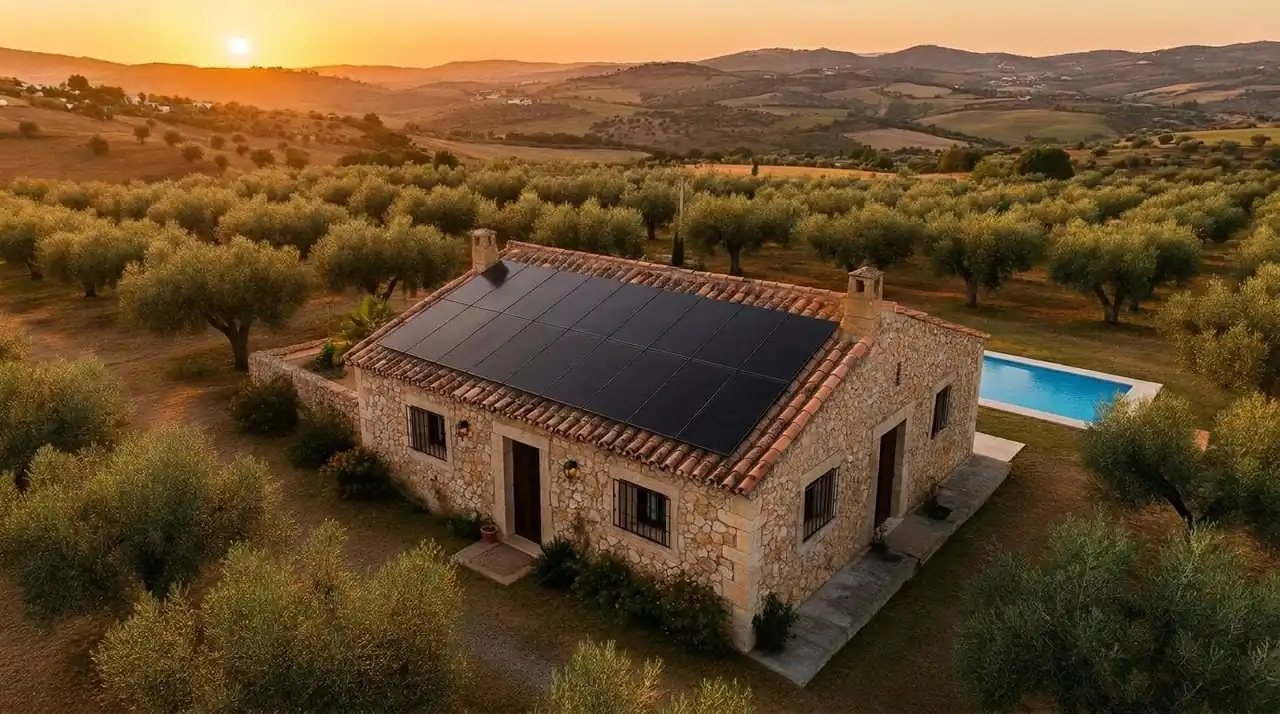
FOR anyone weighing up solar panels, the first question is rarely about kilowatts or inverters.
It’s often: how long before the system pays for itself?
The answer matters more here than almost anywhere in Europe. Because the Costa del Sol has the one ingredient that decides it – sunshine.
Málaga averages around 5.82 peak solar hours a day across the year, stretching to seven or eight in the summer months.
London manages roughly 3.1.
The same panels on the same roof will produce almost twice as much electricity in Málaga as they would in southern England, and the money comes back in roughly half the time.
READ MORE: Revealed: Spain’s electricity bills to top €100 for the first time in four years
“For a well-designed residential installation we typically see a payback period in the region of four to seven years,” said Brandon van Assen of Mi Techo Solar, which installs across Marbella, Estepona, Mijas, Fuengirola and the surrounding area.
“Although this depends heavily on the property’s consumption, electricity tariff, system size and how the energy is used.”
How that compares to an investment
Payback periods are an unfamiliar way of thinking about money. It helps to translate them.
A four to seven year payback is the equivalent of an annual return of between roughly 14 and 25 per cent.
For context, a rental property yielding five per cent is generally considered solid and 10 per cent is considered excellent.
The S&P 500, the benchmark most investors measure themselves against, has averaged in the region of 15 per cent over the past decade. (Though its longer-run average is closer to 10 per cent.)
On those numbers, a seven-year solar payback sits in similar territory to the stock market (14.3%) and a four-year payback comfortably beats it (25%).
The comparison is not like-for-like, however, and in three respects it favours solar.
The first is that a saving is not the same as an earning. Solar does not put money into your account – it stops money leaving it, which raises disposable income by cutting a fixed household cost.
The second is that electricity is not optional. Unlike an investment, which is made with money you could have left in the bank, this is spending you cannot avoid, so reducing it is a guaranteed return rather than a hoped-for one.
The third is tax. Investment gains in Spain are taxable, while money saved on your own electricity bill is not.
Rising inflation means faster payback
There is another factor that can speed up the payback period: rising electricity prices.
If grid electricity becomes more expensive, every kilowatt-hour a household generates and uses itself becomes more valuable. All else being equal, that increases the annual saving and shortens the payback period.
Battery storage can furthr increase self-consumption by shifting surplus daytime solar production into the evening.
READ MORE: Bad news for wallets in Spain as rising fuel prices push inflation to highest level in three years
Why there is no single figure
The reason Mi Techo Solar quotes a range rather than a number comes down to how the system is designed.
“Our approach is not simply to install as many panels or as much battery capacity as possible,” said Dassen.
“We look at the customer’s actual consumption profile – including daytime and evening use, air conditioning, pool equipment, EV charging and contracted power – and size the solar and battery system around that.
“This helps maximise self-consumption and makes the financial return as strong as possible.”
The company shared three recent projected calculations that show how widely the figures move.
Case study 1 – 3.75-year payback
The first is a 13.42 kWp system with 22 panels, a 10 kW three-phase hybrid inverter and a 16.07 kWh battery, at a total investment of €15,621 including IVA.
Projected annual production is 21,438 kWh, with an estimated first-year saving of €4,287.60 and a calculated payback of 3.64 years.
Case study 2 – 7.2-year payback
The second is a 7.14 kWp system with 14 panels, an 8 kW hybrid inverter and the same 16.07 kWh battery, at €12,705 including IVA.
Projected annual production is 10,797 kWh, with an estimated annual saving of €1,770 and a calculated payback of 7.2 years.
That second example also shows what the battery contributes. Around 4,047 kWh of the year’s solar production is projected to be stored for later use, covering roughly 70 per cent of the property’s annual electricity consumption from its own system.
Case study 3 – 8.2-year payback
The third is an 8.33 kWp system with 14 panels, an 8 kW hybrid inverter and a 16.07 kWh battery, at €11,882 including IVA.
Projected annual production is 14,060 kWh, with an estimated annual saving of €1,451 and a calculated payback of 8.2 years.
All three are projected calculations rather than measured long-term results, and should be read as estimated savings and calculated payback periods.
The spread between them is the point. The same battery appears in all three, yet the payback varies by more than four years, depending on how much electricity the household uses and when it uses it.
Find out what your roof would return
Mi Techo Solar offers a free survey for Costa del Sol homeowners, covering consumption analysis, system sizing and a projected payback calculation for the property.
Visit mitechosolar.com or call 644 856 490.
Click here to read more Environment News from The Olive Press.









Bit confused by this.
The only difference between the second and third options is that the third option has a bigger kWp system. However, the third option is cheaper. Also, as expected, the third option has a higher annual production (over 3000 kWh more) but somehow has a higher payback time and lower annual saving.
Surely if the third option has a higher production, has a bigger system, and is cheaper to install, the payback time should be shorter? What am I missing here?