IT may seem hard to believe, but Pedro Sanchez is the first prime minister of Spain who can actually speak English.
He has been putting these linguistic skills to good use while in New York for the United Nations General Assembly last week, where he palled around with his progressive counterparts in el mundo anglo-sajon.
Sanchez first took a stroll through Central Park with new UK Prime Minister Andy Burnham, where the pair tried to strike up a slightly forced bromance while chatting entirely in English (Burnham’s only contribution in Spanish being a cry of seguro!)
He then filmed himself shooting crumpled paper ball ‘hoops’ with New York Mayor Mamdani Zohran, joking that ‘being a leftist means taking big shots’.
READ MORE: Revealed: The city in Spain where English is spoken best – and it’s not the obvious choice
He also found time to make an appearance on Jonathan Stewart’s podcast The Weekly Show.
Spain’s first English-speaking prime minister
As slightly cringey as some of his appearances may have been, it was also a breath of fresh air.
Long gone are the days of Spanish prime ministers sitting forlorn and isolated on the world stage while other leaders mingle in convivial side huddles.
His predecessors regularly shied away from speaking English in public, relying instead on Spanish interpreters.
Most famous among them was former conservative Partido Popular (PP) leader Mariano Rajoy, who fumbled a famous exchange with a BBC reporter in 2017.
When asked a question about Brexit in English, he responded awkwardly in Spanish: Bueno hombre, no vamos a hacer esto (‘Well, no, we won’t be doing that now’), before giving the floor to another journalist.
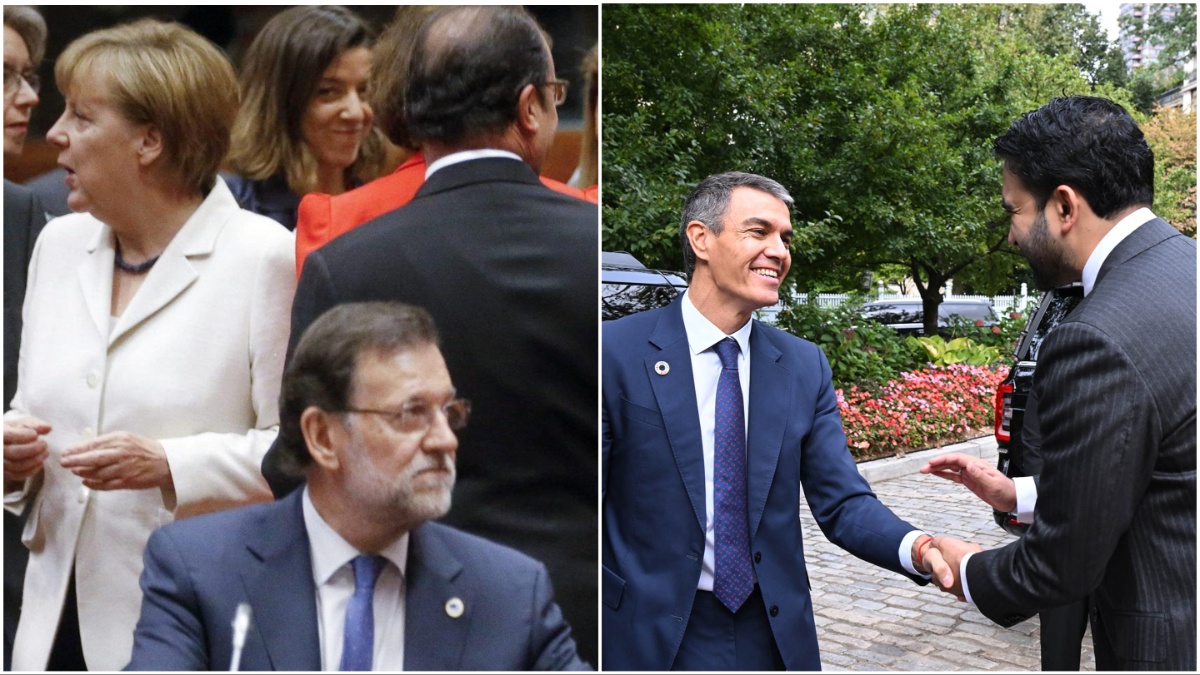
And in a revealing photo dating back to 2016, the PP leader could be seen sitting on the sidelines as former German Chancellor Angela Merkel led a lively debate with other EU leaders.
READ MORE: Trouble learning the lingo? Linguists identify new hybrid English-Spanish dialect forming in Miami
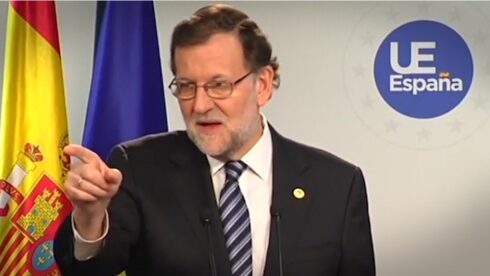
“It’s very difficult, todo esto,” Rajoy then tentatively put forward, the clumsy splicing of Spanish and English his modest contribution to the exchange.
But the days of the insular, inward-looking leaders are long gone.
Spain’s polyglot economy minister
Now 54-years old, Sanchez learned his English during a stint at the Office of the High Representative in Bosnia and Herzegovina in 1997.
And he’s no longer the exception among Spain’s political class with a gift for linguistics – but one that is restricted, seemingly, to only those on the progressive left.
His economy minister Carlos Cuerpos, 46, is famously fluent in English, and more than happy to appear on CNN to discuss the world economy and market movements using a level of English lexus that would be beyond most native speakers.
In a February interview with the Financial Times, he discussed common European debt, the future of the euro and financial integration entirely in English.
A career economist, Cuerpo studied for a master’s degree at the London School of Economics before working at the European Commission.
Not only has he mastered English, but he also speaks French and recently addressed an audience in Tokyo in Japanese.
Fluency on the front bench
Meanwhile, Foreign Minister Jose Manuel Albares is another one who speaks both impeccable English (as one might expect) – and also French.
A career diplomat, Albares spent years working in Paris before serving as ambassador to France and Monaco.
As recently as July this year, Albares was filmed meeting British Foreign Secretary Ed Miliband in Madrid, where the pair held talks on bilateral relations, climate change and gender equality.

And then there’s Health Minister Monica Garcia, 52, who may not have the complete grasp of the English language that her fellow cabinet members wield, but at least she’s game.
In May, the former doctor attempted to answer questions from foreign journalists in English during a press conference on the hantavirus outbreak aboard the cruise ship MV Hondius.
Garcia began to struggle when the discussion moved off script, and at one point, after failing to understand a question, she had to turn to colleagues for help.
But she still delivered a far better performance in English than the average Spanish politician.
So is this all a harbinger of a new more outwardly-focused breed of Spanish politician, ready and equipped to look beyond the borders of Spain?
Well, no. The contrast couldn’t be clearer than when we look directly across the aisle.
And then there’s the right-wingers
While Rajoy was being mercilessly mocked and pilloried up and down the country for sitting on his own among European leaders, his successor – and some might say el presidente elect – Alberto Nuñez Feijoo, is unlikely to fare any better.
The current PP leader has openly admitted when asked about his level in 2026 that it is ‘badly’ [sic] – before joking that he relied on his mobile phone to translate for him.
He had previously admitted that he planned to take lessons.
And well he might, if he wishes to avoid future embarrassment.
But he’s unlikely to endure the level of linguistic humiliation suffered by the then-Mayor of Madrid in 2013.
Disastrous public English
Ana Botella – of course from the PP – delivered a speech in English to delegates in Buenos Aires as she pitched the capital’s bid to host the 2020 Olympic Games.
Her efforts to sell the charms of Madrid became the stuff of legend in Spain.
Speaking in heavily accented, phonetic English, Botella told the International Olympic Committee: “There is nothing quite like a relaxing cup of café con leche in Plaza Mayor.”
The awkward Spanglish phrasing, rigid delivery, and exaggerated cadence instantly backfired, turning her into an overnight global meme and national laughing stock across Spain.
Madrid crashed out in the very first round of voting, and the phrase remains the definitive Spanish political benchmark for disastrous public English.
Spain’s ‘Margaret Thatcher’
Vox leader Santiago Abascal has been similarly candid, saying he can ‘more or less’ make himself understood but prefers simultaneous interpretation because it offers greater precision.
Andalucia’s PP president Juanma Moreno and Sumar leader Yolanda Diaz are less clear-cut cases, but neither has cultivated the kind of English-speaking international persona associated with Sanchez, Cuerpo or Albares.
READ MORE: LEARN THE LINGO: A brief A to Z of the Spanish language that a text book won’t tell you
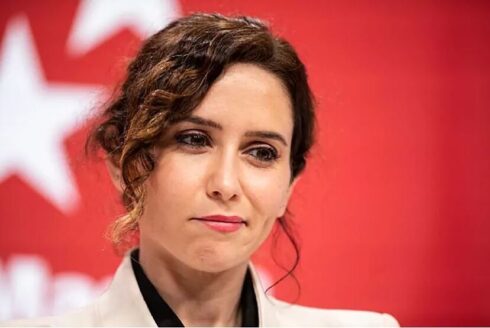
And then there’s ‘Spain’s Margaret Thatcher’, Isabel Diaz Ayuso, who certainly doesn’t take after the Irony Lady in her command of the English language – despite living in Ireland for a stint.
The President of the Madrid Community has even joked in interviews about her school-level of English, noting that her practical vocabulary stopped at basic greetings like ‘how are you’.
What about the rest?
According to data from the European Commission, just 38% of Spaniards say they can comfortably hold a conversation in English.
This is a figure more than matched by the country’s highly educated political class – but on just one side of the spectrum.
Could it be coincidence? Many of the political class, especially those on the right, blame the legacy of Franco and Francoism for their lack of linguistic skills.
It was General Franco who legally banned the screening of foreign films in their original language and made full dubbing into Castilian mandatory in 1941, conditioning future generations of Spanish to consume films and television in only their own language.
The old dictator was also famous for purging the teaching profession in favour of National-Catholic dogma, and preferring to reach French in schools until at least 1970.
Spain is a country that was inculcated into cultural insularity over two generations, and has been struggling against it ever since.
It’s just curious that the results differ so massively depending upon which side of the aisle the political class is on.
Click here to read more Spain News from The Olive Press.