
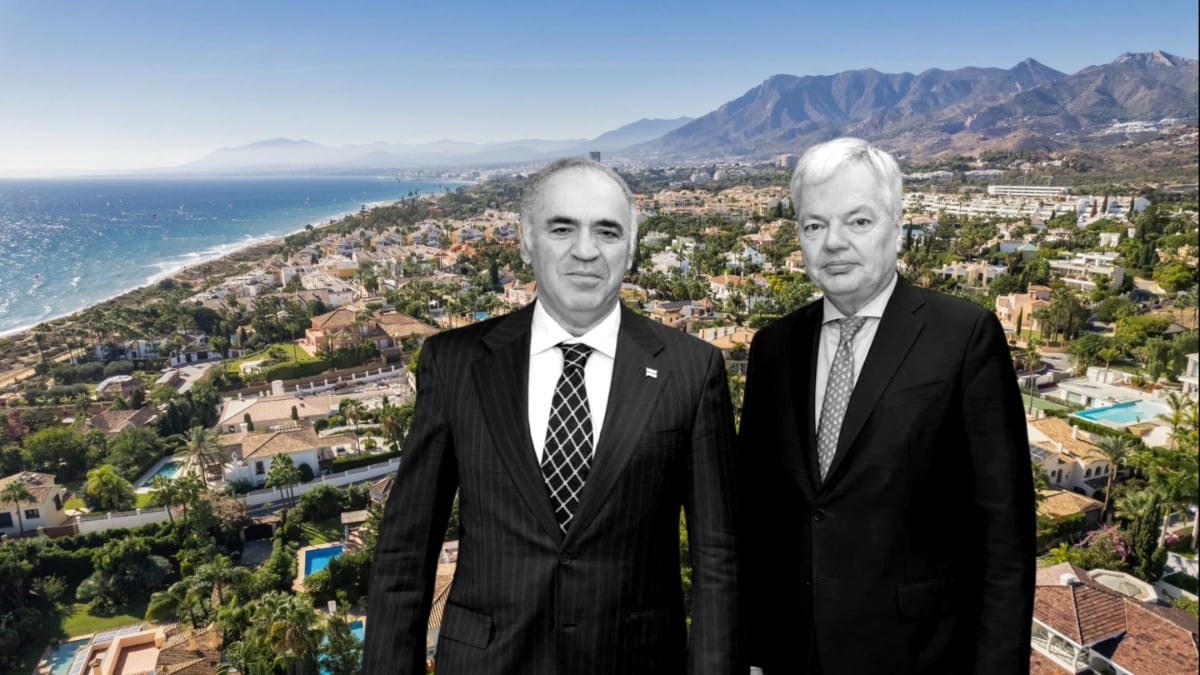
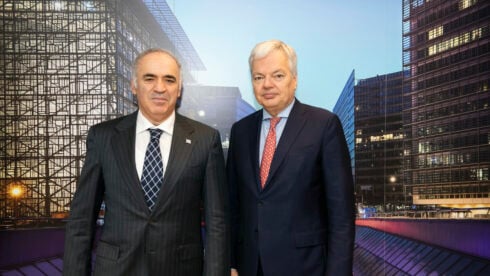
CHESS champion Garry Kasparov has singled out Marbella in an attack on the EU’s soft line on Russian nationals after Spain issued 100,000 visas to them last year.
The former world champion and outspoken Putin critic named Marbella alongside the French Riviera and Lake Como in northern Italy as holiday hotspots whose tourism money shapes Europe’s response to Russia, .
“Marbella cannot prosper without Russian tourism,” he said during a security forum in Halifax, Canada, on November 20.
He urged the EU to stop issuing visas in Moscow and St Petersburg and make Russians apply from third countries such as Armenia or Serbia, where they can travel without a visa, which he argued would keep a route open for those who oppose Putin while making travel harder for those who benefit from his regime.
Spain’s consulates issued around 100,000 short-stay visas to Russians last year, the third most in the EU behind France and Italy, according to European Commission data.
Across the EU, 623,451 visas of all kinds were granted to Russians in 2025, up 10% on the year before, with France, Italy and Spain accounting for more than two thirds of them, according to Schengen Barometer data.
That is the equivalent of around 1,700 a day, and almost 478,000 of the visas were for tourists.
Eleven European countries, mostly in the north and east, wrote to the European Commission in June calling it deeply worrying that Russian tourists enjoy holidays on European beaches while missiles and drones hit civilians in Ukraine, and describing the uneven approach across member states as a grave deficiency in the bloc’s policy towards Russia.
Sweden’s migration minister, Johan Forssell, said he wanted no more shopping weekends or elegant trips to Europe while Ukrainians die on the battlefield.
But critics argue the case against Russian visas goes beyond punishing Moscow for the war in Ukraine.
European ministers say Russia is stepping up sabotage, cyberattacks and other covert operations across the continent to weaken support for Kyiv, with EU foreign policy chief Kaja Kallas warning in September of a ‘fast proliferation of sabotage attacks and airspace violations’.
Estonia has proposed a screening mechanism to stop anyone with current or past links to the Russian armed forces from entering the Schengen area, and diplomatic sources say the idea is gaining traction.
In Spain, a report by Golden Owl, an intelligence firm based in Alicante, found a Spanish political scientist living in Moscow who recruits Spaniards as informants, paid cyber-attackers and soldiers for the Russian army, in the weeks before Spain’s general election on November 29.
He is the subject of an arrest warrant issued by Spain’s National Court over his alleged collaboration with a pro-Russian hacker collective.
A second Golden Owl report, published as police dismantled the neo-Nazi group Nucleo Nacional, found that a Russia-connected influence channel reached inside the group through documented organisational links and people tied to Russian state institutions.
A court in Gijon outlawed the group this month after 14 members were arrested on suspicion of unlawful association, hate crimes and weapons possession.
Speakers at its events included a man who presents himself as a collaborator with Russian state outlets RT and Sputnik.
The group has ties to another far-right organisation, Democracia Nacional, and through it to the network of the sanctioned Russian oligarch Konstantin Malofeev.
The analysts argue that Moscow benefits from both the group’s pro-Russian wing and its pro-Ukrainian one, while spreading distrust of Spain’s institutions and Western alliances.
They found no evidence of Russian funding, foreign payments or direct control, however, and the group’s leaders have said they turned down offers of foreign money.
Police say several members trained with assault rifles in Ukraine and discussed a possible armed uprising in Spain.
Leaked documents reviewed by the investigative network OCCRP and El Periodico indicate that the director of Casa de Rusia (Russia House), a Russian cultural centre in Alicante, reported to a Russian state-linked foundation sanctioned by the EU in 2023.
The same director also claimed credit for pressuring the University of Alicante to halt a 2023 exhibition of photographs from the siege of Mariupol in Ukraine and described cultivating ‘a pool of Spanish lawyers and journalists loyal to the Russian Federation,’ while the centre says it promotes ‘peace between nations.’
Spanish police have also repeatedly dismantled Russian-speaking criminal networks, with Europol saying in December 2020 that one had infiltrated Spanish public institutions through philanthropic activities and used bogus companies and cryptocurrency to launder money into luxury property.
In early 2025, raids on properties in Marbella, Malaga and Torremolinos targeted a money-laundering ring, mostly made up of Russian nationals, that Europol said served criminal gangs across Europe.
Brussels has not yet decided on a course of action, but the Commission has said it intends to present a proposal to revise the EU’s Visa Code in early 2027.
Click here to read more Marbella News from The Olive Press.