THERE’S never a dull moment in Marbella for a journalist.
From tracking down President Putin’s hilltop mansion to shooting the breeze with ‘Wagatha Christie’ Coleen Rooney, or from following Mark Thatcher in his Porsche 911 to playing golf with David Bentley (did I remind you of the six-pack of beers?), I’ve had some fun.
But one of my favourite sights was seeing actor Hugh Grant holding court with a group of friends on a warm summer evening in the old town.
Swirling a glass of flinty rose, he looked every bit the suave English gentleman you’d expect of him… and the funny thing, nobody apart from the restaurant owner batted an eyelid.
It was June, after all, and Marbella was at its very finest; the scent of orange blossom in the air, the bougainvillaea in full bloom, candles on every table.
READ MORE:
There was so much else for the throngs of tourists to be taking in.
At the request of Casanis boss Guy I took a quick snap of the Hollywood star, but declined to interrupt his convivial terrace bonhomie.
Grant’s regular trips to Marbella have sparked rumours over the years that he owns a house in the resort, in particular, in the luxury enclave of La Zagaleta (technically on the border in Benahavis).
But when I was actually introduced to him a year later, the Bridget Jones’s Diary star told me it was just a ‘good marketing tool for local agents’.
That said, he told me he loves the place but is mostly in Marbella, these days, on business or to film.
It perfectly summed up the resort, which has rightfully earned the reputation of being southern Spain’s playground for the rich and famous.
Full of tycoons, movers and shakers and, increasingly, tech billionaires, Marbella manages to remain Europe’s top location for a spot of business, alongside pleasure.
Over the last few years Novak Djokovic, Oleksandr Usyk and Spotify owner Daniel Eck, have all bought homes in Marbella, a town of nearly 180,000 residents, a third of which are foreigners.
READ MORE:
It is now a truly year-round resort that never hibernates and I can tell you traffic jams are just as likely now through Puerto Banus in December as in May.
Having lived here for nearly a decade, the best months are certainly from October to May, when the tourist numbers remain manageable, while all the top restaurants are still open and the sports clubs buzzing.
Meanwhile, infrastructure-wise it counts on around two dozen excellent private schools, two cinemas showing VO movies and just about every shop you could desire for from Apple to Corte Ingles and Marks & Spencer to Armani.
But Marbella has been the glamorous dream escape for movie stars, sportsmen and captains of industry since the 1950s. The roll call includes Audrey Hepburn, Cary Grant and Sean Connery, while more recently boxers like Tyson Fury and Anthony Joshua have graced its gyms, and Harry Kane and Gareth Bale have taken to the fairways.
Julio Iglesias, Alan Sugar and Eden Hazard own properties here, while footballer Ronaldo and Robert de Niro have enjoyed various holidays.
Since COVID and the giant increase in home working, tens of thousands of digital nomads and entrepreneurs have also decamped here, adding to the heady mix.
And is it any wonder, with photos of the glamorous destination filling glossy travel magazines making it probably the most aspirational place to live in Europe, bar perhaps San Tropez or Ibiza.
The New York Times frequently dubs the resort the ‘Crown Jewel of the Costa del Sol’, while its most exclusive five star hotel, El Puente Romano, takes out full page ads in the Financial Times in the heart of winter, when Washington and London are freezing.
Property prices have continued to soar and Marbella was the first place in Spain to return back to the levels of 2006 before ‘La crisis’ kicked in.
Prices more than doubled in a decade and the current average is between €4,500 and €6,100 per square metre, depending on the property type.
“It is all about quality, not quantity,” explains Chris Clover from the town’s longest-established agency Panorama, which reports that for some ‘hyper-luxury’ areas like Puente Romano, frontline beach, or exclusive new developments, penthouse and villa resale prices routinely reach €14,000 to €20,000 per square metre.
READ MORE:
Demand far outstrips supply and there are simply not enough properties for sale nor plots to build on. “It is slowing down a bit but Marbella is almost bulletproof from a crash,” explained estate agent Adam Neale, of Terra Meridiana. “It is almost unique in Europe.”
Culture vulture
But what is certainly different about Marbella than other nearby resorts like Estepona (or further afield in Javea, Begur or Ibiza, say) is its amount of history and culture on offer, when you know where to find it.
Don’t laugh. History-wise there is a lot more to do than just inspect the Moorish walls in the casco historico.
Do your research and you will find Roman villas, Arabic bathhouses, Visigothic churches and even a Roman bridge at the Puente Romano hotel (the clue is in the name).
Indeed, rewind the clock several millennia, and you’ll find it’s always been a popular spot.
Marbella’s earliest origins are as a palaeolithic settlement. Humans hunted and gathered over the very same land that now boasts Michelin-starred restaurants – and yes, there are lots of them.
The Phoenicians were here, before its next incarnation came as a Roman port. You can see the evidence at the Termas de Las Bovedas Roman baths, near San Pedro de Alcantara or at the Roman villa in Rio Verde.
The northern European Visigoths were frequent visitors to the coast and left their mark in the form of the Vega del Mar Basilica, a necropolis, also to be found in San Pedro.
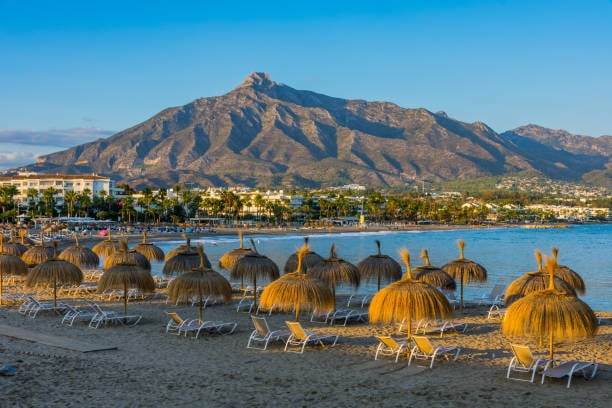
They, like the giant number of northern Europeans who live here today, would have been attracted by the excellent warm temperate climate, which rarely goes below eight degrees, nor over 30 degrees, thanks to the protection it gets from the nearby Sierra de las Nieves National Park and pointy La Concha mountain.
In contrast, the early Arabs, or Moors, who arrived in the 8th century found it a fair bit cooler than across the pond, spotting the town’s potential, calling it bien habitada, or ‘place of good living’.
They eventually built a walled city in the old town in the tenth century and even a large Alcazaba castle.
The walls, some of which survive today, were dotted with around a dozen towers, including the Torre del Puente Levadizo (meaning the ‘Drawbridge Tower’) and the Torre de la Puerta de Hierro (or ‘the Iron Door Tower’).
It doesn’t compete with Cordoba or Sevilla for Moorish architecture, but it came a close second to Ronda in terms of size falling to the Christian Crusaders in the same year, 1485, just seven years before the Catholic Reconquest was complete in Granada.
Finally, something that almost nobody credits when thinking about a holiday to southern Spain.
Marbella has some of the most amazing natural scenery and walks.
It sits right next to the Sierra de las Nieves National Park and the park can be easily accessed.
So yes, it is a destination that has ticked many boxes for many different people for centuries, a place best summed up by its cosmopolitan atmosphere, lovely hills, world-class restaurants and perfect climate.
Click here to read more Marbella News from The Olive Press.