

In today’s Europe, Lisa Tilley asks should it be legal to force a wild animal to perform human tricks. A dancing European Brown Bear touring with a medieval market and three Siberian Bears performing at a Granada circus have provoked a fresh debate on the subject.
A PERFORMING bear at a medieval market in Los Morales near Sevilla caused one onlooker in particular to question the morality and legality of such a spectacle. The eyewitness, who only gave his name as David, described how he was enjoying the market when, “suddenly this performing, dancing bear appeared.”
During its ten-minute act, the bear danced, clapped and rolled over – much to the delight of onlookers who applauded, shouted and touched the back of the bear as it was finally led away. David, on the other hand, was shocked and disturbed. “I was really upset about it. How much pain did that animal have to go through to learn such unnatural stunts?” he asked the Olive Press.
Meanwhile hundreds of kilometres away in Granada, exotic posters advertising the Quiros circus featured not only giant bears, but also the government logo of the Ministry of Culture. It transpires the Scenic Arts and Music department has a finance programme for circuses – although a spokesman told the Olive Press the Quiros circus has not applied for future funding.
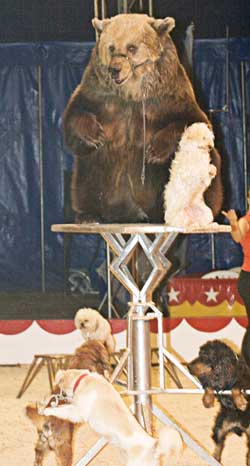
During the circus act, three bears are wheeled into the ring on an open-top jeep – one dressed in a jester outfit. The bears are made to balance on balls and walk on barrels. One even poses on a podium that is pushed around by performing dogs.
 The existence of performing bears has caused incense among animal welfare groups, who are calling for Europe-wide legislation against the use of wild animals in street and circus acts.
Tima, the bear seen performing at the medieval market, is said to be a European Brown Bear (Ursus arctos arctos), a species at risk of extinction in many of its native areas. Complaints against the act at the touring medieval market date back to 2006, but Tima continues to perform around the country.
David first raised the bear’s plight on the Iberianature forum (www.iberianatureforum.com), although he was initially hesitant to report the act. He was worried that a surge of complaints would force the bear underground. “My only concern is the bear” he told the Olive Press. “I worry that by kicking up a fuss, the attention would lead to the bear being killed and dumped in the woods somewhere”.
But the bear’s handlers are no strangers to objections: in April, the Society for the Protection of Animals of Alcoy filed a complaint against the ill treatment of the bear at the festival, which was being held in the Alicante town.
Officials for the group claimed the “degrading” spectacle involved the bear being forced to “play a trumpet and dance with a hula hoop.”
The welfare group is campaigning against the legality of using performing wild animals for financial gain. Concerns were also raised over whether such a bear performing in a crowded vicinity posed a grave risk to public safety.
In addition, Nieves Orellana de Molina from the Kimba animal welfare organisation told the Olive Press: “In July 2006, we denounced this shameful spectacle, but the official reply was that the animal was in Spain legally and his owner has all the necessary documents.
“What nobody could respond to was the tremendous damage done to the bear by making him perform such inappropriate movements.”
In response to questions from the Olive Press, Francisco Javier Gutierrez – who claims to be a former colleague of the bear’s owner – explained that he had “spent a lot of time” with the bear and his trainer, who had been checked, he believes, by the SEPRONA (nature protection service) division of the Guardia Civil.
He says the bear is from Northern Europe and “is the only bear in Europe with permission to perform in such spectacles… He used to belong to a Russian circus but lived in distressing conditions from which he was rescued.”
Despite the apparent legality of the bear, Legend Especialistas, the Alicante-based company that displays the animal and runs the medieval market, makes no mention of its existence on their promotional website.
It seems the performing bear exists in a legislative loophole: because Spain is not a country with a history of dancing bears, there is no specific law concerning such animals being used for public performances. In Bulgaria, however – the most high-profile place for dancing bears – the practice has been illegal for almost a decade.
The Eastern European tradition of training bears to ‘dance’ was exposed as a cruel and violent practice, in which the bears were made to stand on hot iron plates forcing them to lift their paws consecutively to try to relieve the pain. Eventually, the bear becomes conditioned to perform its ‘act’ on cue.
Wild animals continue to be forced to perform in circuses and street acts in Spain despite the fact that the European Union, through its Protocol on the Protection and Welfare of Animals, recognises them as “sentient beings,” whose welfare should be considered in the policies of all member state countries.
But, the only Europe-wide legislation protecting mammals – the EU’s Community Action Plan on the Protection and Welfare of Animals – is concerned with animals in farming rather than those in circuses.
And for many, it is simply unfeasible to work towards the “welfare” of circus animals: “It is impossible for a travelling menagerie to provide circus animals with the facilities they need” says the Captive Animals Protection Society.
The Quiros circus, which was held in Granada for ten days in early October, also featured flamenco-dancing chimpanzees and alligators. Much to the pleasure of the smiling and applauding families in the crowd, the wild animals performed human-like acts. However, the Captive Animals Protection Society urges parents not to expose their families to such spectacles. “Children should be taught to respect animals – circuses teach the opposite,” a spokesman said.
In the United Kingdom, undercover investigations have exposed the barbaric techniques used to train wild animals to perform unnatural acts. The most high profile investigation led to the conviction of handlers at Mary Chipperfield Promotions, who used a variety of weapons in training to force animals to perform.
Thanks to such investigations, global attitudes are changing – with countries such as Singapore and Austria banning the use of wild animals in circuses.
“It is widely acknowledged that vertebrate animals can experience pain, suffering and distress,” according to the Born Free Foundation. “Research has shown that keeping wild animals in cramped conditions, in inadequate and unnatural social environments and subjecting them to repeated travel causes heightened stress responses that result in a serious negative impact on animal welfare.”
There is, however, a growing movement for change in Europe: on October 10, 25 Non-Governmental Organisations met with European politicians and supportive celebrities to discuss ways of improving conditions for a million captive animals across Europe. The conference, organised by ENDCAP, a conglomeration of animal welfare and conservation organisations, pushed for an end to the “appalling conditions” suffered by performing animals in Europe.
It is hoped that public protest, combined with the efforts of MEPs to change European law will lead to animals such as Tima being granted a peaceful retirement at least.
Click here to read more News from The Olive Press.






I think Madrid has now joined Barcelona and Lleida in banning performing animals in circuses. While we wait for other Spanish provinces to join them, I urge Olive Press readers to see what the International Fund for Animal Welfare (IFAW) is doing in their campaign to rehabilitate bear cubs orphaned in Russia by the barbaric hunting of hibernating bears; http://www.ifaw.org/ifaw/general/default.aspx?oid=9049 We may not be able to help Tima but we can stop other bears from succumbing to the same fate.
What a ridiculous and shameful spectacle. Why don’t people in Andalucia have the sympathy and / or intelligence to stand up and say ‘no’ to such barbaric and outmoded forms of so-called entertainment?
why are we talking bout bears yall…this is stupid yo
Hi all, (especially YO Dawg)
We are talking about bears because this particular subject reaches into the heart of a society that cares (or does not care depending on your point of view) about how we live our lives.
What subject would you like to talk about?
The subject doesn’t really matter. It is to the detrimental cost of us as a sentient species, when we allow other life forms on this planet to be abused out of our ignorance and for our petty pleasure needs…
Think about it…. And apply that thought process to the problems we face in our world today…
Clive
i really dont’t agree with the public show of bear dancing imagin yourself having to show off to unfamilliar people
this is stupid
So are there still dancing bears in Spain ( I thought they were all rescued in Europe and now they are only in the indian subcontinent)?
I’ve seen this bear in real life and it’s the best kept animal that I’ve ever seen. The coat is soft and shinny and this animal is extremely well natured. The man whom owns the bear is a bear specialist and is keeping the bear in fantastic conditions as well as his other bears. You just need one person that is mislead by the whole thing and the bear is portrayed to badly looked after which is not the case here. All of the bears that are under the ownership of this gentleman are the best looked after bears in any captive environment in europe.
I agree with you, Johnathan. Describing the bear’s trick as degrading is projecting a human’s sensibility onto the bear; the bear does not look like it is in any way distressed. Would the bear have run over to the trainer if he was afraid, abused or did not want to engage in the game of tricks? I think not! Secondly this man’s bear is a 3rd generation “raised in captivity” bear! Which I think is admirable! In its wild habitat this species is endangered (they were probably killed into near extinction because of their hides, meat, etc…) so this man successfully raised them in captivity and his bears may eventually be the only bears of its kind LEFT!!! So thank you, Pavel and Tima, for being able to keep this subspecies of bear in existence! Also, unhappy or un-cared for bears in captivity would NOT breed! So praise should go to his keeper!
I think bear dancing is horrible it needs to be stamped out and stamped out NOW.weither the bear is looked after or not it is still totally un-natural for this poor bear.the bear doesnt exactly look happy.I am an animal care student and using the dancing bear as a topic for a project so I can bring this issue even more to light. For people to acually say that it is ok should have a loop through there nose and chains on them and made to dance infront of strangers.I am highly disgusted by johnathans comment. GET REAL MATE IT IS WRONG FULL STOP…
It’s not natural to see a dancing bear and it is cruel beyond belief. When you see the horrible conditions some bears are kept in worldwide, not just for dancing but where they are farmed for their bile, it is heart-wrenching.
This is one of the worst things in the world. What can i physically do to help?
We do not need to look at bears, we need to look at humans, a disgusting species that needs to be eradicated from the planet as soon as possible. May the ice caps melt and destroy us all – there are nice people on this forum with good intentions, but humans are just not fit to inhabit the planet, are they?
OMG!!! this is the worst thing in the world!! it is so cruel!!! i cant believe that this is happening and that humans are actully doing this and being amused from an awful thing like this!!
i thing this is so wrong and that the owners of this the bears should be made to dance in public! these bears have feeling too
from danielle (age 14)
Does anyone understand how these bears are trained? In most cases the mother is killed in order to capture her cubs. The cubs are trained to associate a song, command, or other cue with pain.
One common technique is forcing the cub onto a hot metal sheet so that it “dances” while playing the song or the command is repeated.
An accompanying technique to bore a hole into the cubs very sensitive nose and pull it towards the sky to make it stand. The cub reacts instantly to avoid the pain while the music or command is repeated.
I encountered this kind of performance on the street and spoke up asking my fellow travelers on the spot NOT to support this cruelty. I urged them not to take pictures, give any tips to the “trainer”, and complain to the tour operator.
We all have choices and each choice has consequences.
Why should these cubs be tortured for peoples mere pleasure?
Its revolting.
I did this for a project and i tried to point out everything. As soon as i saw the report on television i started crying. I wanted to put a stop to it. And i still do. All i want to say to the people is just leave the innocent creatures alone and get a life really. In India if
ANYONE see’s ANYONE doing this they should go to the nearest police station and the so called ‘owners’ should be locked up.
Jodie (11)
this is cruel and HORRIBLE.
@Victor, i agree! there are so many other alternatives to get ”pleasure”
@Peter
Losing bears will do great damage to the world’s natural ecosystem and food chain. If you care so much about humans, did you even notice that this changing ecosystem WILL affect humans someday? >=(
Irene(12)
bear dancing is so very cruel !
Dancing bears is awful and we all need to stop talking about it and do something for these poor animals.My daughter and i will be.
i dont care the bear could probally kill them all
This is not fair for bears of course, but what about bullfighting and other cruel spectacles in which animals are tortured and killed (especially bulls) that are so common in Spain? And what about fur and meat industry, fishing,hunting etc.
Bears are not the only victims.
All animals should be treated in a manner that does not cause harm or discomfort.
While I have a great deal of concern for the wellbeing of animals I am more concerned about the treatment of fellow humans.
Having travelled extensively and worked as a volunteer in Indonesia, I am constantly appaled by the conditions under which people live and work.
It seems to me that we spend a lot of time debating the plight of the European Brown Bear – put your feet where your mouth is and get out there and do something to bring about change – for humans and the bear.
Jonathan Smith, If this bear is so well cared for, why does it have cataracts? You can see them in the photo.
No animal, especially a wild animal, like this bear, should be forced into animal slavery like this. It’s cruel and unusual punishment. I hope that there is enough negative messages toward this act that the government in this area makes the act illegal and arrests the “owner” of the bear and puts the bears in a sanctuary.
If you are against this sort of exploitation then you should feel the exact same way toward every motion picture, commercial, and public display of wild animals in any forum. Stop watching movies and supporting products that use wild animals, heck why not include ALL animals. Doug Sues and Bart the Bear, that Kacy guy with Brutus, Budweiser and its abuses of horses. Common! don’t be so narrow minded, only true vegans that don’t wear leather or animal products can claim disgust by this or your just a bunch of hypocrites that watch movies with animals actors in them and football commercials on TV.
This guy loves this bear (look at his YouTube page) and shows it. He claims no sadistic methods were used to train him and most of what the bear does it discovered himself, then rewarded for repeating it. This bear lives better than most Russians. Bears name is Tima and man is Pavel Vyakin.
It’s always funny when people site extreme animal torture can only be complained about by ‘true vegans’ etc in this case… BULLSHIT! This is plainly cruel slow torture for years and years!
Pathetic CAINUS!
Likewise a prisoner of war may be safer in captivity than in the shooting war, even though in solitary confinement or otherwise mistreated. Bullocks!
Tima is still being made to perform. She is scheduled to perform in France on December 2nd and 3rd 2017.
Here is a link where we can protest to the show organisers and the town hosting the event:
https://www.aves.asso.fr/2017/10/contre-la-presence-de-pavel-vyakin-et-son-ours-tima-aux-spectacles-de-noel-euphorie-a-beauvais-et-saintes/