

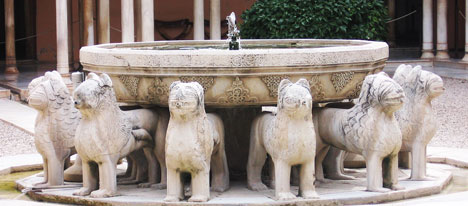

The Alhambra’s famous Patio of the Lions is missing its famous beasts: they are being restored elsewhere and revealing a secret or two in the process
THE 12 marble lions of the Alhambra have gone wild over the centuries, gradually acquiring populations of living organisms – black fungus, algae, lichen and bacteria – as well as 15 layers of calcium carbonate measuring a centimetre and a half in places.
Lion tamers with a difference have therefore been employed to bring the feral crusts under control.
And along the way they have uncovered a clue or two about the lions’ history.
Restorers scraping away at the coatings – which have been building up since the 14th century – have discovered graffiti etched hundreds of years ago.
Restorer Carmen Tienza expressed her disbelief at finding words inscribed in 1831 by the British author and hispanist, Richard Ford: “I thought I was having visions,” she said recalling her discovery. “As restorers, we all get a little obsessed at times.”
It will take a team of nine people two years to remove the lions’ extra coats by scraping away painstakingly with precision instruments.
So discovering 200-year-old graffiti could be described as a perk of the job.
Nine months into the project, the restorers have given the lions pet names to ease the monotony: Félix, Melanie, Olivia, Rey Gudú and Calimero sit patiently waiting for the day’s scraping session.
Each bears a different expression, varying in ferocity, and as the crusts are gradually removed their expressions become ever more detailed – the hidden faces of the lions are revealed once more.
In fact, the marble, which originally comes from the village of Macael in Almería, is perfectly conserved under its limey coating.
The restorations have demanded a great deal of coordination, time and money – just hoisting the lions from their home in the Nazarí palace to a building close to the Generalife gardens is said to have cost more than half a million euros.
However, the ornate bowl of the fountain was too large to remove, so it is being restored in situ in the Patio of the Lions; they have simply built a wooden cabin around it to provide protection from the elements while it is polished up.
The fountain of the lions is often called the greatest Islamic sculpture of Al-Andalus, but this could prove to be a myth, as the most likely theory suggests it is probably Jewish.
Some believe it represents the Sea of Bronze in Solomon’s temple – in which twelve white lions hold up the ocean.
The marble creation has been dated back to the 11th century and said to have been previously owned by a local Jew, Samuel Ibn Nerela who gave it to his Moorish king; testament to the peaceful relations between Jews and Muslims in Al-Andalus.
When the fountain was first ‘plumbed in’ to the palace, water was redirected straight from the nearby river Darro and emerged from between the lions’ marble jaws.
But since the 16th century, the water distribution system of the palace has been altered more than 20 times.
The current architect scratching his head over the Alhambra’s running water – integral to the ambience of the palace – is Pedro Salmerón. “Not much remains of the original system,” he explains. “But our project is looking to restore the traditional system of water distribution as far as this is possible.”
But the water passes through five kilometres of acequias (small water channels) before arriving in the palace.
And the acequias have become ever more contaminated, meaning the water trickling through the priceless fountains is causing more and more damage.
“If the water does not arrive treated after the restoration, it is best that we do not open the tap, because all will have been in vain,” warned Salmerón.
So the meticulous process of restoring the lions of the Alhambra to their former glory continues, but for the army of patient experts working on the project it is hardly a chore. “An operation like this is always delicate,” explained Salmerón. “That is its attraction. It is all about having the sensitivity needed to do it.”
Click here to read more Spain News from The Olive Press.

I am very interested in learning about the original system of water distribution and how it has been altered over the centuries. I am especially interested in how the water was supplied to the fountain in the Patio of the Lions. Can you give me contact information for Pedro Salmeron?
What was the text of the graffiti?
Schon, read Cuadernos de la Alhambra nº3, published in 1965 by the Patronato de la Alhambra, This contains an extensive study of the fountain. Unfortunately the most comprehensive study of the water system was undertaken by Rafael Contreras in 1853 prior to the start of repairs to the Baths and the court of lions, but has never been published, it is held in the Alhambra Archive.
Richard ford was prone to leaving his signature all over the Alhambra, it has been found in several rooms in the palace. His drawings and book originally 1831 (Granada 1955)are very interesting.
What a fascinating thing to do – to give the lions names as they are being worked upon. I would be interested in knowing what the other six lions are called.
Is there any information about the intended improvements of the water source for the fountain when the patio de leones is completed?
I’m planning to visit Granada next April (2011) and I’m wondering if the lion statues will be back in place by then. I hope they will be because we missed them in 2008.
cheers
Mal