LIKE many good things, it was born in a barn.
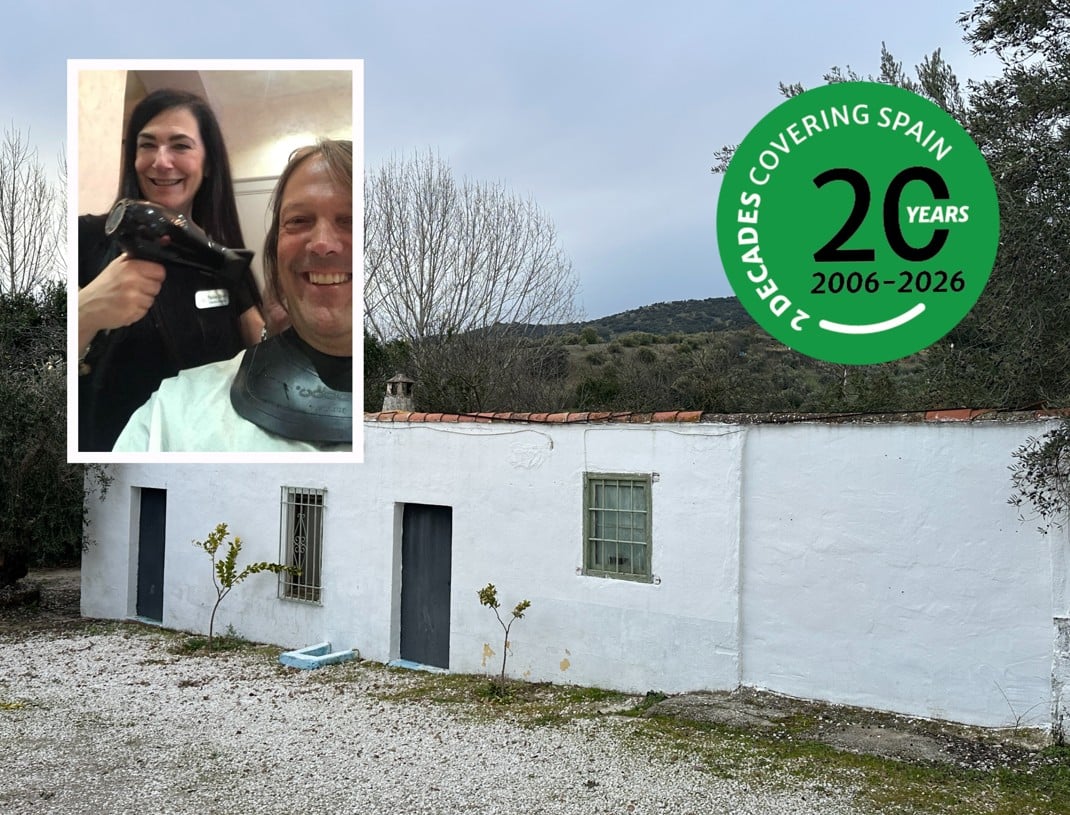
Or rather, a spare bedroom at first – before we were shipped across the track to a shed where the neighbours had once kept their sheep. It had a corrugated iron roof and no electricity, but at 150 euros a month it was a bargain, if rather cold.
When I write we, I mean our admin and accounts genie Pauline Oliveira – a hairdresser from Croydon – and graphic designer Jackie McAngus, who had once run an advertising agency in London. And then there was me.
READ MORE:
- LANDMARK ANNIVERSARY: Twenty Years of The Olive Press – Why Independent Journalism Still Matters
- Los Merinos would ‘gravely endanger’ local ecosystem
- ‘Like being accused of dropping the Hiroshima bomb’
I had insisted to my wife it would be a part-time job. “Maybe two days a week.” The idea was simple enough: set up a decent local English-language newspaper to report on the dozens of regional expat stories nobody else was touching.
I’d moved to Spain to escape the daily grind of deadlines, planning to write a book, build an earth house and start an organic farming business. But inevitably, a scandal was brewing in our charming inland town of Ronda – and nobody, literally nobody, was writing about it.
The issue was Los Merinos: a vast macro-development proposing two golf courses, three luxury hotels and 2,000 houses inside a UNESCO-protected area beside the Sierra de las Nieves. It threatened local water supplies and would permanently alter a region defined by its history, landscape, food, wine and walking.
On one side were a handful of brave ecologists and concerned expats. On the other, politicians, developers, much of the local media – and the usual promises of jobs and prosperity. When my neighbour, a green policeman, was quietly removed from his post after submitting an official report warning of water shortages, it was time to act.
With no real planning and no fixed publishing schedule, we set out with a single aim: take on the developers and produce a brilliant local paper that informed and entertained in equal measure.
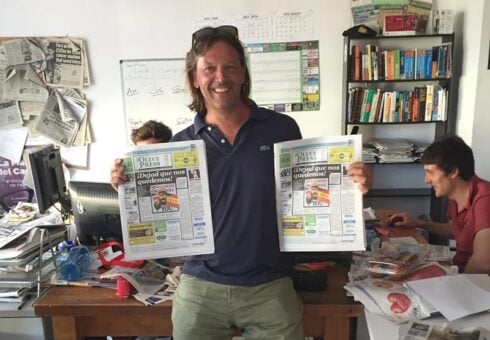
That summer I’d been writing travel pieces for the UK press and came across an environmentally-focused English-language paper in Granada called The Olive Press. I liked its tone and range. It was outspoken, irreverent and nothing like the awful free papers cluttering the Costa del Sol.
We began sharing content. I briefly considered calling my western edition The Wine Press, given the boom in vineyards around Ronda, but the name never quite worked. The Olive Press did; rooted in the Mediterranean, with a satisfying double meaning and a distinctly green sensibility.
Better still, it signalled what we stood for: campaigning, locally focused journalism unafraid to challenge the status quo.
The first issue appeared in November 2006. Its centrepiece was a simple photo story: one image showing a GR-7 footpath sign beside the Los Merinos site, and another showing it removed and the path blocked. ‘Now you see it, now you don’t’. Alongside it, a story on a crackpot plan to build an airport in Antequera.
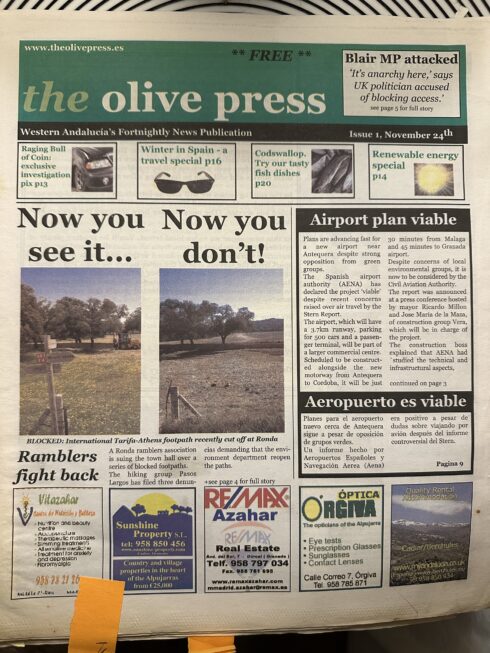
The impact was explosive. Hundreds of calls and emails flooded into our agrarian HQ within days. Better still, local businesses wanted to advertise, and readers wanted to know when the next issue would land.
We took a breath, regrouped, and returned in January. A seasoned sales rep soon joined us, setting up shop beside the barn in what became known as ‘the dog house’ – open to the elements, freezing in winter, baking in summer. It didn’t matter. He brought in vital early accounts.
Not long after, we were joined by a highly experienced journalist who became my mentor. He helped impose structure and rigour, shaping the paper into a proper fortnightly – from planning and reporting to sub-editing, legal checks and the sacred ritual of ‘the stone’, when every caption and headline was checked before the presses rolled late on Tuesday night.
Print runs were modest at first: 5,000 copies, carefully placed in English-friendly cafés, bars and businesses across the Serrania de Ronda, Antequera and Coin. The Golden Triangle of inland Malaga. The aim wasn’t saturation, but impact – reaching people affected by Los Merinos and other crazy schemes and those starved of serious local reporting.
Within a year, the original Granada team decided to return to the UK, and I bought the name and brand. What had been a ‘two-day-a-week’ project became a full-time obsession – terrifying, exhilarating, and irreversible.
Our reputation spread. Young journalists arrived from the UK, hungry to learn, some of whom would later go on to major international careers. We even hosted interns from Princeton University, sparking a summer exchange programme that lasted well over a decade.
On deadline days, staff spilled into our house for lunch; some lived in our spare room and played with our kids in the garden. It felt chaotic, familial, and utterly alive. Cakes appeared for birthdays. Stories broke weekly – crime tips, floods, demolitions (remember the unlucky Priors in Almeria?) – nothing was out of bounds.
Distribution expanded dramatically. Drivers fanned out from the Costa de la Luz to the Subbética, delivering papers to villages far off the tourist map. It became one of our quiet strengths: a paper that physically reached people who felt forgotten.
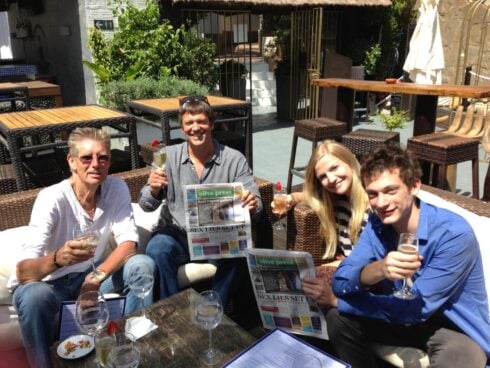
Eventually, the barn became too small. The phones never stopped ringing, deadlines grew tighter, and the noise from the ‘dog house’ made it clear that a more professional base was inevitable.
That move – and what followed – is for the next chapter.
But a few things are worth holding onto as we look back from here. Despite power cuts, storms and rural chaos, we never once missed a deadline.
On one occasion, we quite literally produced the paper from our local pub, unplugging three computers, carrying them to the bar, and borrowing their electricity and internet to get the issue out on time.
And then there were the moments that reminded us exactly where we were: gypsy neighbours quietly tapping into our power supply, sheep wandering past the office window – and the three little pigs that once walked straight into the barn mid-deadline, giving Pauline the fright of her life.
Those early years set something in motion that never really stopped. The technology has changed. The team has changed. The scale is different. But the instincts forged in that barn – to question power, to stand up for communities, and to publish stories others won’t touch – are the same ones that shape the Olive Press today.
As we enter our twentieth year and launch this week’s brand new national edition, it feels like the right moment to look back – not out of nostalgia, but because the reasons we started have never felt more relevant.
Click here to read more Other News from The Olive Press.