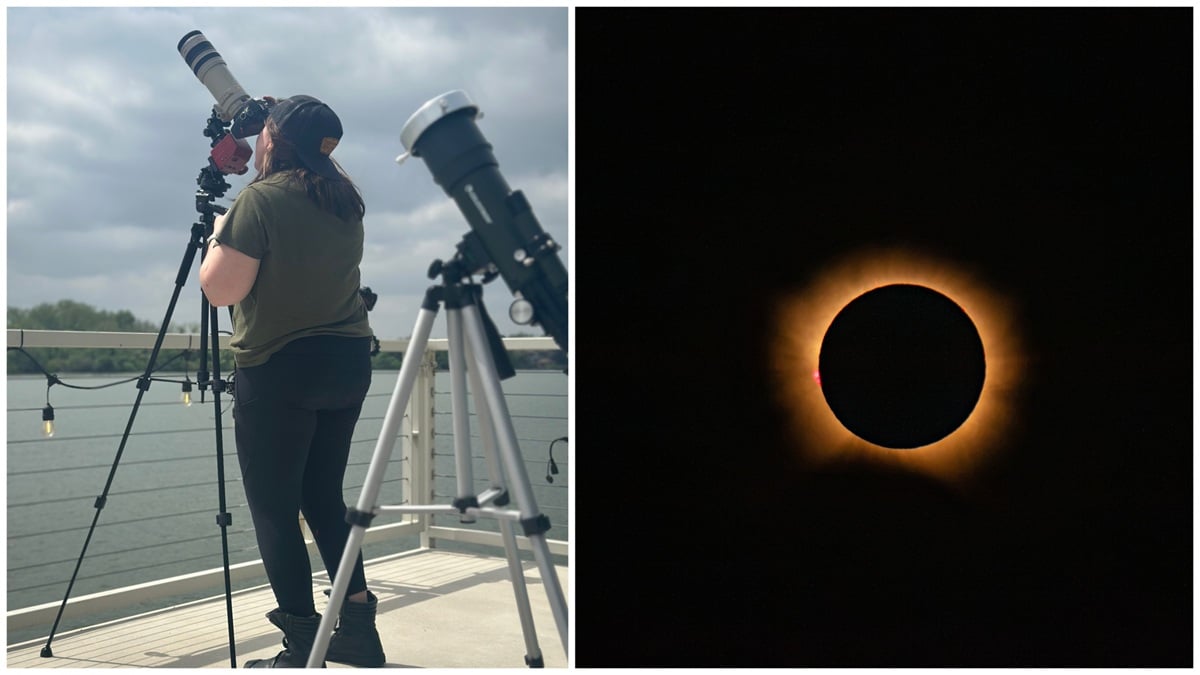
EMILY Pittman steadied her breath as an amber glow settled over the Roman ruins of Juliobriga, in northern Spain.
She pointed her lens towards the setting sun, adjusted her frame, and lay in wait.
Then it happened.
The world around her was plunged into darkness as the moon briefly obscured the sun over the region of Cantabria.
For a moment, a ring of fire shone around the pitch-black blot in the sky. Church bells tolled, the crowd around her erupted in cheers, and she was awash with relief as she snapped the photo she had been longing for.
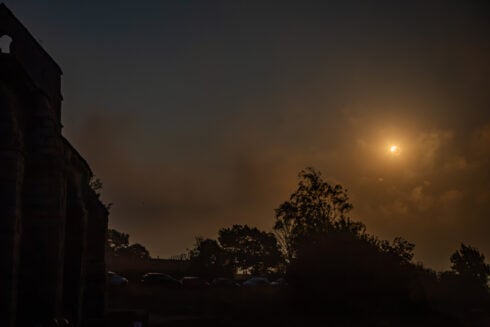
“There was such a surge of emotion all around me,” she told The Olive Press. “The crowd was bathed in this golden light while the sun prepared to set. For a moment, everyone was happy.
“It may have been the best eclipse of my life.”
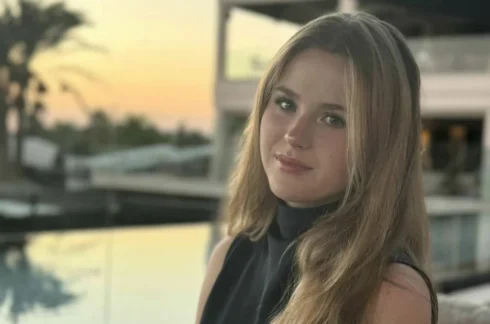
Pittman, 33, is an American photographer who has been chasing eclipses around the world since 2017.
Earlier this month, she travelled from her home in Atlanta to Spain to capture the country’s total solar eclipse on August 12 – the first in more than a century.
For thousands who gathered on hilltops and coastlines on Wednesday evening, it was the first time they had witnessed the phenomenon.
For Pittman, it was the fifth.
“Not that it means it’s any less exciting,” she said. “Seeing an eclipse is always hard to beat.
“For me, there’s a rush of adrenaline as I try to capture the perfect shot, but also this amazing connection with hundreds of strangers who share the experience.
“It’s addictive.”
Pittman’s first eclipse was in 2017, when she drove to Nebraska with a friend to watch the event from a field.
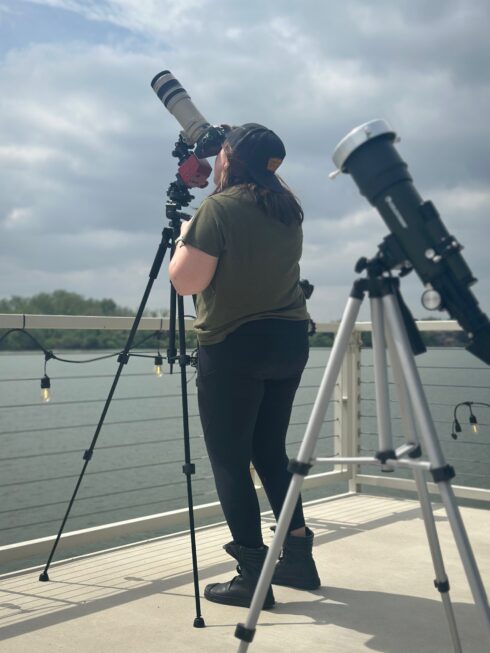
Admittedly, she knew little about eclipses at the time. She and her friend simply parked their car at a random spot, unloaded their gear, and set everything up about an hour before the event.
Then, as the minutes ticked by, hundreds of people began arriving with mini-freezers, tents and loudspeakers. The quiet field had suddenly been transformed into an impromptu party.
“I loved every minute of it,” Pittman said. “It was all so spontaneous, and everyone cheered when the moon passed over the sun. It was amazing.”
Since then, the photographer has hunted down eclipses across three continents, travelling as far as Chile and even Antarctica in her quest for the perfect shot.
This year, she told The Olive Press, she had planned her trip rather more carefully – but, of course, last-minute mishaps are always lurking around the corner.
Depending on where they are viewed from, eclipses can see the sun obscured either fully or in part.
This year, the path of totality – the narrow band from which observers can see the moon completely cover the sun – swept across Spain in an arc stretching from Galicia in the north-west to the Balearic Islands off the peninsula’s eastern coast.
Pittman, who had never been to Spain, chose Cantabria as her viewing spot.
The region offered a long stretch of coastline, crisp blue seas and milder temperatures – and to Pittman, that sounded like the sweet spot.
She arrived in Spain on August 8, rented a car and began scouting locations across the region.
She ruled out several spots that threatened to be blighted by cloud cover before eventually settling on Bolao – a stunning village perched on moss-covered cliffs on the Cantabrian coast.
READ MORE: NASA and BBC take over abandoned Spanish villages to broadcast historic solar eclipse
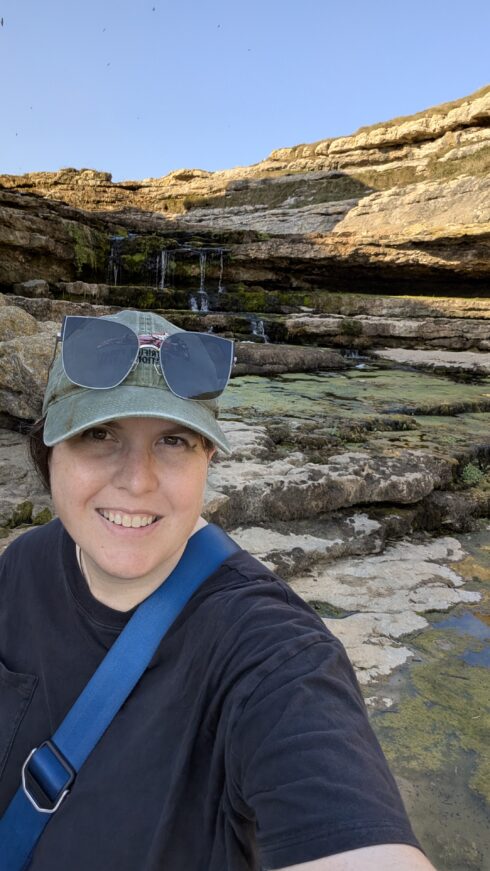
On the day of the eclipse, she drove there, set up her gear, and kicked back for a couple of hours before the event was due to begin at around 7.20pm.
Then, at 5pm, she spotted a single cloud hovering ominously overhead.
“At first I thought it might just go away, but instead it seemed to be growing.”
Westerly winds threatened to sweep in a thick curtain of cloud, which would have made it impossible to even see the eclipse – much less photograph it.
So Pittman scrambled her gear back into the car, searched for a few nearby spots at higher altitude, and darted off towards her new destination: Juliobriga.
“I can’t even begin to say how anxious I was feeling,” she said. “At this point I only had a couple of hours before the start of the eclipse, and Juliobriga was about one hour away.”
But when she arrived, her nerves began to settle. She knew, she said, that she might just have had the stroke of luck she needed.
In this quiet corner of northern Spain, some two hours by car from Bilbao, the ruins of an entire Roman city jut from a green pasture.
Amid the wind-smoothed stones and reconstructed Roman columns, the church of Retortillo rises above the ruins like a sentinel keeping watch over the crumbling old town.
The view was stunning, Pittman said.
READ MORE: Millions enjoy total eclipse of the sun in Spain- not witnessed in the country for over 100 years
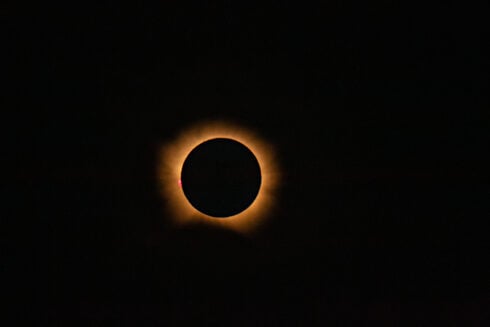
By the time she parked her car by the church, dozens of people had already arrived. She took a look around, considered the sky and made up her mind to take her shot beside the church.
When the celestial event began, it was all very familiar to her – except for the golden light that descended on the ruins and the excited Spaniards chattering away beside her.
What she did not expect, however, was for the church bells to begin ringing out during totality, in a moving celebration of the event that ‘seemed to bring people even closer together.’
“That was so beautiful, I didn’t see that coming at all,” she said. “I was focused on the camera, mesmerised by what I was seeing, and then people cheered, and the church bells began ringing.
“It was just perfect. When it finished, I really wasn’t ready for it to be over.”
With her mission accomplished for this year’s eclipse, Pittman is now enjoying some much-deserved downtime in Cantabria.
But she will not remain idle for long.
Next year, another eclipse on August 2 is set to grace much of the Mediterranean, including Spain – and it is going to be exceptionally long, Pittman explained.
“It’ll last for about six minutes in Egypt and four in Spain, which is very rare,” she said.
“But personally, I’ll be going to Morocco. I’ve never been to the country,” she mused.
By the end of 2027, if she follows through with her plan, Pittman will have visited four continents – her eclipse collection growing to six.
And one detail about what she carries with her when eclipse-hunting is poignantly revealing of where her passion comes from.
Among the cameras, lenses, solar filters and tripods she packed for her trip to Spain, there was also a special sound recorder she used to capture the reaction of the crowd around her.
“I was interested in re-listening to the sounds people made,” she said. “It tells you a lot about how watchers experience an eclipse.”
Animals, after all, are known to be highly sensitive to solar eclipses. Birds have been observed falling silent and returning to roost, while nocturnal creatures such as bats can emerge during the brief period of darkness.
Farm animals, meanwhile, may become unsettled or confused, with cows and horses sometimes gathering together or heading towards their usual nighttime resting spots.
“Maybe something different happens to us as well,” she said. “I know it happens to me, for one.”
Click here to read more Environment News from The Olive Press.