MOROCCO has ramped up security along its border with the Spanish exclave of Ceuta as fears grow over a mass migrant crossing on August 15.
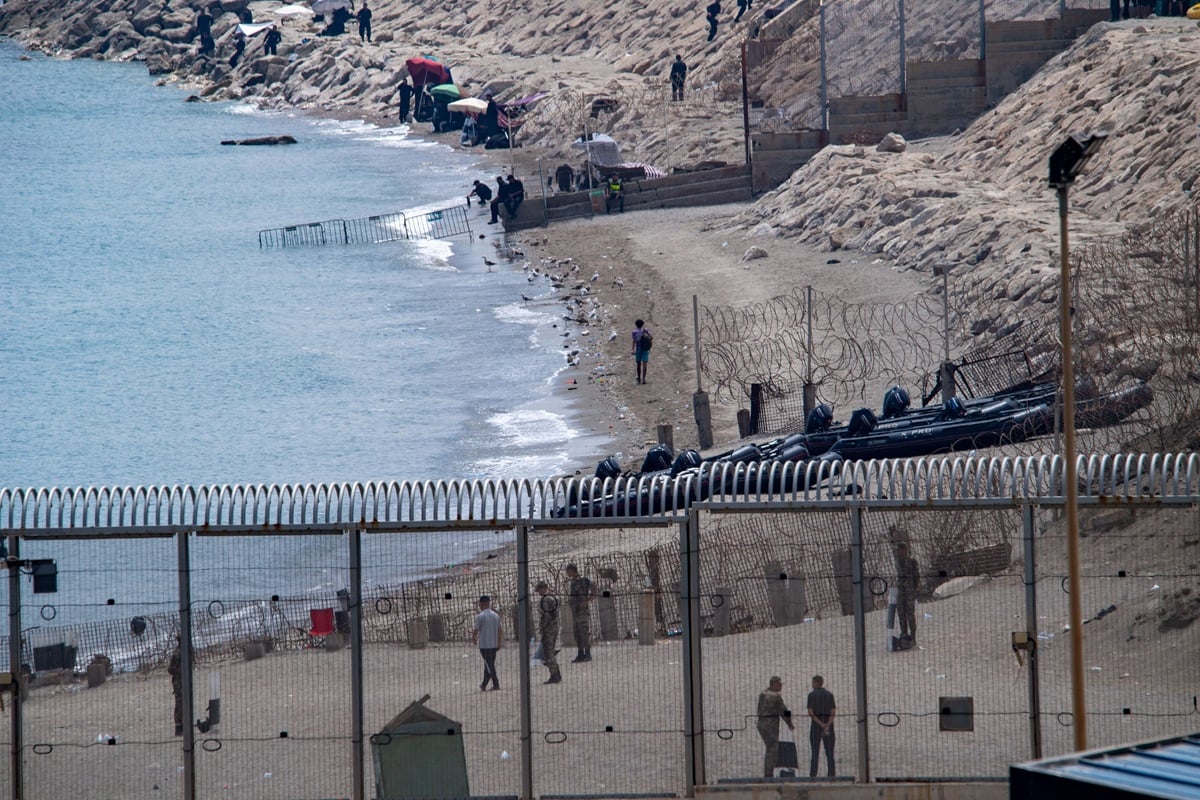
Rabat has deployed hundreds of police and military personnel around the border and begun installing barbed wire and other metal barriers at sensitive points, according to local reports.
The move comes after a social media campaign urged migrants to attempt another mass crossing on Saturday, following the unprecedented scenes of July 30 and 31, when more than 72,000 people entered Ceuta from Morocco.
READ MORE: Vox backs bid to kick Morocco out of Spain’s 2030 World Cup over Ceuta migrant crisis
Moroccan authorities have described the online calls as ‘suspicious and misleading’ and warned that anyone attempting to cross the border illegally will be intercepted.
The country’s National Security, Royal Gendarmerie and Auxiliary Forces have been deployed around the border, with joint patrols monitoring roads leading towards Ceuta from the nearby city of Fnideq.
Police are also checking buses and taxis travelling towards the Spanish territory, while patrols have been sent into surrounding woodland where migrants often gather before attempting to cross.
Moroccan authorities said they had already detained dozens of undocumented migrants, most of them from sub-Saharan Africa, as part of the operation.
Barbed wire and metal posts are also being installed along stretches of the coast from which thousands of migrants entered the water during the July crisis.
Some of the new barriers are being extended several metres into the sea in an attempt to prevent migrants from reaching the Spanish territory by swimming or diving.
The concertina wire – rolls of razor-sharp metal fencing – has previously sparked controversy over the danger it poses to people attempting to cross border fences.
Meanwhile, Moroccan authorities have said they arrested several people accused of using social media to encourage illegal migration.
Rabat has also called on Spain to speed up the return of unaccompanied Moroccan minors who entered Ceuta during the July crisis.
The heightened security comes as Spanish authorities also prepare for a possible second mass crossing.
Spain has significantly increased its security presence in Ceuta, with around 1,600 police and Guardia Civil officers now deployed in the city alongside military personnel.
The government has also reinforced surveillance of the coastline and border area after intelligence services concluded that the latest social media campaign was credible.
Spanish Interior Minister Fernando Grande-Marlaska has warned migrants not to follow what he described as promises made by criminal gangs, insisting that those who remain in Ceuta will not be allowed to stay in Spain or travel onwards to the mainland.
Around 5,000 migrants are still believed to be in Ceuta following the July influx, according to the latest figures from the Spanish Interior Ministry, although other official estimates have put the number higher.
Click here to read more International Affairs News from The Olive Press.