RESIDENTS in Granada have been rocked by a second powerful earthquake in less than a week after a fresh tremor shook the city on Tuesday morning.
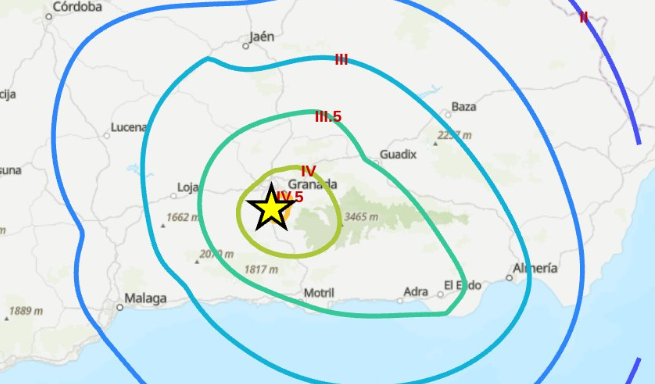
According to early estimates, the quake registered 4.6 on the Richter scale, with its epicentre located in Alhendin, around 8km south-west of Granada.
The tremor was felt widely across Andalucia, with hundreds of reports lodged as far away as 110km from Granada, including on the Costa del Sol.
“I am still shaking – I have guitars pinned to my wall and I could see them swinging,” a local resident told the Olive Press.
“My sofa moved a couple of inches, the coffee table too. I would say it lasted 7-8 seconds, we’re now experiencing aftershocks but they are weak.”
Another resident said: “This one was insane. What a massive shake I just felt – everything trembled.”
Videos shared on social media show extensive damage to vehicles, fallen trees and debris strewn across the city’s streets.
READ MORE: Panic in Granada as magnitude-5 earthquake shakes city, damages homes and sends residents fleeing
Due to the earthquake and a number of strong aftershocks, the Granada Metro has reduced its speed to a maximum of 30km/h, causing slight delays across the network.
The latest tremor comes just three days after a magnitude-5 tremor – later downgraded to 4.8 by the IGN – struck shortly after 1am on Saturday morning.
More than 200 calls were made to emergency services, with the rumble felt across much of Andalucia and as far away as Madrid.
No injuries were reported, although falling debris damaged cars and buildings and several people had to be rescued from lifts.
The quake was followed by a number of aftershocks, prompting some residents to spend their night on the street amid fears that further quakes could follow.
The Granada Basin is one of the most seismically active areas in Spain, with frequent shallow earthquakes of low to moderate magnitude.
The tremors are caused by southern Spain’s proximity to the boundary between the Eurasian and African tectonic plates, which are converging at a rate of around 5mm a year.
Click here to read more Spain News from The Olive Press.