

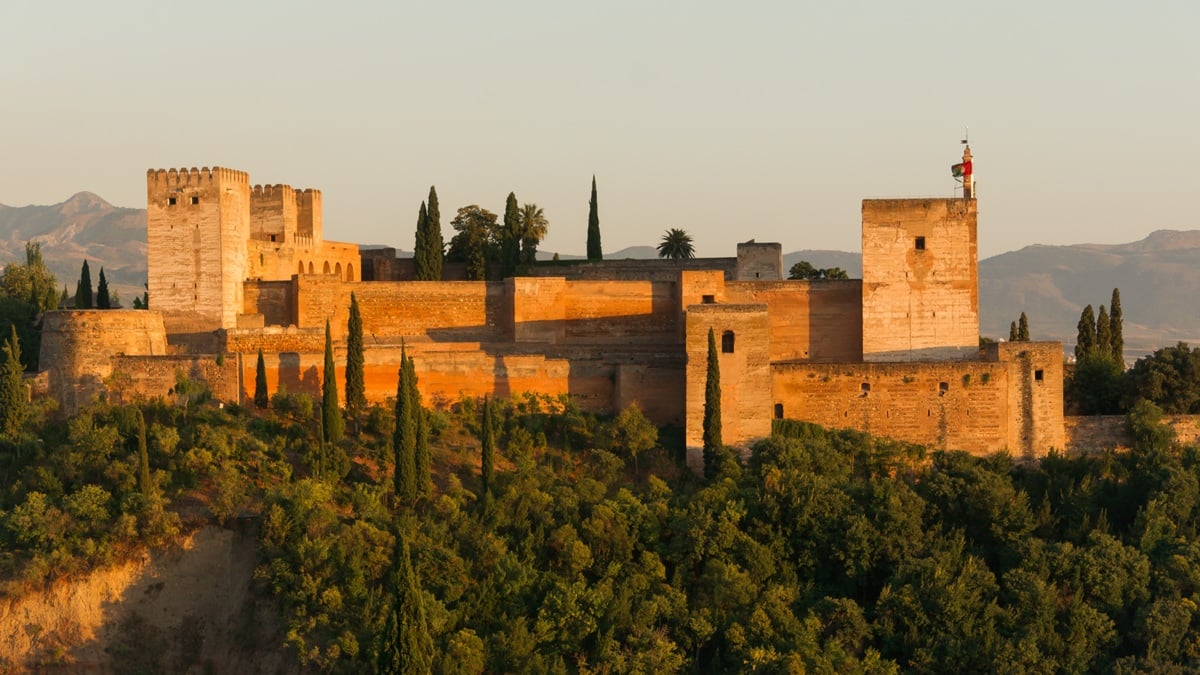
THE world-renowned Alhambra palace has suffered minor damage following a string of earthquakes in Granada, it has emerged.
Local authorities have cordoned off areas of the Alcazaba, the castle’s landmark fortress, after detecting ‘anomalies’ in some of its battlements, according to Spanish media reports.
Experts said the closures were simply a precaution to protect visitors and staff from any potential falling debris, adding that they had detected no significant structural damage.
Staff are now inspecting the affected areas, which include the Alhambra’s historic defensive towers of Torre del Homenaje and Torre Quebrada, looking for cracks or other damage across the sprawling complex.
It comes after Granada was rocked by a series of powerful earthquakes in August, including two tremors measuring 4.8 magnitude.
One, on August 15, had its epicentre near the southern Granada town of Alhendin, while the other hit nearby Gojar on August 18.
The second quake forced the Alhambra to be temporarily evacuated as teams carried out emergency safety checks.
The monument had already been inspected following the earlier tremor, with experts finding no significant structural damage.
However, some decorative elements were affected, including pieces of plasterwork in the Throne Room.
The Alhambra, a protected UNESCO World Heritage Site since 1984, is Andalucia’s most visited landmark and one of Spain’s biggest tourist attractions.
It drew more than 2.7 million visitors in 2025, according to the Andalucian regional government, a figure surpassed only by Barcelona’s Sagrada Familia, which attracted 4.8 million people in the same year.
READ MORE: Granada earthquake: Residents tell of terror as second powerful quake rocks city in four days
The palace sits on a hill overlooking Granada and was first built as a military fortress by Muslim rulers in the 9th century.
Much of the Alhambra as visitors know it today was developed from the 13th century onwards, after the Nasrid dynasty, a Muslim ruling dynasty, established the Kingdom of Granada.
The Nasrids ruled Granada for more than 250 years, turning the fortress into a spectacular royal palace and citadel with ornate courtyards, fountains, gardens and richly decorated halls.
Among its most famous features are the Palace of the Lions, the Court of the Myrtles and the intricate geometric designs and Arabic inscriptions found throughout the complex.
The Alhambra remained under Muslim rule until 1492, when Granada was conquered by the Catholic Monarchs Ferdinand II of Aragon and Isabella I of Castile.
It was later used by Spanish monarchs, fell into periods of neglect and underwent extensive restoration.
Today, it is considered one of the finest surviving examples of Islamic architecture in Europe.
Click here to read more Granada News from The Olive Press.