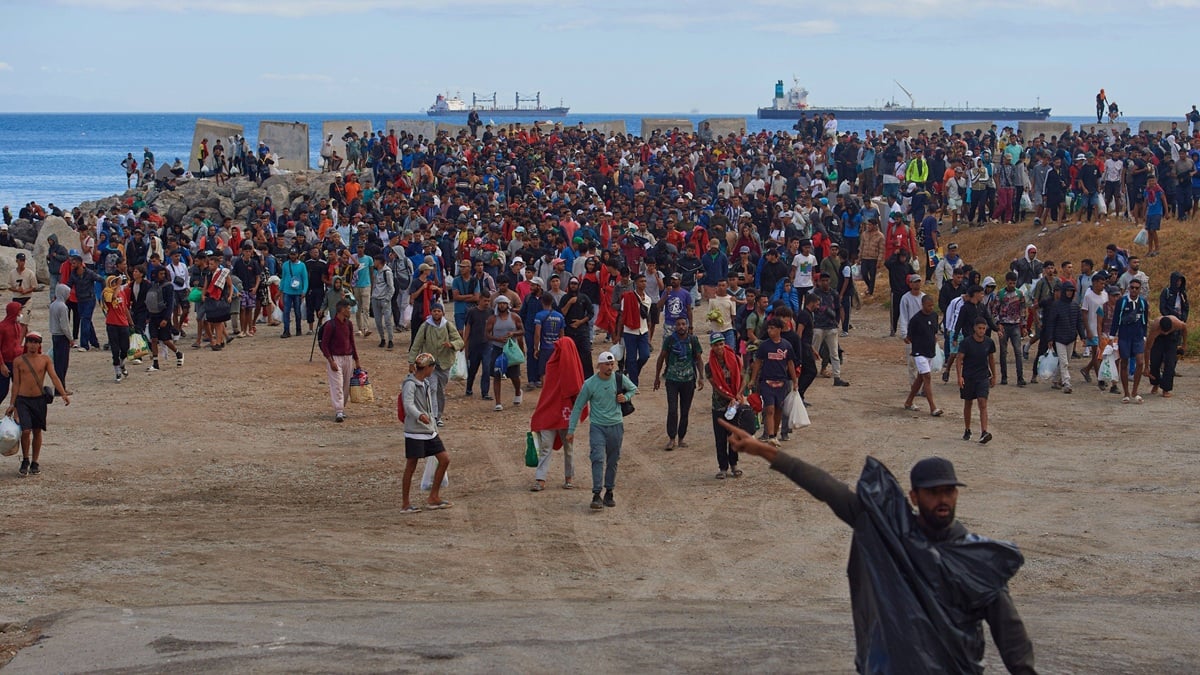
MOROCCO has denied any involvement in the influx of 70,000 migrants into Ceuta this summer, saying it refuses to be used as a ‘scapegoat for settling political scores.’
In a statement released on Thursday, Rabat’s ministry of foreign affairs insisted there was no evidence to prove ‘any involvement of the Moroccan authorities’, adding that it would launch its own investigation into the mass crossing.
“The Kingdom of Morocco refuses to be a political pawn ahead of the elections. It also does not accept being a scapegoat for settling political scores,” the statement read.
It added: “Why continue to make accusations against Morocco, in the absence of any data, facts or reports that prove any involvement of the Moroccan authorities?”
The statement marked the first time Morocco responded publicly to accusations it had orchestrated or been complicit in the massive migrant influx into the Spanish North African exclave on July 30 and 31.
A leaked Spanish police report had previously claimed Moroccan officers were seen directing migrants into Ceuta during the crossing, sparking a political firestorm within the Spanish government.
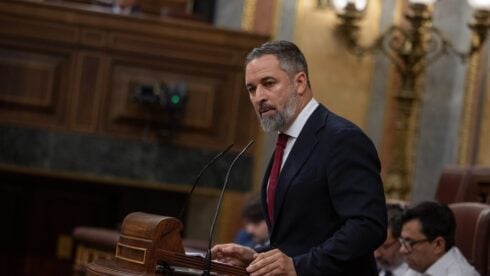
Spain’s left-wing prime minister, Pedro Sanchez, publicly cleared Morocco of any responsibility for the surge – while the right-wing opposition called on him to resign over his handling of the crisis.
On Wednesday, the government released a trove of 40 intelligence reports produced in the run-up to the mass crossing, in a bid by Sanchez to quell the political turmoil.
The documents show Spanish spies had warned the government of the imminent surge just one day before it happened.
On July 29, Spain’s National Intelligence Center (CNI) alerted the Spanish government’s delegation in Ceuta to calls on social media ‘for an assault on the fence and by sea tomorrow at 8pm’.
“There are two different [social media] groups with a total of 180,000 followers,” the declassified message read, “just to give you an idea of its scale.”
On the same day, the CNI also warned Moroccan intelligence agencies of plans for migrants to enter Ceuta by climbing the border fence or swimming around it.
Another declassified CNI document, issued at around 12pm on July 30, stated it was “highly likely that the Moroccan authorities are not actively encouraging the migratory wave, but have so far acted in a negligent and passive manner”.
The document added: “At the operational level, no proactive response from Moroccan authorities was observed regarding the loss of control over the situation, beyond the deployment of a few riot control units.”
Commenting on the declassified documents, Sanchez wrote on X on Wednesday: “The existence of this campaign was known to other institutions and was being monitored, but in no way did it constitute or could it be interpreted as an indicator of the scale, nature, or probability of what happened afterward.”
More than 100 people died attempting the crossing in late July, according to NGOs and Guardia Civil reports.
Around 5,000 migrants, including some 1,200 children, currently remain in Ceuta as the government processes their cases to determine who should be repatriated and who should be granted asylum.
Many of them are sleeping rough in Ceuta’s streets or camping on beaches, with their presence stoking security concerns among the population of the small enclave.
Waves of protests in solidarity with Ceuta swept through Spain last week as the city’s president-mayor, Juan Jesus Vivas, continued calling on the government for added support.
Madrid has already pledged more than €300 million in aid to the enclave since the start of the crisis.
Click here to read more International Affairs News from The Olive Press.