
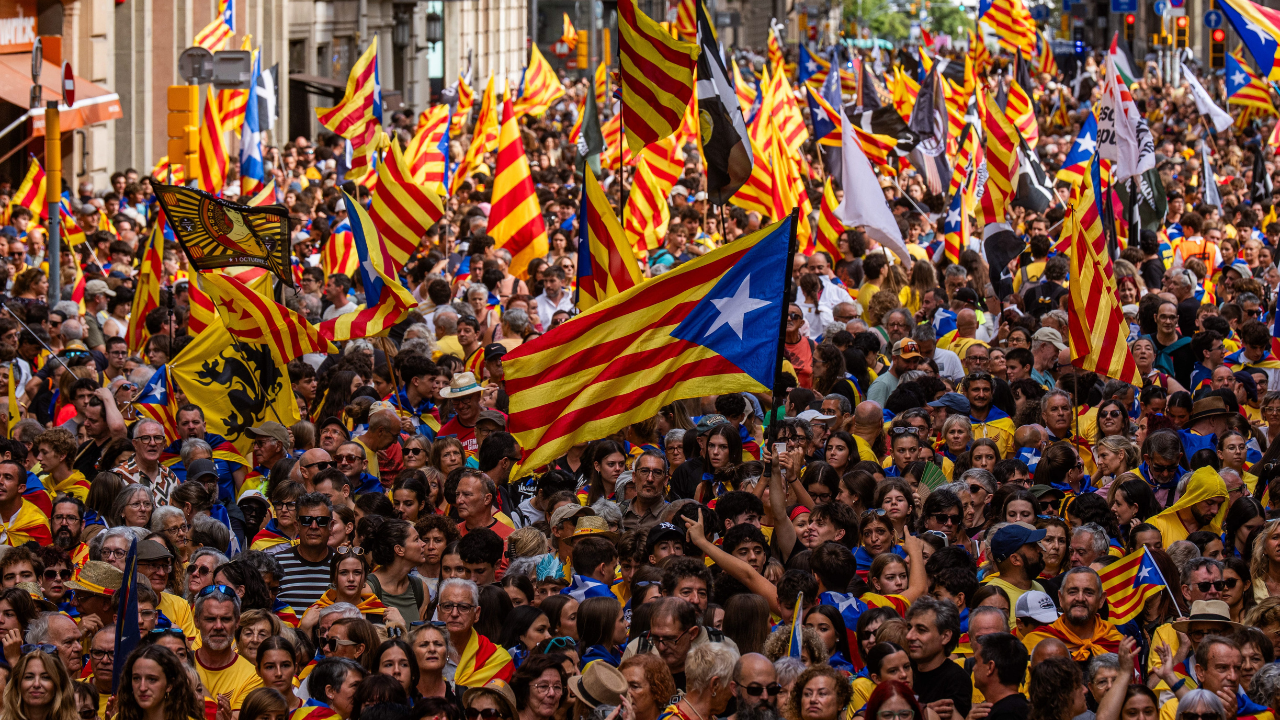
THOUSANDS took to the streets across Catalunya on Friday to celebrate the region’s national day, known as La Diada, with turnout rebounding from last year’s historic low amid growing divisions within the independence movement.
Around 45,000 pro-independence demonstrators marched in Barcelona, the region’s capital – a significant increase from roughly 28,000 in 2025 when torrential rain disrupted proceedings.
Separate smaller processions also took place in Girona and Amposta, consisting of roughly 11,000 and 6,000 participants respectively, according to organisers.
In Barcelona, two marches set off from opposite sides of the city and converged at Placa Catalunya, with the demonstration taking place under the slogan: “I am here. We are here. For the present and future. Independence.’
But the celebrations were overshadowed by clashes between rival political movements, with 18 people arrested – 10 of them minors – and nine Mossos d’Esquadra officers injured.
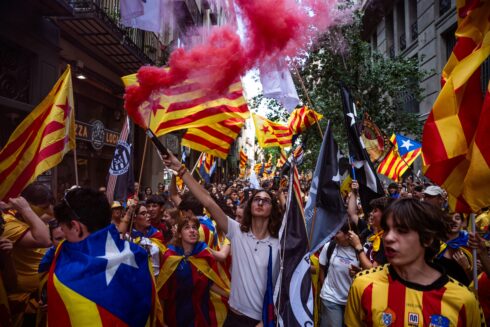
Near the Verdaguer monument, around 500 supporters of the neo-Nazi group Nucleo Nacional gathered under the slogan ‘Catalan identity is Hispanic identity’, while around 1,000 anti-fascist protesters assembled nearby.
Police formed lines between the two groups after protesters attempted to break through, with stones, bottles, fireworks and paint thrown towards officers.
The disorder later spread towards Passeig de Sant Joan and the Arc de Triomf, where rubbish containers and street furniture were set alight.
After the main independence march, anti-fascist activists headed towards Placa Catalunya where Silvia Orriols, leader of the far-right separatist party Alianca Catalana, was among those present.
Riot police formed another cordon around Orriols and prevented protesters from reaching her.
The tensions followed clashes in Barcelona on Thursday evening, when riot police charged at left-wing pro-independence protesters demonstrating against another Alianca Catalana rally.
La Diada marks the anniversary of the fall of Barcelona during the War of the Spanish Succession in 1714 and has come to symbolise the widely-held belief that Catalunya has been historically oppressed by the rest of Spain.
Between 2012 and 2019, La Diada celebrations were attended by over a million people each year amid growing calls for Catalan independence.
The movement culminated in the infamous 2017 referendum, which was declared illegal, and a unilateral declaration of independence spearheaded by then-regional president Carles Puigdemont, which led Mariano Rajoy, Spanish prime minister at the time, to dissolve the Catalan regional parliament.
After the Covid-19 pandemic, the Catalan independence movement became paralysed in crisis as voters grew increasingly frustrated with a decade-long process which has provoked political and economic instability.
The movement was also quelled by the rise of the socialist PSOE in Madrid, who adopted a more tolerant approach towards the Catalan question than the hardline stance taken by the conservative Partido Popular (PP).
This year’s national day took on added significance, coming 50 years after the first major public La Diada celebrations took place following the end of General Franco’s dictatorship.
It also came amid renewed political tensions with Spain over the non-implementation of the controversial amnesty law and a growing division within the pro-independence movement itself amid the rise of Alianca Catalana.
Click here to read more Spain News from The Olive Press.