
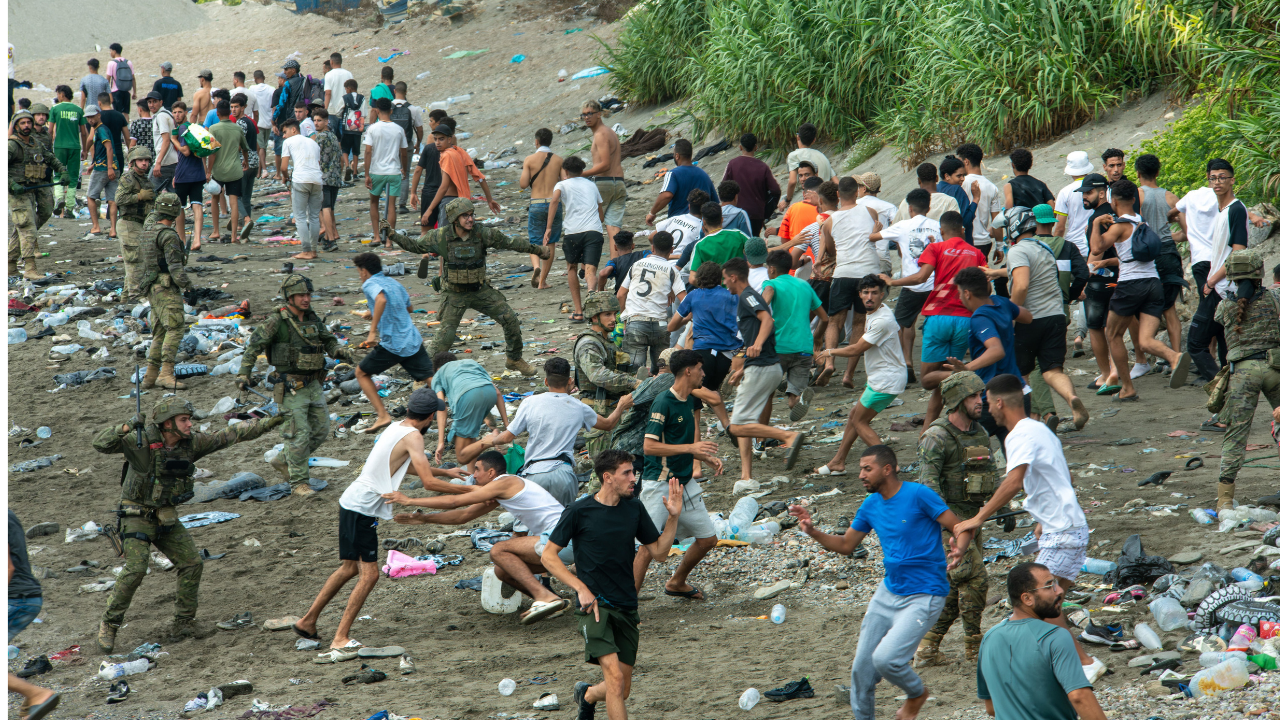
SPAIN’S intelligence services have cleared Morocco of orchestrating July’s unprecedented migrant surge into Ceuta – despite earlier claims that Rabat had deliberately stood back and let it happen.
In a report presented to the National Court, Spain’s official intelligence agency, the CNI, said that ‘to date, no evidence has been obtained’ that the mass crossing on July 30 and 31 was ‘instigated, planned or coordinated by the Moroccan authorities’.
The document instead blames a call on social media that reached ‘an extraordinary level of virality’ for inspiring more than 80,000 migrants to pour into the tiny north African enclave.
The CNI said it could not identify a ‘single organiser’ behind the call, nor any direct link to ‘the apparatus of the Moroccan state’.
It marks a shift from the picture painted in the days after the crisis erupted.
At the time, intelligence sources cited by El Pais said that while Rabat had not planned the surge, Moroccan authorities had gradually scaled back border surveillance throughout July and then exploited the ensuing chaos for political gain.
The CNI now draws a sharp distinction with May 2021, when around 10,000 Moroccans crossed into Ceuta in a ‘direct and deliberate state operation’ organised to pressure Madrid after Polisario Front leader Brahim Ghali was treated in a Spanish hospital.
This time, the main triggers may have been a Supreme Court ruling that migrants caught swimming into Ceuta or nearby Melilla could not be immediately sent back, along with the weather.
The agency did acknowledge that Moroccan authorities were aware of the mass calls circulating online – but said awareness was not the same as instigation.
It also found no ‘cooperation’ between social media agitators and individuals flagged by police at the border as possible Moroccan agents, with facial recognition and biometric data failing to match anyone up.
A separate report from the Guardia Civil backs the CNI’s conclusions, finding that Moroccan forces had shown a ‘willingness to contain’ the crowds, having intercepted nearly half of the 1,109 attempted swimming entries made in the 24 hours before the breach.
“It cannot therefore be concluded that the Moroccan authorities acted with an evident dereliction of duties,” it said.
READ MORE: Spain and Italy agree to end border checks after dispute over Ceuta migrant crisis
The Guardia Civil also criticised the CNI for its advance warning, saying intelligence shared on July 29 ‘cannot be considered’ a proper ‘early warning’ for what was to come.
That day, a CNI agent contacted a Guardia Civil officer by WhatsApp, saying: “I’m calling about the situation in Ceuta…We have information about an attempt to enter by swimming and to jump the fence tomorrow, the day of the Throne Festival.”
The warning said that ‘various Facebook and WhatsApp groups’ were ‘encouraging’ crossings.
But the Guardia Civil said ‘the logical level of communication should never have been handed at a tactical level, but at a much higher level’ – meaning political figures.
The mass morder breach was the largest single-day arrival of irregular migrants in European history, leading to hundreds of deaths.
The chaos also triggered a diplomatic dispute with Italy and intensified criticism of embattled prime minister Pedro Sanchez, with the situation in Ceuta continuing to take centre stage during the general election campaign.
The enclave’s own government told the National Court last month that it believes between 15,000 and 18,000 of those who entered the city are still there – far more than official figures suggest.
Click here to read more Spain News from The Olive Press.