

Disclaimer: The data for Europeans rely on tiny sub-samples and are intended as an illustrative snapshot rather than a statistically standalone poll.
FRESH of the back of Podemos leader Irene Montero telling them to go home, it may be safe to say that she will not be counting on the expat vote.
Instead, Spain’s eligible expat voters are leaning towards Pedro Sanchez and the Spanish left ahead of Sunday’s general election, according to an Olive Press analysis of raw polling microdata.
While British, German, French and Swiss-born citizens favour the Socialist Workers’ Party (PSOE), naturalised voters from the Netherlands, Belgium and Portugal break sharply to the right towards the Partido Popular (PP) and Vox.
The findings come from Spain’s state pollster, the Centre for Sociological Research (CIS), which surveyed 45,074 voters across 4,190 municipalities between October 7 and October 30.
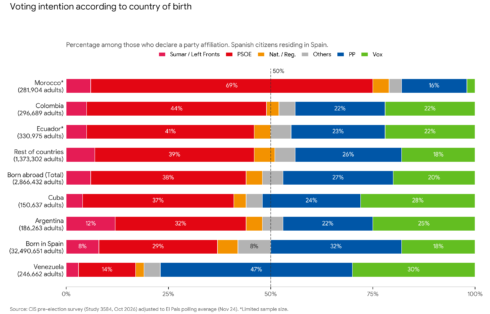
Only foreign-born residents who hold Spanish nationality are eligible to cast a ballot in Sunday’s parliamentary election, meaning non-naturalised British and EU residency-card holders remain locked out of the vote, despite being able to participate in local municipal polls.
Across the entire 45,074-person CIS sample, just 5.9% of respondents were born outside Spain — representing around 2.9 million naturalised adults nationwide, or roughly one in every 12 eligible electors.
Voters born across 28 European countries account for 17.8% of all foreign-born electors in the survey, amounting to just 518 people quizzed — just over 1% of the total respondents surveyed, admittedly a tiny data set.
The 413 respondents born in Western, Northern and Southern Europe — the core demographic of Spain’s traditional ‘expat’ communities — 51.0% of decided voters back the political left.
Prime Minister Sanchez’s PSOE leads the pack among decided Western European voters on 42.6%, alongside 4.9% for Sumar and Frente Amplio coalitions, and just 2.1% for Montero’s Podemos.
But despite the left-winger’s recent ‘anti-guiri’ diatribes, she still came out more popular among this cohort than regional left-wing alliances such as Compromis and Adelante Andalucia, who scored 1.4%.
By contrast, the right-wing bloc commands 39.3% of decided Western European voters, split between 21.9% for Alberto Nunez Feijoo’s PP, 17.1% for Santiago Abascal’s hard-right Vox.
A further 6.1% opt for smaller parties — including 2.8% for Alvise Perez’s anti-establishment Se Acabo La Fiesta (SALF) and 1.2% for animal rights party PACMA — while 3.7% back regionalist or pro-independence parties such as Esquerra Republicana de Catalunya (ERC), Galicia’s BNG and the Basque PNV.
Among the 32 UK-born Spanish citizens captured in the survey, the political left holds a more than two-to-one advantage over the right.
Of the 18 UK-born respondents who declared a specific party preference, nine back the left — eight for the PSOE and one for Podemos — compared to six for the right, with four for the PP and two for Vox, while the remaining three chose other parties (two for Galicia’s BNG and one for animal activists PACMA).
Notably, 43.8% of UK-born respondents (14 out of 32) said they were undecided, planned to cast a blank ballot, would abstain or refused to answer.
Across the Irish Sea, meanwhile, the CIS survey recorded zero respondents born in the Republic of Ireland out of 45,074 interviews nationwide, reflecting how few Irish citizens undergo Spain’s naturalisation process when they already enjoy EU free movement and municipal voting rights.
In sharp contrast to British voters, Dutch and Belgian-born citizens in Spain swing heavily to the right.
Among the 11 Dutch-born respondents interviewed, five back the right-wing bloc — four for the PP plus one for Vox — against four for the left, split between three for the PSOE and one for Valencian coalition Compromis-Front Valencia, while two remain undecided.
Among the 15 Belgian-born voters interviewed, six back the right-wing bloc — four for the PP and two for Vox.
This is against five for the left, split between four for the PSOE and one for Valencian coalition Compromis-Front Valencia, while two are undecided, one plans to cast a blank ballot and another refused to answer.
Nordic-born voters appear in tiny numbers across the CIS dataset — just seven raw respondents across Sweden, Finland and Denmark, and none from Norway or Iceland.
Of the two decided Swedish-born voters, one backed Catalan pro-independence party ERC and one chose Vox, while both Finnish respondents backed the PSOE and the sole decided Danish voter chose the PP.
Larger Western European communities in Spain mirror the left-leaning pattern seen among British-born electors.
German-born Spanish citizens (87) favour the left by 53.3% to 34.8%, with 44.7% backing the PSOE, compared to 18.0% for the PP and 16.8% for Vox.
French-born voters — the single largest European nationality in the survey with 144 respondents —break 50.4% for the left against 40.5% for the right.
Within the French-born cohort, the PSOE leads on 38.8%, followed by Vox on 22.2%, the PP on 18.4%, alongside a 90.2% turnout rate in the 2023 general election that virtually matched native-born Spaniards.
Swiss-born Spanish citizens (79) also lean heavily left at 56.4% — led by the PSOE on 53.0% — compared to 16.1% for PP and 11.8% Vox.
Further south, of the 15 Italian-born respondents, seven back the left — six for the PSOE and one for Sumar — against three for the right (two for the PP and one for Vox).
Mmong the 17 Portuguese-born citizens, eight back the left (six for the PSOE, one for Sumar and one for Podemos) and eight back the right (seven for the PP and one for Vox), with one undecided.
In the CIS data, 89.1% of Swiss-born respondents, 83.5% of Dutch-born, 78.1% of German-born, 71.9% of UK-born and 61.5% of French-born voters held Spanish nationality from birth.
Click here to read more Politics News from The Olive Press.