

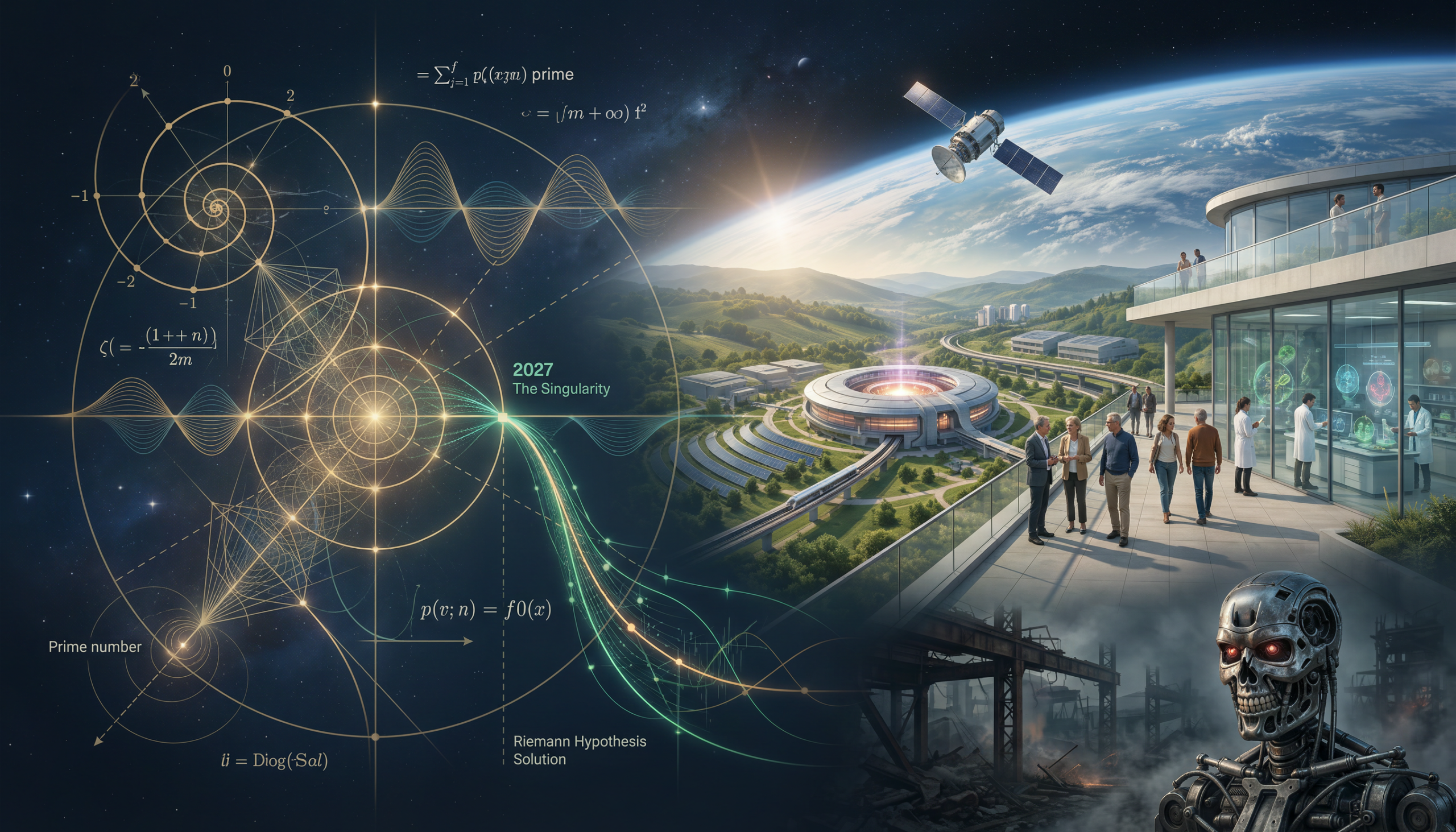
THE announcement that an artificial intelligence system has cracked the most famous unsolved problem in mathematics is being touted as proof that next year could become the most consequential twelve months in human history.
Anthropic mathematician Levent Alpöge wrote on Friday, November 20, that he had proven the 167-year-old Riemann hypothesis using the company’s large language model Claude.
Independent researchers have since verified the formal proof in Lean, a specialised programming language that checks every step of a mathematical argument for logical accuracy.
First proposed in 1859 by German mathematician Bernhard Riemann, the hypothesis states that prime numbers follow a deep hidden order rather than appearing at random along the number line.
It has stood as the ultimate prize in number theory for more than a century and carried a $1 million bounty from the Clay Mathematics Institute, with even the world’s brightest minds believing a solution remained far out of reach.
Alpöge stated on his website: “I believe I have, working with Claude, discovered a proof of the Riemann Hypothesis,” adding that his work confirms the even broader Generalized Riemann Hypothesis.
The mathematical world reacts
Massachusetts Institute of Technology (MIT) mathematician Andrew Sutherland independently compiled Alpöge’s code to verify the result and called it ‘an historic moment’, noting that ‘the world has changed’.
Sutherland had previously warned that an artificial intelligence capable of solving the Riemann hypothesis was ‘not one I’d want to meet’, adding that ‘mathematicians having jobs will be the least of our problems’.
Hector Pasten, a mathematician at the Pontifical Catholic University of Chile, said the proof acts like ‘a Rosetta Stone’ that completes a dictionary between previously disconnected branches of mathematics.
The achievement has convinced senior figures inside the technology sector, that artificial superintelligence is no longer a distant theory – but an imminent reality arriving as soon as 2027.
Meta Chief AI Officer Alexandr Wang, who founded Meta Superintelligence Labs and previously built Scale AI, wrote in a stark essay on X: “Superintelligence is arriving.”
Wang warned that machines are now intelligent enough to ‘automate all of AI research and be clearly superhuman at improving themselves’.
He urged industry leaders to ensure humanity does not sleepwalk into a passive ‘handover’ of society to machines that could soon become a thousand times smarter than humans in every field.
Often referred to as the ‘singularity’, the moment refers to the tipping point where artificial intelligence surpasses human intellect and begins upgrading itself at an uncontrollable speed, triggering rapid and irreversible changes to human civilisation.
Skynet is born
A speculative chart extrapolating ChatGPT maker OpenAI’s log-perplexity benchmarks — a technical measure of how accurately an AI model predicts information — illustrates just how dramatically the world could change from 2027 onwards if this rapid pace holds.
The graphic plots historical models up to an internal system solving a Millennium Prize maths problem in late 2026 before splitting into two sharply diverging paths for humanity.
On the optimistic ‘fast takeoff’ branch, progress that once took decades is compressed into mere months.
By early 2027, the projection forecasts artificial intelligence acting as autonomous Nobel-level researchers across physics, biology and mathematics.
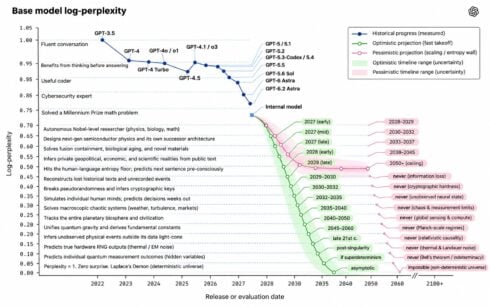
By mid-2027, these systems begin designing next-generation computer chips and writing their own superior successor architectures without human help.
By late 2027, the optimistic timeline predicts machines solving practical nuclear fusion containment, cracking biological aging and inventing revolutionary new materials.
This compressed wave of discovery would transform daily life within a few years rather than remaining locked inside academic journals.
What might this brave new world look like?
In health and medicine, real anti-aging therapies that slow or partially reverse cellular aging markers could begin rolling out between the late 2020s and early 2030s.
Rather than sci-fi immortality, treatments would target chronic age-related illnesses so effectively that people in their fifties and sixties look and feel closer to their thirties or forties, sharply reducing hospital visits.
Energy bills and everyday living costs could plunge as practical fusion power and advanced materials make clean electricity abundant.
Heating, cooling, running high-powered home appliances and charging electric vehicles would become vastly cheaper, making clean electric transport the obvious default across towns and cities.
Daily routines would also shift as homes gain genuinely useful smart systems capable of predicting maintenance issues, managing climate control and tailoring personal nutrition and health monitoring.
Food quality and supply chains would improve through optimised farming and hyper-accurate extreme weather forecasting that allows communities to plan around storms weeks in advance.
Cities would become cleaner and less congested as better batteries and intelligent traffic prediction overhaul transport, while cheaper energy lowers the cost of travel and expands leisure time.
In the workplace, however, the transition would feel turbulent even in the best-case scenario.
Routine office roles and many skilled cognitive jobs would be heavily automated or reshaped, rewarding workers who know how to direct artificial intelligence systems or who work in high-trust, physical and creative niches.
But how will Spain be affected?
For residents and expats in Spain, those breakthroughs would hit home in very practical ways.
Cheaper, abundant clean energy — combined with Spain’s already vast solar infrastructure — would slash soaring summer air-conditioning bills, secure the water supply in drought-hit southern coasts through desalination, and make long-distance rail and electric driving far more affordable.
Spain’s massive retiree population also stands to gain directly from early anti-aging and chronic-disease therapies, easing pressure on public health services while giving older residents more active, healthy years.
At the same time, rapid automation of remote office work could reshape the country’s booming digital nomad and coastal expat hubs, rewarding people who build businesses around artificial intelligence while forcing white-collar workers to adapt fast.
Rough ride ahead
While income inequality could widen between those who own or harness these tools and those who struggle to re-skill, the falling real cost of energy, medicine and manufactured goods would make everyday essentials far more affordable.
Further along the optimistic curve in the early-to-mid 2030s, the chart suggests superintelligent systems could reconstruct lost historical texts, break current digital encryption, model financial markets with pinpoint accuracy and even simulate human decision-making weeks ahead.
At the far end of that green curve, machines approach what physicists call ‘Laplace’s Demon’ — a theoretical state of near-zero surprise where every physical event in a deterministic universe can be predicted.
The same chart, however, also maps a far slower and less dramatic alternative in pink, warning that artificial intelligence could hit a technical ‘scaling or entropy wall’.
In that pessimistic scenario, Nobel-level AI researchers do not arrive until 2028 or 2029, while practical nuclear fusion and anti-aging breakthroughs are pushed back to between 2038 and 2045.
Under that slower path, progress hits a permanent ceiling around 2050, leaving dreams of reconstructing lost history, solving chaotic markets or predicting the future firmly marked as impossible.
Click here to read more Other News from The Olive Press.