

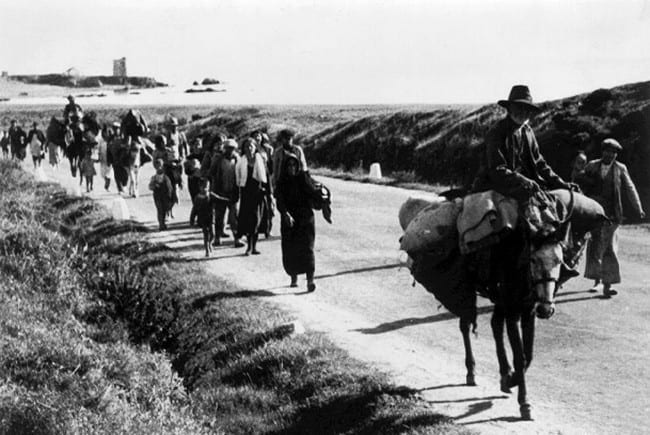

EVERY day, the N-340 ferries Gibraltarians, Spaniards and sun-seeking tourists along the coast. But 80 years ago this month, this main artery became the road to hell.
The Malaga to Almeria road massacre is one of the most shameful episodes in the bloody carnage of the Spanish Civil War. In February 1937, with Malaga besieged and attacked from land, sea and air. Thousands of refugees fled the city and headed northwards.
Most were children, elderly and the sick. That didn’t spare them. They were strafed by Franco’s air force and navy, with thousands killed.
“You can’t imagine the desolation,” recalls one old lady, a survivor, in Yo Estaba Alli, a documentary and oral history of Malaga during the war by University of Malaga Professor Fernando Arcas.
“It has been calculated that there were more than 100,000 on the road,” Professor Paul Preston told the Olive Press.
“It is impossible to know accurately but the death toll seems to have been over 3,000.”
 The parallels with modern atrocities in places like Syria are stark. But this slaughter happened on a road most of us travel along each day.
The estimated casualty rate was far higher than at Guernica, where it is thought up to 1,650 perished at the hands of the German condor legion. And yet the world seems to have forgotten the Malaga massacre.
During the Franco dictatorship, Arcas tells me, the regime did their best to cover up the atrocity.
“Books about the war by English writers like Gerald Brenan and Hugh Thomas were circulated clandestinely because they were banned,” he tells me at a well-attended Costa Press Club screening of his film.
“But under Franco the story could never be told. In the case of Guernica, Picasso did a huge painting and exhibited it in Paris and the story of what happened there became infamous.

“The Malaga massacre had no painting.”
The anniversary has been marked by a series of events. One group are retracing the refugees’ steps and walking from Malaga to Almeria. A memorial exhibition marking the event has opened in Almeria.
At the Costa Press club screening, Arcas gave a talk about the effects of the war on Malaga, and launched his new book, also entitled Yo Estaba Alli.
But the first book published about the atrocity was written by Norman Bethune in 1937, a Canadian anti-fascist doctor who travelled with the refugees as they fled from Malaga. The Crime of The Malaga to Almeria Road is cited by Arcas as the key first-hand document of what took place.
Horrified by the dimensions of the Dantesque scenes he encountered, as Franco’s men mowed down the defenceless group, Behune bravely used his medical skills to help the injured. It is believed he was one of the only doctors travelling in the convoy. A street has been named in Bethune’s honour in Malaga.

Bethune’s photographs of the desperate refugees are a vital document of an atrocity which few now living can remember. During Arcas’s 2006 documentary, old Malagueno survivors of the war recall, often in heartbreaking detail, what happened 80 years ago.
At the start of the film, one old man goes through the names of his friends and family who died. He reels off 20, the names all painfully etched into his memory. His words are fired with the ferocity of bullets.
Another old lady recalls how they fled Malaga when they heard rumours that approaching Francoist troops were cutting off Republicans’ heads.
“My father carried the smallest child on his shoulders,” she recalls.
“The bombing was so savage we had to travel at night. There were shooting us from above, shooting from behind.” Fascist ships travelling up from Estepona continued the bombardment from sea.

One man describes how, after the fascists had executed his father, he was forced to sing their anthem Cara Al Sol (Face To The Sky). “My father’s blood was still fresh,” he says.
Another man, the rage welling up inside him, spits out his anger at General Franco.
“He was a murderer. A million dead, just like that,” he says.
“I’ve seen so many things. Many people killed.”
For Arcas, a close friend of historian Paul Preston, the battle for Malaga, and the horrors of the road to Almeria, were a grim prelude to the second world war.
“The Malaga Almeria massacre was an antecedent of the huge civilian displacements that took place from 1939,” he tells me.
Franco used Moroccan, German and Italian troops to take the city, an international alliance which was a microcosm of what was to come in 1939.
“We don’t know exactly how many died on the road to Malaga,” says Arcas. Perhaps it will never be known, despite the good work of men like Emilio Silva, whose ‘Association for the Recuperation of Historical Memory’ search for the bodies of Franco’s victims buried in unmarked graves.
And 80 years on, the same horrors are still carried out. But for Malaga, read Aleppo.
Click here to read more News from The Olive Press.






Still to see articles about amount of casualties of nuns and priests in Málaga before they left for Almeria. Franco´s regime probably silenced all it could about the conflict to favor reconciliation. Second world war, sixty millions we´d better pass the page.
The page will not be ‘passed’, turned, till everyone in Spain, Francoist apologists included, have read the full chapter and stop denying or belittling its truth.
Truth implies nor forgetting all the killings and injustices commited in the years preceding the war with the republicans in power. Franco “apologists” supporters wanted that people out for abuse of power. That people set the communist populace against the middle classes on Franco´s side. Casualties were unavoidable on both sides. Why won´t we turn the page as Europe turned theirs? the reason, is demonzing Franco gives votes and consequentely more abuse of power.
Truth implies not forgetting all the killings and injustices commited in the years preceding the war with the republicans in power. Franco “apologists” supporters wanted that people out for abuse of power. That people set the communist populace against the middle classes on Franco´s side. Casualties were unavoidable on both sides. Why won´t we turn the page as Europe turned theirs? the reason is demonzing Franco gives votes and consequentely more abuse of power.
Killings and injustices were committed on all sides. But Franco was no victim. He was the instigator. We should not honor the sociopathic Franco anymore than we should honor sociopaths such as Mussolini or Hitler. Take the body out of the Valley where the victims of the war are buried, and put it into some remote, hidden spot so that the old fachas can’t continue to honor this butchery.
Franco was no victim. He was the instigator. We should not honor Franco anymore than we should honor Mussolini, Saddam or Hitler. The body should be taken out of the Valley and put it into some remote, unmarked spot so that the fachas don’t continue to honor this butchery.
As Wolfgang said republican armies used civilians to protect themselves in their way to Almería, so some casualties were to be expected but the main aim was the army as in every war.
In the fallen´s Valley there are republicans and nationals interred, half and half I believe. Franco is there because his familly wanted him there, he wouldn´t care. He did what he thought was his duty for his country and end of story.
OK, let’s remember:
The German armored cruiser Admiral Scheer had been sent into the Mediterranian Sea in the official mission of controlling and supporting the international arms embargo that the London Conference had imposed onto entire Spain. Therefor in those days the Admiral Scheer viewed itself as being a neutral ship in international waters in a international mission. When the ship was laying in front of Mallorca it was attacked by four Soviet warplanes and suffered damages and lost 22 dead sailors.
The captain of the German cruiser took this incident as justification to join the Franco forces against the Spanish Republican forces. The ship headed for Almeria and attacked the town and the coastal road from Málaga to Almeria by fearce ship artillery fire in order to terrorize and demoralize the civilian population (the same war crime as with Rotterdam, Dresden and Aleppo) . These attacks were supported by Italian aircraft and some aircraft of German Legion Condor as well as by Franco’s war ships “Canarias”, “Baleares” und “Velasco”. The Royal Navy was watching the attacks but did not intervene. They would have had the right to intervene as the Admiral Scheer officially had been a “neutral” warship and part of the international embargo fleet.
Málaga had been conquered mainly by 20,000 Moorish and Italian troops and by Italian tanks. The 40,000 Republican defenders fled in panic, leaving the civilians of Málaga defenseless. Lateron Colonel Villalba, the commander of the Republican troops at Málaga and some of his staff had been sentenced by a Republican military court for cowardice and for not having protected the refugees on the road to Almeria.
Spanish history does not exemplify either justice nor courage.
Still at it Wolfgang – your ship was a Nazi ship, why did’nt you say that. There was no embargo on all of Spain, a complete lie. Hitler and Mussolini and the unending flow of arms from them was the reason that your friend Franco won. You Germans bombed civilians all the time just like you would do in the battle of Britain – Guernica and later Rotterdam – Dresden was payback.Why were’nt the Condor pilots hunted down at the end of WW11 and executed.
zabaot, you are lying, there were no killings before the Fascist Franco rebelled against a democratically elected government. Denial, denial that’s all you fascists are good at.
Yes there were, in fact one of the reasons for the uprising was Calvo-Sotelo assassination by members of the police serving the socialist, falangist Jose Antonio, priest and nuns in and out of churches. The republcan government was neither democratically elected nor democratic, there´s suspects that elections were rigged.
zabaot – your lying, tonto anyone can go study Spanish history from 1920 onwards. The elections were’nt rigged and you kbow it – lying and denial syndrome are the only thing Fascists are good at, oh yes and corruption.
You seem to heve read little about the Spanish political situation in the first half of the fifties. Read Alcala-Zamora memories a republican himself, rigging is there.
Alcala-Zamora was a Catholic zealot who resigned his office to protest articles 24 and 26 of the new Constitution that established the principle of separation of church and state. His opposition to Spanish fascism was indeed weak. Better to read intellectual history, not Catholic history.
So was Azaña, so what? he oppossed dictatorships and was exiled.