

NATIONAL identity (ID) cards are central to everyday identification worldwide. From accessing banking services to crossing borders, they are as essential as driver’s licenses. But just like passports, these cards cannot remain static forever. Eventually, a renewal of identity card documents or an ID card update becomes necessary—whether for security reasons, compliance with new standards, or the launch of an updated ID card series.
The result? A diverse mix of ID cards from various generations circulating simultaneously. For identity verification providers, this makes it crucial to adapt to different formats and designs. Below, we explore the major drivers behind ID card renewal and updating ID cards, supported by real-world examples.
Security enhancement
One of the main reasons behind any identity card renewal is improving document security. Criminals constantly attempt to counterfeit IDs, so governments strengthen protective features with every new issue.
Take Germany, for example. The country moved from laminated paper IDs to polycarbonate cards with RFID chips, holograms, and barcodes that store additional biometric information. Bulgaria followed a similar path, issuing biometric IDs in 2024 that include fingerprints and facial data.
Even small changes, like adding a QR code on Austria’s updated ID card, significantly improve anti-fraud measures. In El Salvador, the 2022 renewal of identity card series introduced an impressive 37 security features, including a multiple laser image (MLI) with the holder’s birthdate and portrait.
Every update to an ID card strengthens its resistance to forgery, ensuring that identity verification remains reliable both offline and online.
Compliance with standards
Another driver of ID card updates is compliance with regional and international rules. For instance, ICAO Doc 9303 sets global requirements for machine-readable identity documents.
West African nations under ECOWAS updated ID cards to a standardized biometric version that doubles as a travel document. Similarly, EU countries such as Croatia, the Netherlands, and France modernized their cards to include the EU emblem and enhanced features.

Turkey provides a strong example of compliance-driven modernization. In 2016, the country replaced its older, gender-colored laminated IDs with ICAO-compliant biometric cards. Although many citizens still use their previous documents, the new version aligns with global standards and improves cross-border recognition.
A format upgrade
The evolution of ID cards follows a clear path: handwritten ? printed ? machine-readable ? biometric ? digital. Updating ID cards is essential to keep pace with this progression.
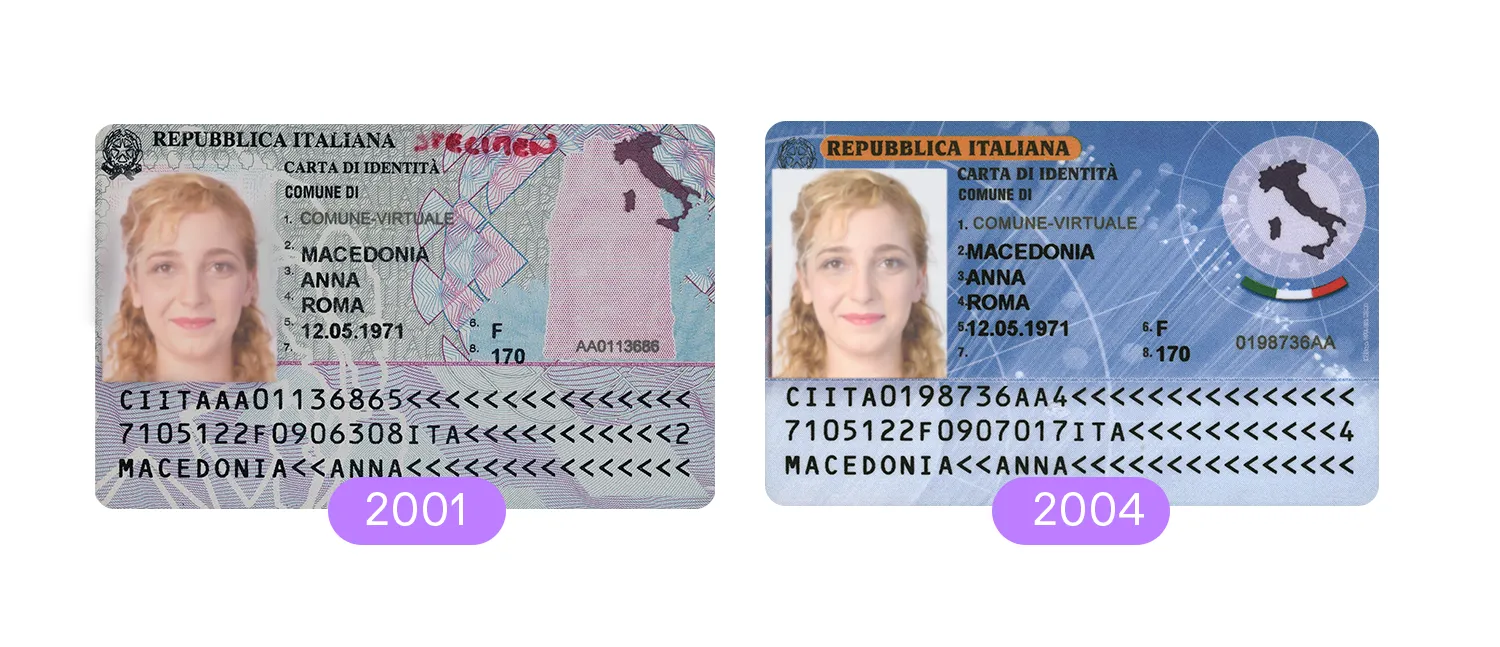
Italy’s journey illustrates this perfectly. Starting with paper IDs in 1994, the country transitioned to biometric smart cards in 2022. Each update introduced features such as holograms, MRZ codes, and barcodes.


Greece took a more radical step, leaping from non-standard printed IDs directly to polycarbonate biometric cards in 2023. Meanwhile, Saudi Arabia is at the cutting edge, issuing millions of fully digital IDs accessible via a government mobile app.
Updating ID cards in line with technological progress ensures that verification processes remain both fast and secure.
Identity card model harmonization
Harmonization often drives governments to update ID cards alongside passports. Chile and Finland have both pursued this strategy, making their driver’s license or ID card and passport designs consistent for easy recognition by inspectors.
In Chile’s 2024 renewal, both ID and passport adopted national motifs like the huemul deer and Andean mountains. Finland did the same in 2017 and 2023, ensuring both identity documents matched in style and security features.

However, harmonization doesn’t always mean identical designs. Paraguay’s latest ID card update differs from its passport but won recognition for incorporating cultural motifs while modernizing its security.
New ID series launch
The launch of a completely new ID card series is a milestone that often requires citizens to renew their ID cards. Such projects usually coincide with broader modernization efforts.
France, for instance, issued its first new ID in nearly three decades in 2021. It added an EU emblem, enhanced durability with a polycarbonate base, and kept the laminated top layer for tradition.
These large-scale projects mean that multiple generations of cards remain valid at once. For example, Turkey’s old IDs still circulate, and Greece will allow its previous series to remain valid until 2026 despite its brand-new biometric launch.
For citizens, that means keeping track of renewal notices, ensuring they have the right documents when traveling, and preparing supporting paperwork like a birth certificate or social security number when completing an ID card renewal.
Conclusion
ID card updates are not just bureaucratic processes—they are crucial steps in keeping identity systems secure, standardized, and technologically current. Whether it’s a renewal of identity card documents for security enhancement, a compliance-driven update ID card project, or a new series launch, every change has significant implications for both citizens and verification providers.
For businesses, verifying IDs requires access to a global document template database that covers every version in circulation. Regula’s advanced ID verification solutions, powered by a comprehensive ID card library, help companies authenticate documents quickly and accurately—whether a customer is presenting an old laminated card or the latest biometric upgrade.
In short, keeping up with ID card updates worldwide ensures seamless verification, stronger security, and compliance with global standards.
Click here to read more Other News from The Olive Press.