

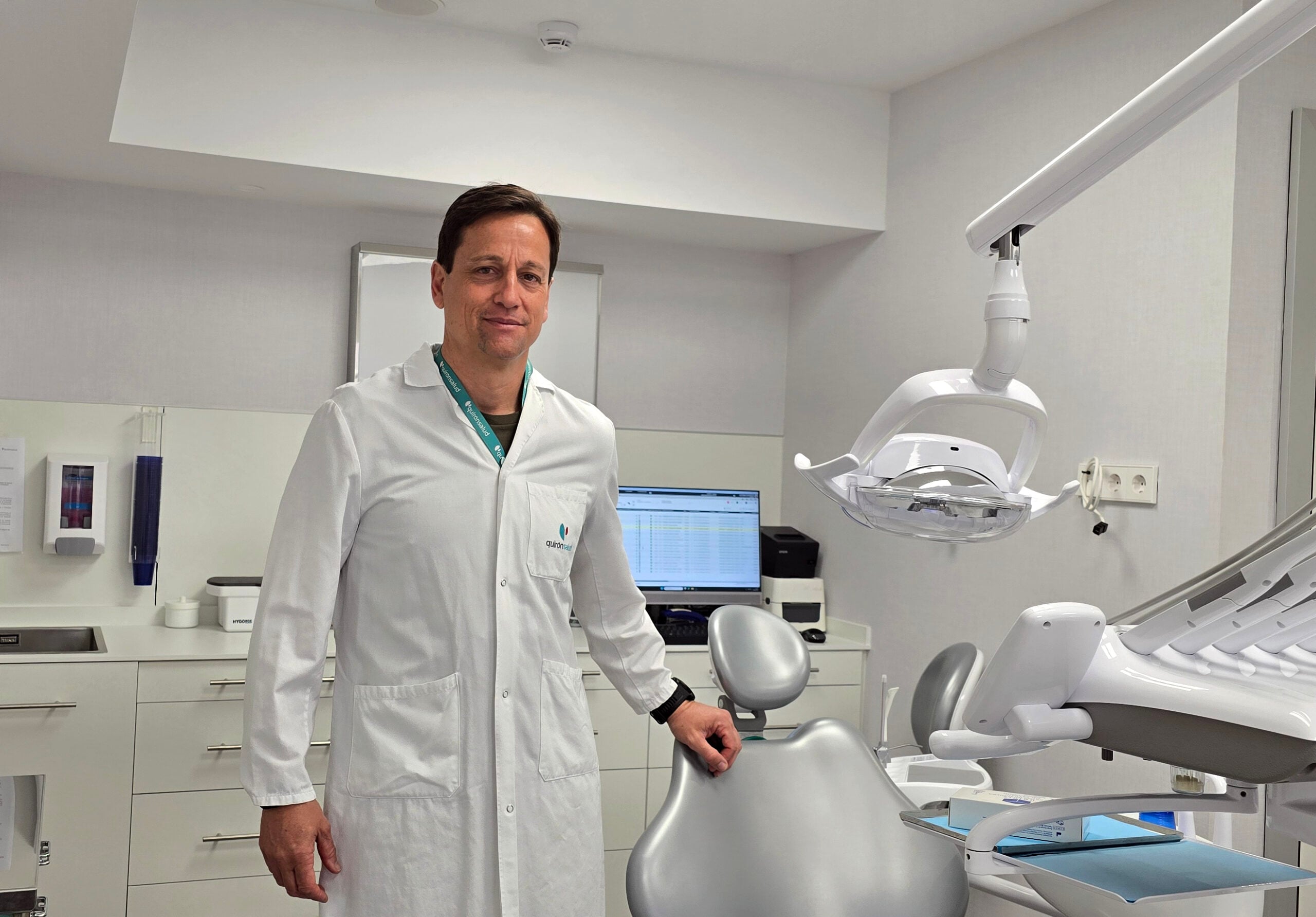
A STRING of Quironsalud hospitals in Andalucia have introduced a new technique to help anxious patients undergoing dental implant treatments.
State-of-the-art facilities in Quironsalud Marbella, Hospital Quironsalud Malaga, and Hospital Quironsalud Campo de Gibraltar are now offering intravenous, or IV, sedation to significantly improve the patient experience, particularly during lengthy procedures.
While the surgical technique remains completely unchanged, the deep relaxation induced by the sedation is a game-changer for those suffering from severe dental phobia.
The Head of the Maxillofacial Department, Dr Primitivo de la Quintana, explained that the new procedure responds to a rapidly growing need among the public.
“Many patients experience anxiety or intense fear of visiting the dentist, especially when facing long or complex procedures”, he said.
“Sedation allows us to provide a calmer, more comfortable experience”.
In standard dental operations, local anaesthesia is used to successfully alleviate pain, but the patient remains fully conscious and hyper-aware of their clinical surroundings.
For individuals with a deep-seated fear of the dentist or previous negative experiences, this acute awareness can lead to extremely high levels of psychological stress.
By contrast, IV sedation induces a state of profound relaxation that significantly reduces that anxiety, making it particularly beneficial when multiple implants are placed in a single session.
“Patients go through the procedure with a level of calm that is difficult to achieve with local anaesthesia alone”, the specialist noted. “Many tell us, I didn’t feel a thing”.
From a purely clinical standpoint, the medical procedure itself is exactly the same as before.
“The difference lies not in the surgery, but in how the patient experiences it, which directly impacts their well-being and their willingness to continue treatment”, added Dr de la Quintana.
To ensure maximum safety, the sedation is administered in a strict hospital setting with continuous monitoring under the expert supervision of an anaesthesiologist.
Dr de la Quintana pointed out that this approach provides significant reassurance for both the patient and the medical team, making it especially suitable for elderly patients or those with pre-existing medical conditions.
Following the implant procedure, patients are safely transferred to a recovery room and are typically discharged on the very same day.
They must be accompanied by a loved one when they leave and are strictly advised to rest for the following 24 hours.
The Quironsalud Group in Andalucia currently operates eight major hospitals located in Malaga, Marbella, Los Barrios in Cadiz, Cordoba, Huelva, and three in Seville, namely Sagrado Corazon, Infanta Luisa, and Materno-Infantil.
In addition, the network runs two dedicated surgical day hospitals in Seville and Malaga, alongside 22 speciality and diagnostic medical centres, cementing its position as the leading private hospital group in the region.
Quironsalud is the leading healthcare group in Spain and, together with its parent company Fresenius-Helios, is also one of the undisputed leaders across Europe.
Beyond the Spanish borders, the expansive group also successfully operates across Latin America.
Altogether, the company employs more than 50,000 professionals across over 180 healthcare facilities, which includes 57 hospitals equipped with more than 8,000 beds.
The group boasts advanced medical technology and a highly specialised team of internationally recognised medical professionals.
Its sprawling network includes renowned centres such as Fundacion Jimenez Diaz University Hospital, Teknon Medical Center, Ruber Internacional, Quironsalud Madrid University Hospital, Quironsalud Barcelona Hospital, Dexeus University Hospital, Policlinica Gipuzkoa, General de Catalunya University Hospital, and Quironsalud Sagrado Corazon Hospital.
Quironsalud is also deeply committed to education, with 11 of its hospitals being university-affiliated, and it places a heavy emphasis on medical and scientific research.
It operates the FJD Health Research Institute, a prestigious body officially accredited by Spain’s Ministry of Science and Innovation.
Healthcare services across the group are organised into cross-disciplinary units and networks that allow for the seamless sharing of expertise across different centres and the efficient clinical application of new research findings.
The group is currently leading numerous vital research projects throughout Spain and stands at the very forefront of medical specialties including oncology, cardiology, endocrinology, gynaecology, and neurology.
For more information, please visit https://www.quironsalud.com/marbella or call
+34 952 774 200
Click here to read more Sponsored News from The Olive Press.