

Have you been impacted by the air traffic control strike? If so, we’d like to hear your story. To get in touch, send an email to newsdesk@theolivepress.es
AIR traffic controllers in Spain have officially launched indefinite strike action, raising fears over widespread disruption.
The strike, called by the Air Traffic Controllers Union (USCA) and CCOO, targets control towers managed by Saerco.
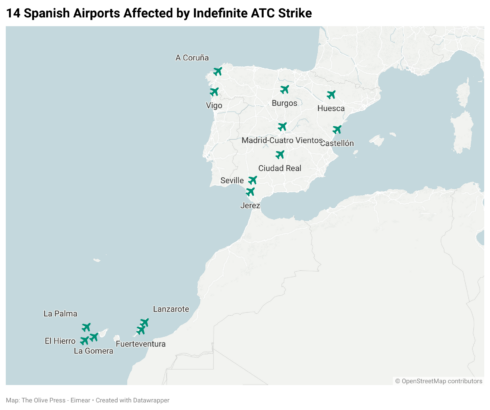
Some 14 airports across Spain are impacted, including Madrid-Cuatro Vientos, Lanzarote, Fuerteventura, La Palma, El Hierro, La Gomera, Castellón, Burgos, Huesca, Ciudad Real, Vigo, A Coruña, Jerez and Seville.
The walkout involves air traffic controllers responsible for managing aircraft movements, meaning it could impact how flights are coordinated in the air and on the ground.
READ MORE: Relief for holidaymakers as Spanish airport strikes are called off ahead of Easter getaway rush
The action began at midnight on April 17 and will continue indefinitely unless an agreement is reached.
Flights are expected to continue operating under minimum service rules, but delays and disruption are likely.
Passengers may experience knock-on effects including longer waiting times, rescheduling and congestion at affected airports.
Travellers should monitor their flight status regularly through their airline’s app or the official Aena website on the day of travel.
For journeys within mainland Spain, high-speed rail services such as the AVE offer a reliable alternative unaffected by aviation strikes.
READ MORE: Dual nationality? What you need to know about travelling to the UK from Spain under new ETA rules

Passengers with connecting flights are advised to allow a buffer of at least four to six hours to account for potential delays.
Unions say the strike is driven by staffing shortages, deteriorating working conditions and growing risks to aviation safety.
They argue the conflict reflects a long-standing structural problem caused by years of staff cuts, excessive workloads and poor planning.
According to union representatives, staffing levels have been reduced without adequately replacing departing workers.
They also point to cancelled holidays, last-minute shift changes and failures to respect mandatory rest periods.
Union leaders warn that aviation safety ‘cannot be sustained on a workforce subjected to fatigue, stress and permanent uncertainty’.
Efforts to resolve the dispute have so far failed, with unions claiming planned negotiations were repeatedly postponed or cancelled.
A request for mediation has been submitted to the Interconfederal Mediation and Arbitration Service (SIMA), but no agreement has been reached.
Click here to read more Spain News from The Olive Press.