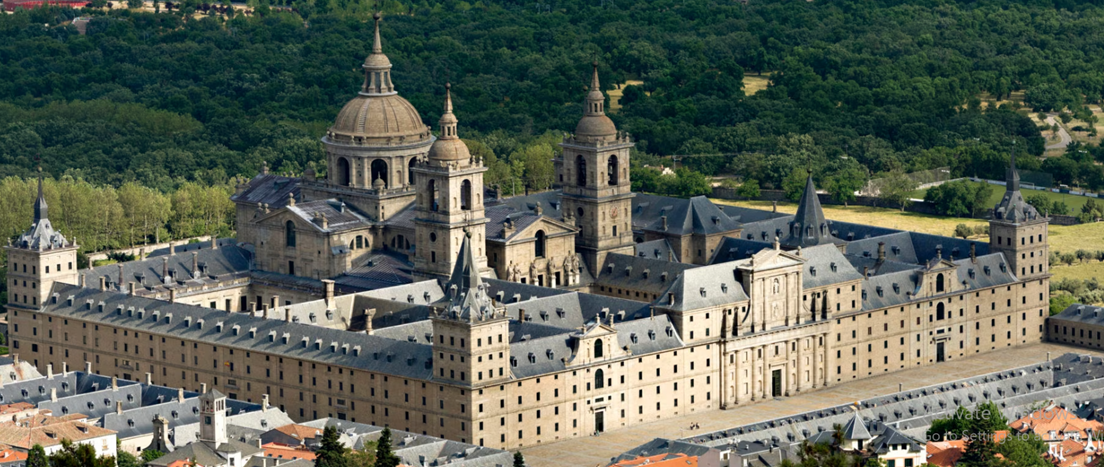
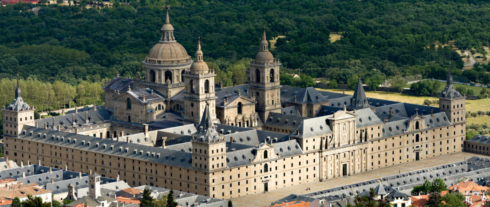
ON April 23, 1563, the first stone was laid in the construction of The Monastery of Saint Lawrence of El Escorial, 30 miles west of Madrid.
As the world’s largest Renaissance building, there’s nothing quite like El Escorial anywhere else on earth.
It functions as a monastery, basilica, royal palace, pantheon, library, museum, university, school, and hospital – all in the shape of a grille!
Furthermore, its design was conceived by the king himself, Philip II (the ‘armada’ guy) who commanded his architects to achieve ‘simplicity in the construction, severity in the whole, nobility without arrogance, majesty without ostentation’.
The magnificent complex took 20 years to complete.
It was such a massive undertaking that the project passed as a saying into everyday Spanish: a never-ending task is said to ‘durar más que la obra del Escorial’ (‘last longer that the Escorial work’).
King Philip had all the riches of the Americas at his disposal, and two ambitions in life – to be a renaissance monarch, and to be a solitary monk!
The Escorial was his way of using those resources to achieve those ends.

The structure stands on a lonely mountainside, in a beautiful wilderness.
Philip felt a personal religious devotion to Saint Lawrence, martyred by being roasted alive on a gridiron.
The king was also fascinated by biblical descriptions of the Temple of Solomon.
He wanted the shape of the Escorial to combine these two concepts.
A rather melancholy individual, Philip not only included a burial chamber for kings in his new palace, he also had his own tomb constructed – and often used to go there and lie in it!
While the Escorial was being built, the king ordered a stone seat erected on the mountainside, and he used to go there, and sit watching the work in progress.
You can still visit the ‘silla de Felipe’ today.
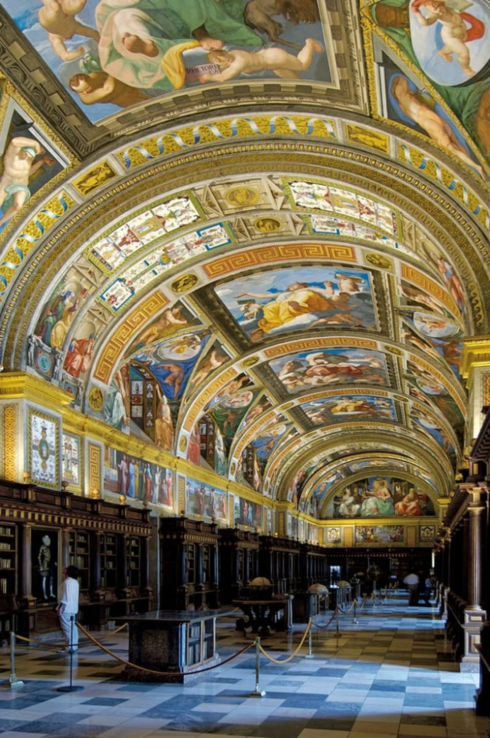
The Escorial’s spectacularly vaulted library boasts an impressive collection of manuscripts (including many in Arabic, Hebrew and Latin) and rare editions, protected on bookshelves made of rare woods.
Everything about the palace reeks of over-the-top opulence: the Escorial has 16 courtyards, 11 cisterns, 88 fountains, 13 oratories (small chapels), 7 refectories, 9 towers, 15 cloisters, 86 staircases, 1,200 doors and 2,673 windows.
Although Philip named Madrid as the country’s permanent capital in 1561, he preferred the Escorial, and lived there intermittently for 14 years.
Shutters in his bedroom wall allowed him a view of the high altar and, when dying from gangrene in 1598, he could watch mass being celebrated as he lay his bed.
Philip’s apartments were simple, befitting his personality, but otherwise the interior of the Escorial contains dazzling ornamentation.
Of the 1,600 canvases, most have a religious theme.
Paintings collected by Philip II and his successors range widely from the late Middle Ages to the 17th century.
There are more than 500 frescoes covering walls and ceilings, and there are floors of marble and jasper in a variety of colours.
Rare, exotic wood – mahogany, ebony, cedar, orange wood, walnut, terebinth (a kind of sumac) – make up shelves, gold is used generously on altars and to cover larger than life figures of saints and royalty.
READ MORE: Sevilla’s Feria de Abril 2026: Your ultimate guide to Spain’s wildest spring party
There are 570 sculpted, bronzed and gilded reliquaries, containing about 7,500 relics of saints (Philip was a ‘relicomaniac’).
The gardens were constructed at the order of Philip, a great lover of nature, in order to constitute an ideal place for repose and meditation.
Manuel Azaña, who served as the last president of the Second Spanish Republic during the civil war, studied in the monastery’s school and mentions them in his memoirs and in his stage play El jardín de los frailes (‘The Garden of the Friars’).
Students at the school still use the gardens today.
As the saying suggests, the work of the Escorial never ends.
In 2024, a renovation began (it will last until 2027), funded by €6.5 million from the EU’s coffers.
Visitors now enter through the imposing Patio of Kings courtyard.
The Patio of the Evangelists, a garden with fountains and statues, will be open to visitors.
The painting and architecture galleries, long dormant, are being reopened, reorganised and revitalised.
The building is being updated with LED lighting, electric vehicle charging points, and solar panels.
So you have no excuse not to go!
Click here to read more Spain News from The Olive Press.