

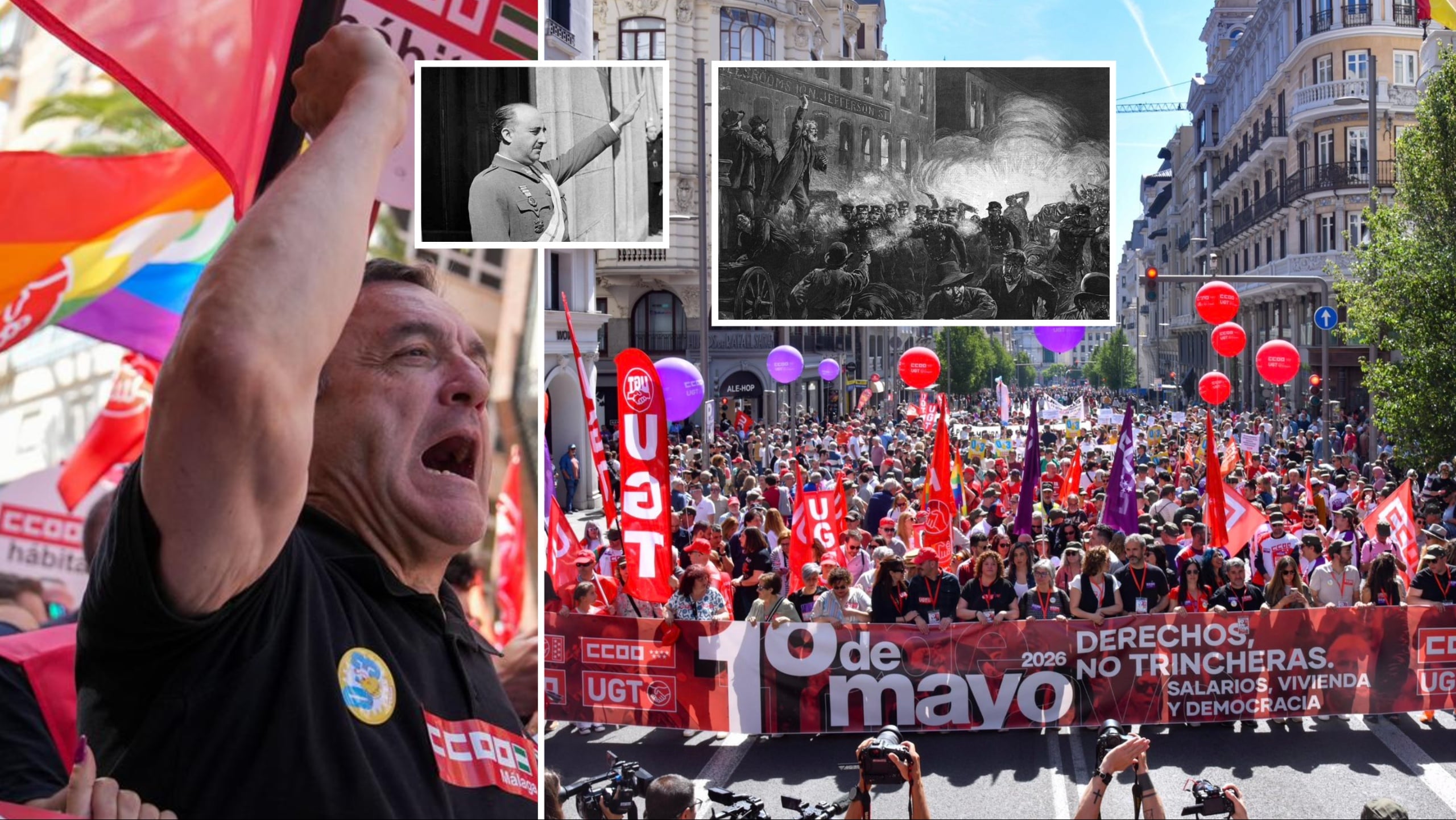
HUNDREDS of thousands of people have taken to the streets across Spain this Friday to mark International Workers’ Day.
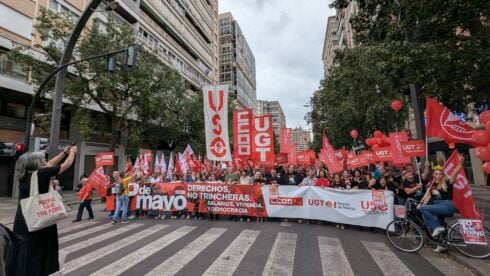
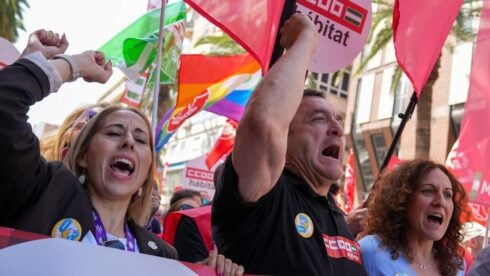
The country’s two largest unions have chosen Malaga to hold their largest demonstration, where trade unionists and workers have chanted the slogan ‘Rights, not trenches. Wages, housing and democracy’ (derechos, no trincheras. Salarios, vivienda y democracia).
Union leaders are calling for affordable housing, higher wages and stronger labour protections as Spain’s cost-of-living crisis bites.
Spain’s left-wing prime minister, Pedro Sanchez, marked the occasion by pointing to record employment figures, with 22 million people currently in work and a minimum wage that has doubled in a decade.
But why does Spain – and most of the world – observe May 1st as a public holiday?
International Workers’ Day is rooted in events that took place in a city in the American midwest nearly 140 years ago, and the answer goes to the heart of how the modern world was built.
American origins of the modern labour movement
The story begins in Chicago in 1886.
Factory workers across the United States had long been forced to toil in 12 to 18-hour shifts, six or even seven days a week.
The factory owners, meanwhile, grew rich off their labour, and become the wealthy industrialists (sometimes earning the epithet ‘the robber barons’) of the age.
A law passed in 1868 had already established an eight-hour day for federal workers, but it had numerous downsides.
It applied only to government employees, was routinely ignored, and carried a maximum fine of just $25 for violations. Private industry was entirely untouched.
America’s largest union, the American Federation of Labor, declared that from May 1st that year, the working day would be capped at eight hours.
Where employers refused to comply, workers went on strike.
In Chicago, then the second-largest city in the United States, the confrontation escalated over three days.
On May 4th, at a protest in Haymarket Square, an explosion killed six police officers. Police opened fire on the crowd, killing dozens of people.
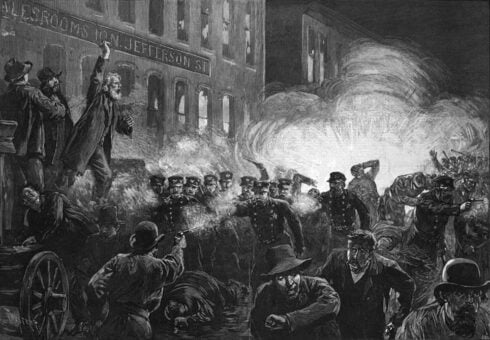
Eight anarchist union leaders were arrested. Five were executed following a trial later demonstrated to be a sham. They become known as the Haymarket Martyrs.
Three years later, the International Socialist Workers Congress declared May 1st International Workers’ Day in their memory.
Their central demand, the eight-hour working day, eventually became the global standard.
The weekend, sick pay, the concept of a minimum wage – basic rights that we today take for granted – all trace their lineage to this moment and those men.
READ MORE: Ryanair urges Spain to scrap EES rollout to avoid summer of border queue chaos
Revolution waylaid
The United States, where the movement was born, is one of the few countries that does not observe May 1st.
President Grover Cleveland moved Labor Day to the first Monday of September, fearing that the date’s association with radicalism would strengthen the socialist movement – soon to gestate into communist revolution in Russia – at home.
His anxiety was shared across the Western world, and not without reason.
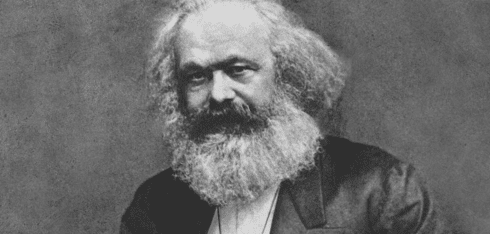
By the 1880s, industrial capitalism was generating extraordinary wealth for owners and systematic misery for workers.
Karl Marx and Friedrich Engels published the Communist Manifesto in 1848. Revolutionary ideas were spreading rapidly. Governments were frightened.
The man who grasped the danger most clearly was, improbably, one of the 19th century’s most conservative statesmen.
German Chancellor Otto von Bismarck – the ‘Iron Chancellor,’ architect of a unified Germany built on military power and hard realpolitik – introduced the world’s first modern welfare state.
He was candid about his motives: “Whoever has a pension for his old age is far more easy to handle than one who has no such prospect.”
His welfare programme – accident insurance, sickness cover, old-age pensions – was designed explicitly to undercut the socialists by giving workers a stake in the system.
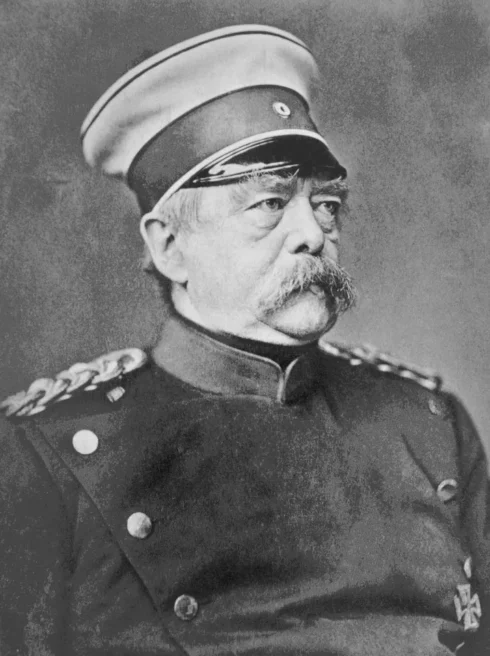
His biographer AJP Taylor wrote that Bismarck ‘acted on his beliefs at the exact moment when they served a practical need.’ In this case, the need to keep revolution at bay.
The broader pattern becomes clear in hindsight. The countries that granted meaningful workers’ rights and built welfare states largely avoided revolution.
The one major industrial power that did not – Tsarist Russia – got one.
The Bolshevik Revolution of 1917 did not emerge from nowhere.
It came from a society in which workers had no protections, no unions, no recourse and no stake in the system.
After 1917, Western governments accelerated their concessions to organised labour still further. The Soviet threat concentrated minds.
May Day is, in this sense, the annual reminder of capitalism’s near-death experience — and of the reforms that saved it.
Franco’s fascist reversal
Spain’s story is a particularly vivid illustration of what happens when that lesson goes unlearned.
Francisco Franco’s victory in the Civil War in 1939 crushed the labour movement entirely.
Unions were banned.
Workers were herded into a state-controlled fascist structure called the ‘vertical union,’ serving the regime rather than its members.
The result was not the tranquility Franco had hoped for. Instead, radicalisation was driven underground.
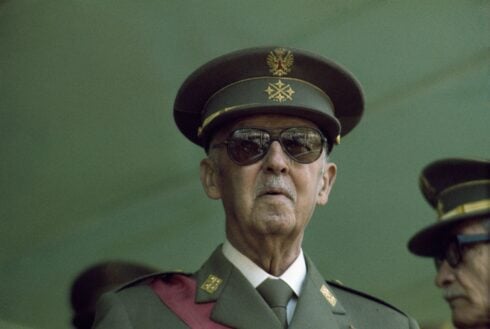
In the 1960s, communist and Catholic workers’ committees began subverting Franco’s official union from within.
Out of that resistance was born the Comisiones Obreras — CCOO — today one of Spain’s two major unions.
Strikes escalated through the 1970s. In March 1976, police shot dead five workers in Vitoria-Gasteiz during a strike.
Far from suppressing dissent, decades of repression concentrated it.
When Franco died in 1975 and Spain began its transition to democracy, legalising unions was not some minor concern.
It is central to the entire project. Unions are legalised alongside political parties. The 1978 constitution enshrines the right to strike.
Spain is catching up, rapidly and painfully, with a bargain the rest of Western Europe struck a century earlier.
That bargain, in essence, is this: give workers a stake in the system, and they will not try to destroy it. The eight-hour day, the weekend, the pension – none of these were gifts.
They were concessions, extracted by organised labour from governments and employers who feared the alternative.
The marchers in Malaga and across Spain today are not revolutionaries. They are workers calling for wages that keep pace with rising rents, and housing they can actually afford.
Different words, same argument that men died for in Chicago in 1886.
The holiday exists to make sure nobody forgets it – although many have.
Click here to read more Spain News from The Olive Press.





A concise summary, well done!