
FOR a few minutes on August 12, daylight will fade, temperatures will drop and millions of people across Spain will look towards the sky.
But this is when is where the danger begins, because even a brief glance at the Sun without proper protection can permanently damage your eyesight.
The total solar eclipse will be the first visible from mainland Spain in more than a century.
It will take place shortly before sunset, creating the rare sight of a darkened Sun sinking towards the western horizon.
However, most of Spain will experience only a partial eclipse. In these areas, part of the Sun will remain exposed throughout the event.
That means viewers must protect their eyes from beginning to end.
Ordinary sunglasses are not safe, regardless of how dark they appear.
The Institute of Astrophysics of the Canary Islands warns that even 1% of the Sun’s surface emits enough radiation to damage the retina.
Worse still, you may not realise the damage is happening.
The retina has no pain receptors, so looking at the eclipse may cause no immediate discomfort.
Symptoms can appear several hours later. These include blurred vision, a dark patch in the centre of your sight and straight lines appearing bent.
This condition is known as solar retinopathy.
There is no specific treatment, and some damage can be permanent.
What glasses do you need?
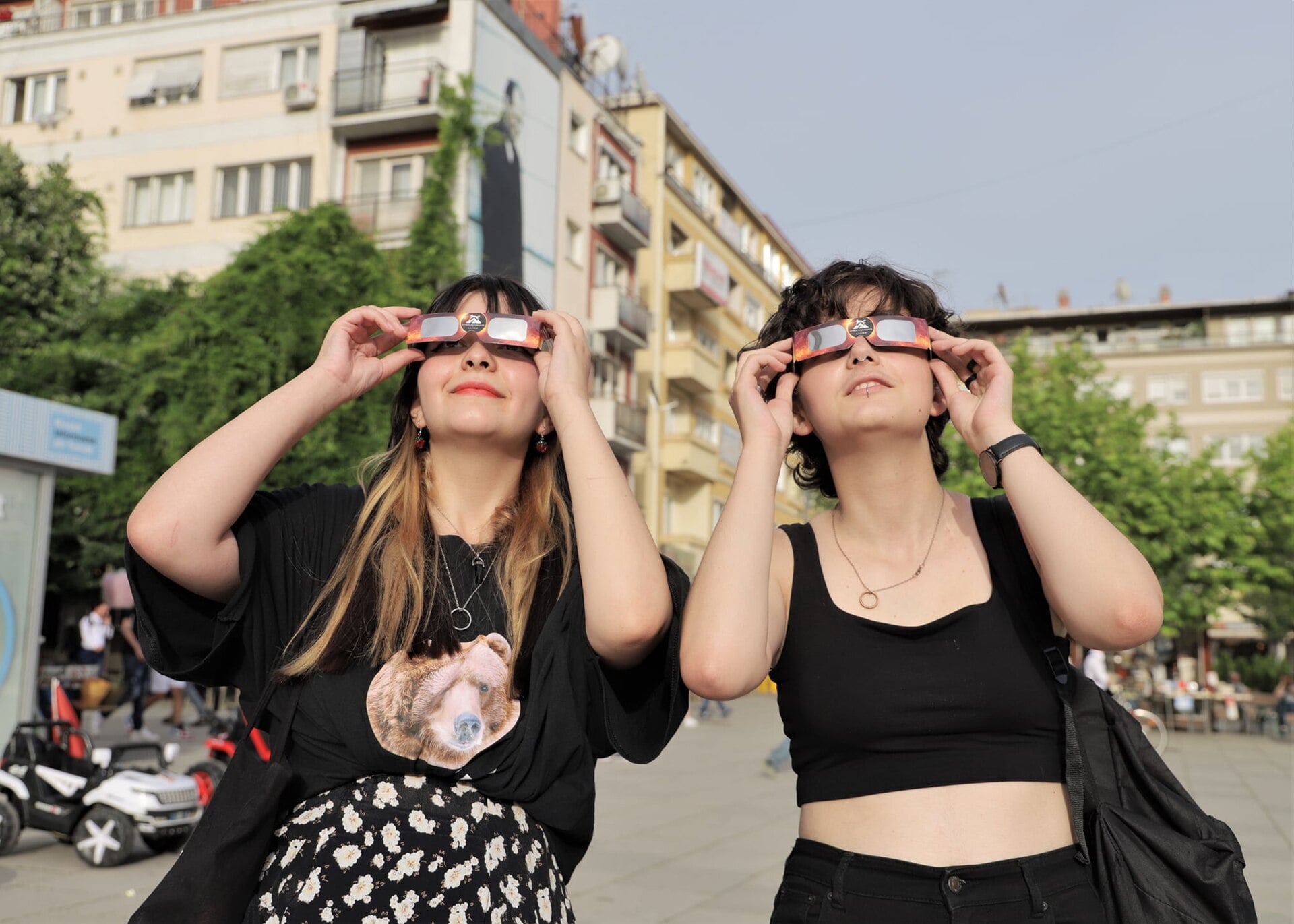
Experts recommend eclipse glasses or a handheld solar viewer which meets the EN ISO 12312-2:2015 international safety standard.
These filters are around 100,000 times darker than normal sunglasses. They block harmful visible, ultraviolet and infrared radiation.
However, an ISO logo on the packaging does not always prove that the glasses are genuine.
Safe products sold in the European Union should also carry the CE mark, alongside the manufacturer’s name and clear instructions.
Viewers should inspect their glasses before the eclipse.
READ MORE: Where to find safe eclipse glasses in Spain – and support a youth-led fin whale project
Any pair with scratches, holes, tears or loose filters should be thrown away.
Where can you get eclipse glasses?
The Spanish government and the ONCE social group are distributing two million certified pairs free of charge.
ONCE sellers across Spain will hand out 1.7 million pairs, with distribution beginning during the first week of August.
A further 300,000 will be supplied through science museums, research centres, universities and other public institutions.
Certified glasses are also available to buy through the National Geographic Institute’s CNIG sales points and its official La Casa del Mapa shop.
Buyers should avoid unverified online listings and check for the full EN ISO 12312-2:2015 certification before using any pair.
Where will the eclipse be total?
The level of protection needed will also depend on where you are watching.
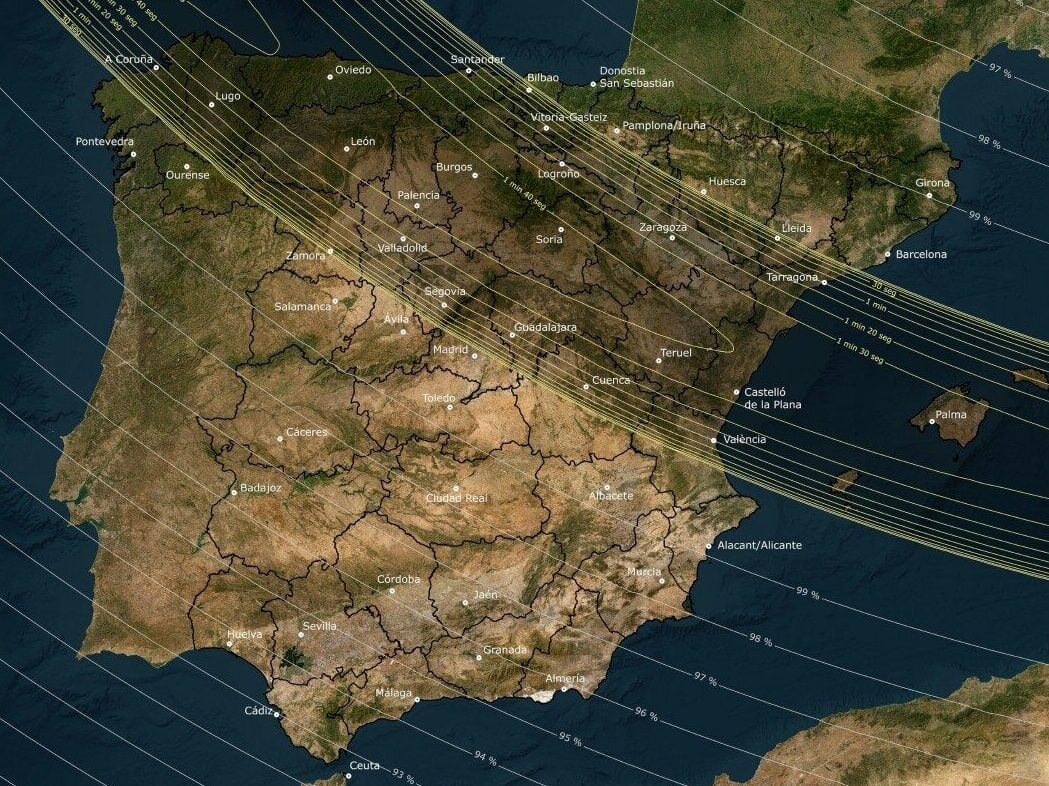
The map below shows the narrow path where the Moon will completely cover the Sun. It also marks the much wider area that will experience a partial eclipse.
The path of totality will cross northern Spain from Galicia towards the Balearic Islands.
Asturias, the Basque Country, Castilla y Leon, Aragon and parts of Valencia will briefly fall into darkness.
Meanwhile, most of Andalucia and the Costa del Sol will see a partial eclipse. Part of the Sun will therefore remain visible throughout.
The event will begin after 7.30pm in many Spanish cities. Its main phase will take place at around 8.30pm, although exact times will vary by location.
Because the Sun will already be low in the sky, astronomers recommend finding an open spot with a clear view of the western horizon.
Then, as evening falls, millions of people across Spain will watch daylight briefly give way to darkness.
It will be a sight mainland Spain has waited more than a century to see, and one unlikely to be forgotten.
Click here to read more Solar Eclipse News from The Olive Press.
Click here to read more Spain News from The Olive Press.