PEOPLE-SMUGGLING networks have been dropping off migrants at the isolated beaches and secluded coves of southern Spain in a practice known as patera-taxi for years.
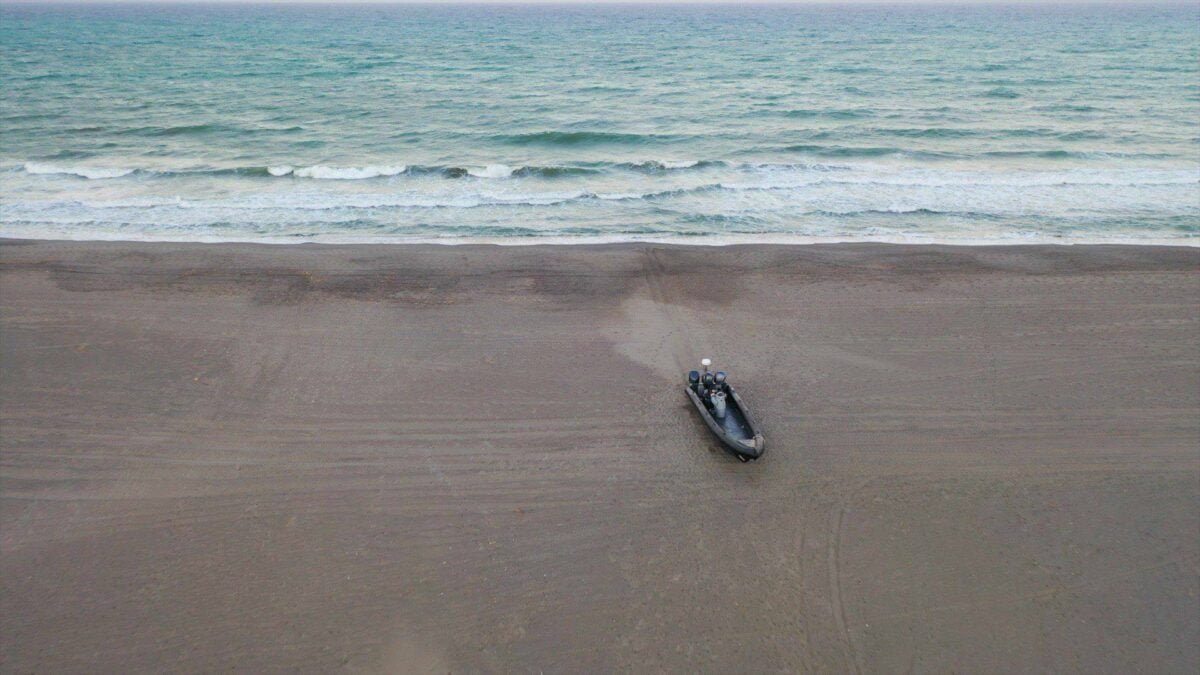
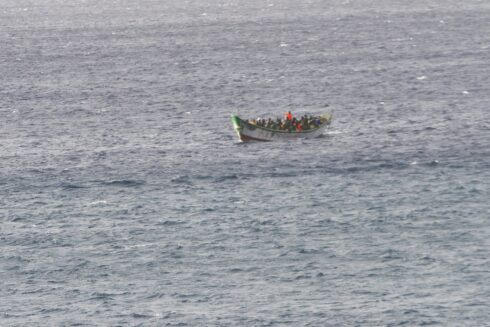
Which is why it came as a shock at one particular Murcia hotspot when one such high-powered speed boat laden down with dozens of migrants cruised up to the shore in broad daylight on Wednesday, August 19.
Numerous videos from the scene in the Cala del Barco, Cartagena, captured the moment the sleek black vessel – so long associated with narco trafficking – cruised into the cove, and the chaos began to unfold.
Beach-goers started scrambling to gather up their belongings in alarm as 62 people, among them 45 men, two women and 15 children, dived over the side of the boat and swam to Spanish shores.
Private security from the nearby La Manga Club were first to respond to the new arrivals traipsing up the dirt track from the cove that passes the resort’s entrance.
Security guards, dogs and a drone tracked down those who were attempting to disappear into the nearby surroundings and held them in tents until the Guardia Civil arrived.
While this arrival was foiled, it was just the latest on a route Frontex calls the longest and most dangerous smuggling corridor in the western Mediterranean.
One in which the drug traffickers that took root in the western Mediterranean years ago are repurposing their speed boats to the increasingly profitable smuggling of people into Spain.
How the networks operate
Investigators describe a modus operandi built for speed and disposability.
Crews use large semi-rigid boats fitted with two or three high-powered outboard engines, capable of covering the roughly 200km from the Algerian coast to Murcia and the Balearics in a matter of hours.
Some networks avoid returning to port at all, refuelling at sea through a practice known as petaqueo — taking canister of petrol from other speedboats, so the smuggling vessel never has to dock and risk being identified
This was the conclusion of Spain’s Policia Nacional when it dismantled a network running boats out of Aguilas, Murcia, just last week.
Officers in that case found the smugglers had also been altering the boats’ names, registration numbers and structural features after repeated trips, making them harder to trace at any port or mooring.
When a boat is intercepted, the standard response from the traffickers is to force their passengers into open sea and flee at speed rather than risk arrest.
That is what happened in an incident off Aguilas on July 1.
The crew ordered 24 migrants, four of them children, into the water without life jackets and sped off.
In their bid to escape, the propeller of one engine struck a 15-year-old boy, tearing into his chest and both limbs and putting him into emergency surgery.
Several of the rescued migrants needed CPR after swallowing water, since some could not swim, and many were left with first and second-degree burns on their legs and buttocks, caused by petrol mixing with seawater on their skin during the crossing.

Who they smuggle
The people on these boats are overwhelmingly young Algerian men, though the networks also transport women and children.
Once they arrive in Spain, these people quickly disperse and, if not tracked down and caught immediately, little is truly known of what happens to them.
While police and government sources make estimates of the numbers that arrive on Spanish shores each year based on vessels they track, the true numbers are simply unknown.
Four of the 24 migrants found off Aguilas were minors, and Balearic authorities have found that roughly six in ten migrants who claimed to be under 18 this year tested as adults once assessed, a mismatch that has strained the region’s system for housing unaccompanied children.
Wednesday’s boat in Cartagena carried at least one exception to the young-men pattern: a pregnant woman who told bystanders she had lost her phone jumping into the water and asked to borrow one to contact her family.
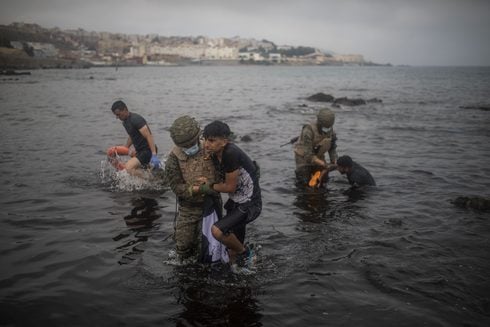
(AP Photo/Bernat //Credit:Bruno Thevenin/SIPA/2105201357
What it costs
Prices vary by network, but the pattern is consistent.
A smuggler based in Algeria collects payment before departure, and the crossing only happens once it clears.
The organisation dismantled at Aguilas charged between €6,000 and €10,000 a person, paid to a member of the network physically based in Algeria, either in cash through relatives or through hawala, an informal transfer system that moves money without any bank record.
In these instances, a client hands cash to a trusted intermediary in Algeria, who passes on a code, and a second intermediary in Spain then pays out the same sum to whoever presents that code, with the two intermediaries settling their own accounts later.
A separate Spain-Belgium network broken up by Policia Nacional, Europol and Eurojust in July charged between €8,000 and €10,000 a person and is estimated to have moved more than 400 migrants in total, generating around €4 million from people-smuggling alone and €8 million once its parallel drug-running is included.
The largest case reported this month involved a network of 78 people, according to investigators, which charged up to €12,000 a head in shipments of up to 50 migrants at a time – about €600,000 in a single crossing – on top of profits from running MDMA, weapons and fuel back the other way.
What happens to them once they arrive
Once migrants make it to Spain, the data on what happens to them is also remarkably incomplete.
For those who are caught and identified, a deportation order is easy for Spain to issue but hard to enforce.
Morocco – and Tunisia – are considered ‘safe countries’ by the EUAA, the EU’s own asylum agency, and rejection rates for asylum applications stand at 94%.
Algeria is not on that list. Even so, its rejection rate sat at 91.2% in 2025.
Algiers cut diplomatic and economic ties with Spain in April 2022 over the Western Sahara dispute, and stopped accepting the return of its own nationals almost immediately afterwards, according to Real Instituto Elcano’s analysis of the crisis.
Spanish law only allows migrants to be held in a Centro de Internamiento de Extranjeros (CIE) — a short-term immigration detention centre used solely to process deportations — for a maximum of 60 days, so once that clock runs out without Algeria agreeing to take someone back, Spain has to let them go free.
Relations have thawed since late last year, with Interior Minister Grande-Marlaska visiting Algiers and both governments declaring a 2004 returns protocol back ‘in force’, but the process remains unfinished.
When Pedro Sanchez visited Algeria in July, the two sides agreed only to a further high-level meeting in October to relaunch cooperation, with the prime minister calling for a return of the ‘the repatriation mechanisms to try to stop the arrival of migrants by patera [small boat], many of whom are landing on the coasts of the Balearics’.
However, there is currently no confirmation that forced removals of irregular arrivals are resuming at scale.
Nationally, the gap between an order and an actual deportation is stark.
Of 41,315 expulsion orders Spain issued between January and October last year, only 3,398 were carried out, about 8%, according to a government reply to a parliamentary question, which cited a lack of cooperation from countries including Algeria and Morocco as one of the reasons.
Put plainly, the great majority of people who Spain formally orders out of the country never actually leave.
It is diplomatic leverage these countries eternally hold against Spain and the EU, one which they use to extract concessions on sensitive political issues or even cash subsidies.
READ MORE: Morocco makes 111 arrests after second mass Ceuta migrant crossing attempt falls flat
Where they end up
For those who do stay, whether released once the 60-day limit expires or simply never traced again after scattering from a beach, the most heavily documented destination for undocumented labour in this part of Spain is the enormous greenhouse belt inland from the coast.
Spain’s Labour Inspectorate puts migrants at 98% of the roughly 40,000 to 50,000 people working Almeria’s greenhouses, and more than half of the 80,000 to 100,000 seasonal workers in Huelva’s fruit sector.
Many end up in precarious situations vulnerable to exploitation, working long hours in incredible temperatures in these endless greenhouses for scant wages.
Many employers in Almeria’s El Ejido sea of plastic admitting they only ‘pay what they can to turn a profit’.
The same inspectorate fined greenhouse employers in the two provinces €6.49 million in 2024 alone for irregular hiring practices affecting 7,506 workers, part of €29.06 million in fines and 32,753 affected workers logged since 2020.
The Andalucian human rights group APDHA puts the number working entirely without a contract across both provinces at around 35,000, with roughly 12,000 living in informal settlements without running water or electricity, though the group itself says no government body actually publishes a figure for the scale of undocumented farm labour.
But these figures are just proxies for something that is incredibly difficult to track, with it being unknown how many fall into the black market elsewhere in Spain, nor how many turn to crime.
READ MORE: Inside Ceuta: thousands of migrant children on the pavement – and thousands more in the hills

How many go on to commit crimes?
There is certainly a perception that some Algerians and Moroccans go on to commit crimes once they arrive in Spain.
Neither the Institute of National Statistics (INE) nor the Policía Nacional release statistics that break crimes down by immigration status.
Both publish figures by nationality – INE only to continent level, the Interior Ministry’s own criminal statistics down to individual countries – but neither says whether the person involved was in Spain legally or without papers.
However, recent stats in Catalunya showed foreign nationals accounted for 65.8% of the 51,063 arrests Mossos made in Catalonia in 2025, rising to 84.3% for theft, 73% for robbery with violence and 60.3% for sexual assault.
While the figures only grouped the arrestees by continent, it showed Africans specifically were reportedly responsible for 46% of all theft arrests in the region and 53.4% of all arrests for robberies with violence.
A near-identical picture emerged in Navarra, where the regional Policía Foral revealed, after a parliamentary question from far-right Vox, that foreign nationals were responsible for 63% of sexual offences, 73% of homicides and 72% of robberies in 2025.
Again, the numbers do not directly point to migrants arriving by fast boats or more fragile pateras boats or dinghies, although such data surely exists.
This statistical gap leaves the arena vulnerable to political manipulation, both by figures on the far right – Vox and Alianca Catalana – and the far left.
READ MORE: Catalunya must be excluded from taking in Ceuta migrant minors, right-wing separatist party demands
Do they get deported?
Nonetheless, criminal foreigners are precisely the kinds of foreigners that Spain struggles to get rid of.
One Algerian national filmed repeatedly stamping on the head of a stranger in an unprovoked attack in Valencia last month was revealed to have an extensive criminal record built up while living in Spain without papers.
He was already under a deportation order at the time of the attack, but it had never been carried out.
It mirrors the exact failure pattern that the Fiscalia (Spain’s state prosecution service) outlined in a 2025 report.
The Fiscalía filed 4,656 requests in 2024 alone to deport foreign nationals already serving prison time, and named the obstacle bluntly as ‘a lack of cooperation from some consular authorities, particularly in the case of Moroccan and Algerian nationals.’
Police in the Balearics, Valencia and Murcia have simply given up asking to detain certain nationalities pending deportation, Algerians chief among them, because they already know Rabat and Algiers will let the request expire rather than process it.
However, things aren’t entirely hopeless. Just over half, 54.7%, of criminal cases that ended with someone locked up awaiting deportation in 2024 did indeed end in deportation.
The real failure happens earlier, in the months it takes courts to catch up and in police simply not bothering to start the process for nationalities they already know will go nowhere.
The response against the people traffickers
Three separate operations against Algeria-Spain networks have been announced in the past six weeks alone.
Police dismantled the Aguilas-based network on August 13, arresting five men and seizing two boats, one worth an estimated €160,000, after tracing it from the 24-migrant landing back through a fuel supplier in Alicante and a second hidden boat in Mutxamel.
On July 8, a joint operation involving Policia Nacional, the French national police, Belgian federal police, Europol and Eurojust arrested 20 people across Alicante, Madrid, Vitoria and Belgium, tracing a network run by a Belgium-based family clan back to a 2022 boat sinking that killed 12 migrants.
And on August 18, investigators described dismantling a 78-strong organisation with a rigid command structure, a single leader controlling finance and weapons supply with pilots, front men and financial handlers beneath him, which had been under investigation for almost three years with help from Europol, France, Portugal and Poland.
That network alone is estimated to have made more than €24 million and owned 18 high-powered boats, landing migrants on the coasts of Almeria, Murcia, Cartagena, Alicante and Ibiza while running drugs and weapons back to Algeria on the same vessels.
READ MORE: Up to 1,000 migrants feared dead in ‘catastrophic loss of life’ after deadly Mediterranean storm

The scale of the route
None of this is confined to one bad month.
Interior Ministry figures for 2025 list 36,775 irregular arrivals. This is in fact down 42% from 2024.
Estimates for the mainland route is a more modest 7,000 arrivals.
But the numbers put arrivals to the Baleares alone up by more than 40% – more than 4,000 so far this year across upwards of 230 boats.
Frontex has identified the Algeria-to-Baleares routes as one of the fastest growing, even as the Ceuta crisis has drawn most of the attention this summer.
A fatal wreck off Cartagena in April, in which three migrants died and a boat pilot was later jailed for reckless homicide, was confirmed at the time to have set off from Algeria.
Wednesday’s boat sped off before anyone could identify it. By Friday evening, no nationality, departure point or operator had been officially confirmed for that particular crossing.
But it goes to show – despite dismantling three separate people trafficking networks in recent weeks, there are still plenty operating.
Click here to read more Spain News from The Olive Press.