WE needed to drive round a third time to fully understand the impact of what exactly we were seeing.
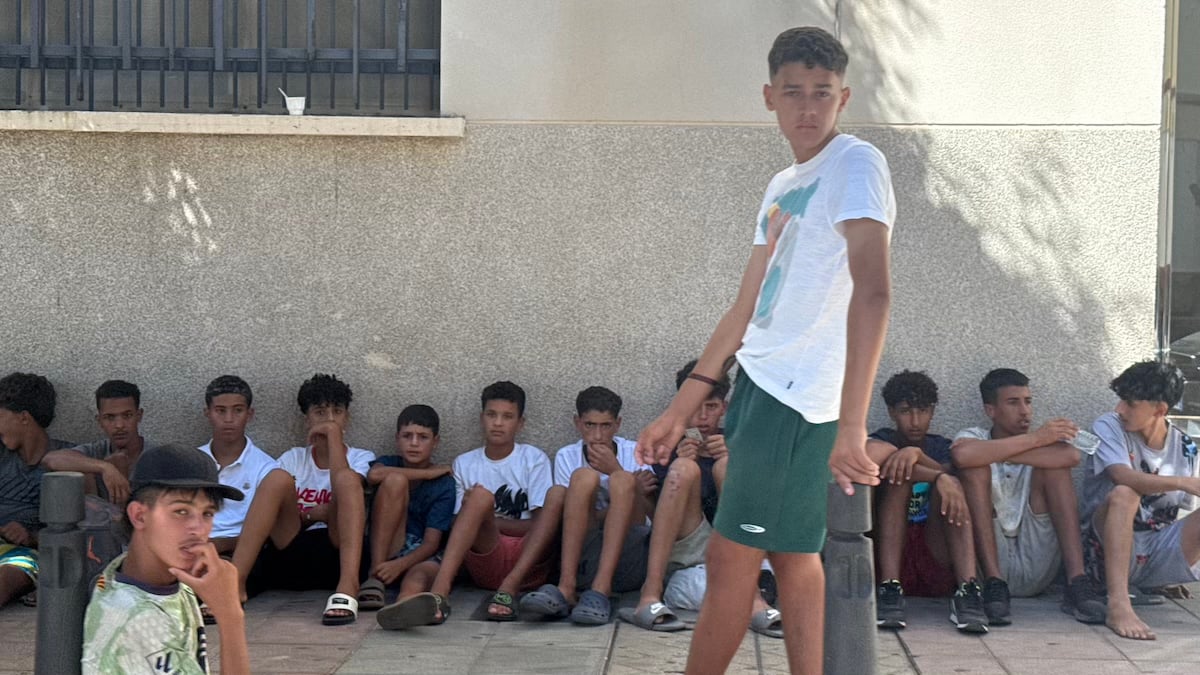
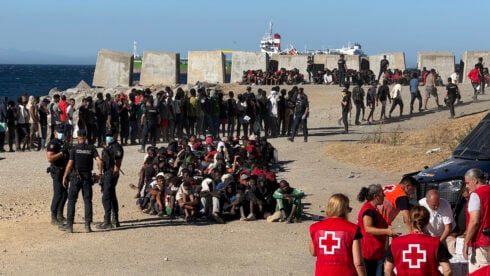
Cross-legged on the pavement, four or five deep, the group of teenage boys easily numbered well into the hundreds.
Clumped into groups to let residents get to their homes, what really struck me was their ages. These weren’t teenagers on the cusp of adulthood. Many were clearly much younger — 13 and 14-year-olds. Perhaps even younger.
A further 20 metres down Paseo de Colon was another group of boys, slightly older, followed by a big huddle of girls and then a group of mothers and children.
Staring at us suspiciously, nervously, they were waiting patiently in the heart of the Spanish enclave of Ceuta to get themselves registered with the National Police. Once registered, a minor seeking asylum would need to be transferred to mainland Spain by law within 15 days.
But with just three radiologists — tasked with studying the bones of their hands to establish if these young migrants really were under 18 — working round the clock, they looked set to be sitting on that pavement for days yet.
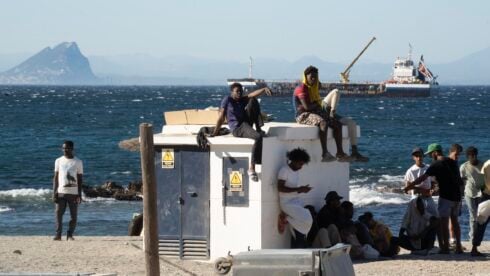
It was exactly a week since the mass incursion that saw an estimated 72,000 migrants flood into the enclave from land and sea from Morocco at the end of July.
And what was particularly interesting was to see how much the group of youngsters had grown since we had passed the day before.
What had been perhaps 150 kids on Wednesday afternoon had clearly grown to 300, perhaps even 400, by Thursday. Official figures claimed some 1,342 unaccompanied minors had been registered by Friday, but by their own admission the count was still incomplete.
The tension, too, had visibly ramped up, with suddenly far more police on the streets and dozens of aid workers now in situ.
Just as striking was the lack of media on the ground. We were the only journalists around — and it was clear the NGOs had taken control.
It has been an extremely fraught couple of weeks for the 83,000 residents of Ceuta, a North African territory that has been part of Spain since the 16th century.
Their normally ordered enclave was entirely engulfed with African migrants, mostly from sub-Sahara, in the last week of July, sending locals to hide out in their homes, while the army needed to be called onto the streets to restore some semblance order.
“It’s been a really stressful time and families here are really scared,” trainee nurse Javier Cepero Cortes, 21, told me.
“Most of them have stayed in for days and they don’t know what’s going to happen. It will certainly mean quite a few of them thinking of leaving Ceuta for good.”
Having grown up in the enclave, he is extremely proud of his heritage and worries that Spain’s central government and the EU are ‘not doing enough’ to help.
“This was an invasion and take a look around, it is so obvious there are many times more migrants still here than claimed.”
It was certainly galling to read Pedro Sanchez’s government insist that all but 2,000 of the 72,000 arrivals had gone home.
The statistic was dutifully repeated across most of the world’s media. The facts on the ground told a rather different story — something alluded to by the President of Ceuta, Juan Jesús Vivas, at the weekend, who insisted in a news conference on Saturday that there were between 8,000 and 11,000 immigrants still there.
Indeed, over 48 hours of criss-crossing the enclave, asking questions and meeting both locals and asylum seekers, perhaps as many as 60, I can safely put the number at around 10,000.
We found up to 1,000 milling around the industrial estate, holed up in makeshift tents cobbled together from sunbeds, parasols and scraps of material, while another 500 to 1,000 were camped out around the village of Benzu.
Add to that the 500 or so we found in the port area, possibly the same in the main city and then comfortably 1,000 waiting around by the sides of the coast road.
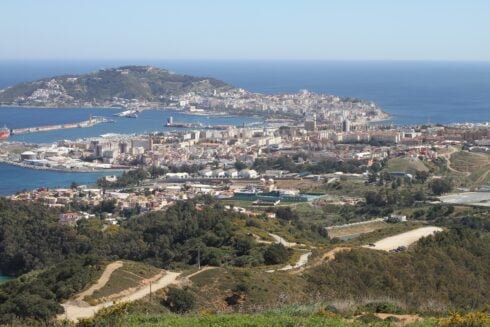
And then there is the official migrant internment centre, known as the CETI, that had ‘900 people inside’, according to the Sevilla-based boss of a company installing toilets and showers for the migrants on a nearby headland by Trampolin Beach.
“There are 900 inside and easily 1,000 camped out in the hills outside it,” he added, explaining that his firm had been tasked with putting a giant marquee up inside the CETI, as well as, ironically, a big marquee for the city’s main feria last week.
“I’ve been coming here to erect marquees for the feria for years and my daughter and her husband, a captain in the army, always come here for their summer holidays.
“They have been here for five years in a row and really like the place. In fact, last year, they came home saying they were thinking of investing in a holiday home, but thankfully heeded my warning of exactly what has just happened,” he insisted, asking to remain anonymous.
It was 400 metres away that we watched around 1,500 migrants get fed by the Red Cross on Benitez Beach, a stunning spot facing north to Gibraltar and Spain.
In an extraordinary police operation, around 50 officers from six riot vans corralled the migrants, around half from West and Sub-Saharan Africa, into groups of 100, before they were carefully led to workers from the Red Cross who handed them bread and water.
A trio of ambulances sat alongside, checking for health issues and patching up the many cuts incurred as they had scrambled over rocks to enter Ceuta.
It was a pitiful sight, particularly in the full glare of the sun, which sent the mercury soaring to around 35 degrees.
Curiously, nearly as many migrants milled around watching from a bluff above the roadside, while around 100, mostly Senegalese, kicked footballs around the beach.
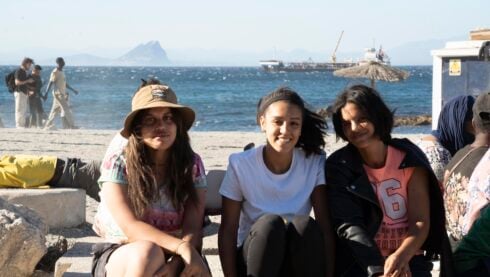
“Football’s in their blood, but we will always beat them,” insisted a local Moroccan lad, wearing a well-worn 1980s England shirt.
Over the weekend, I spotted photos of dozens of temporary shelters erected on the same beach, which will certainly put off most local beachgoers and their parasols this summer.
All along the N-354, the road that heads to the border at Benzu, immigrants were queuing up at beach showers or at natural springs to wash and drink.
Meanwhile, when look up into the hills, hundreds of hectares of stunning mountain forest criss-crossed with footpaths, and you quickly understood the scale of the problem.
Everywhere we drove, we spotted migrants camped out. It’s simply impossible to know how many. And it won’t be easy to send them back, if that is what the Spanish authorities are now mulling over.
“The hills are a total rat run. There are so many places to hide and to escape,” explained IT worker Mohamed Abdeselam, 24, our guide and interpreter.
What was very apparent after talking to dozens of migrants was how they had heard about the incursion. Almost all of them mentioned just two sites: TikTok and Instagram.
They explained how they had begun to hear about the planned incursion weeks before, and people started drifting down towards the border in the days before.
Whether Russia or China had been behind it, the Moroccan government, which faces a general election on September 23, or somebody else, was unknown.
READ MORE: Vox backs bid to kick Morocco out of Spain’s 2030 World Cup over Ceuta migrant crisis
But those that we met, of course, were the lucky ones, with reports suggesting that as many as 150 people had died during the treacherous swim by sea.
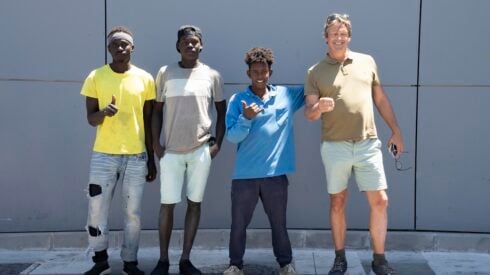
One of those to survive was Safiedine Armrani, 15, from the Ethiopian/Sudan border, who we met at a Repsol petrol station in the port.
His story was both harrowing and predictable, taking him an entire year to make it into Spain.
He told me how he had been sleeping beneath a beach umbrella after swimming onto the enclave using floats made up of plastic bottles.
He had never been to school and insisted there was ‘very little future’ for him back home.
While he had left with his parents’ knowledge, he hadn’t managed to speak to them for a year.
“As soon as I was safely out of the water I called my father. It was a joyous call,” he told me.
A big Real Madrid fan, he now hopes to move to the Spanish capital. Of course, where he gets sent will not be up to him, nor when it will be.
“Inshallah soon,” he told me, smiling.
He’ll certainly need a god over the next few years.
Click here to read more Exclusive News from The Olive Press.