

ONE of Sevilla’s most beautiful monuments, Pontius Pilate’s House is a place of grace and elegance.
Graceful columns, beauty everywhere you look, scented bougainvillea cascading over walls, and a small but lovely garden all combine to create an atmosphere that stimulates the brain and charms the senses.
As we come up to Easter, some of us will recall the Bible stories from our schooldays, particularly the one where Jesus Christ was taken as a prisoner to appear before the Roman governor, Pontius Pilate.
The Jewish people were demanding his crucifixion, but the Roman politician refused to get involved, famously ‘washing his hands’ of the whole affair.
This is the perfect moment to learn about Pontius Pilate’s House (‘La Casa de Pilatos’) in Sevilla. But before we explore the house, it’s important to talk about ceramic tiles, known in Spanish as ‘azulejos.’
READ MORE: Christopher Columbus IS buried in a cathedral in Spain’s Sevilla, new study confirms
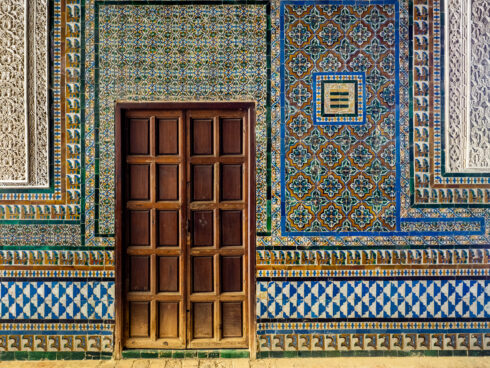
We all know that the ‘Deep South’ of Spain, the region known as Andalucía, was under Arabic rule between 700 and 1500 AD.
One of the lasting characteristics of this era is the use of azulejos. In the hot summers, tiles helped keep the interiors of houses cool.
Muslims, who were strictly forbidden from making any drawing or design that might resemble Allah or Mohammed, focused on geometric patterns instead.
This skill was maintained and even improved after Andalucía reverted to Christian rule.
This house showcases some of the best tiles you’ll ever see, on the very walls they were designed to adorn. These tiles have been in place for 600 years!
A local aristocrat, Fadrique de Rivera (First Marquis of Tarifa), went on a pilgrimage to Jerusalem in 1519.
While there, he was shown the supposed ruins of Pontius Pilate’s Palace, and upon returning to Sevilla, he decided to build a replica.
They sold him a small marble column, which they claimed was the pillar to which Jesus was tied when he was flogged.
Fadrique’s imagination was ignited, and he planned to create a ‘Via Crucis’ (a replica of Christ’s route from Pilate’s Palace to Calvary, where he was crucified) in Sevilla.
On Good Friday, Fadrique envisioned the religious people of Sevilla gathering in his house to pray at the marble column.
They would then walk in procession along his ‘route,’ ending in a field outside the city walls, where he would have a cross erected. T
his area became known as the ‘field of the cross’ (‘el campo de la cruz’). When a German brewery bought the site in Victorian times, they named their beer ‘Cruzcampo.’
You can visit the House’s ground floor (‘planta principal’) on most days of the year.
The entrance costs €12 (with all the usual discounts available, and children under 12 getting in free).
However, we suggest you try to pick a day when the upper floor (‘planta superior’) is open. It costs a little more, but it’s well worth it.
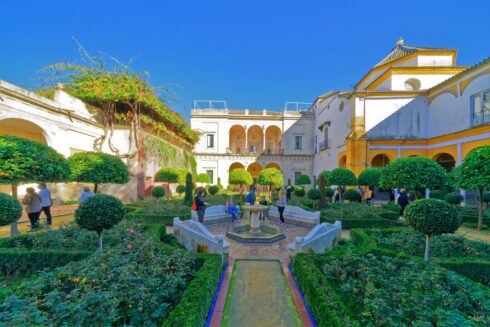
The house is still the home of the Dukes of Medinaceli, and when the family is not in Sevilla, you can tour their domestic quarters and view their fine collection of Old Master paintings.
The house, of course, doesn’t resemble a Roman governor’s palace from biblical times.
However, it is a marvelous ‘transition’ piece, with clear Renaissance features.
Since Arab craftsmen were employed as masons and carpenters, it also has a definite ‘eastern’ feel.
This is one of the reasons why Pontius Pilate’s House has appeared in various films.
In 1962, several scenes of Lawrence of Arabia were filmed here.
Ridley Scott also used the location for two of his movies: 1492: Conquest of Paradise (1992) and Kingdom of Heaven (2005). Additionally, Tom Cruise and Cameron Diaz filmed Knight and Day here in 2009.
Click here to read more Olive Press Travel News from The Olive Press.