

SPAIN’S population will be the only one among the European Union’s major economies still projected to have grown by 2100, new figures show.
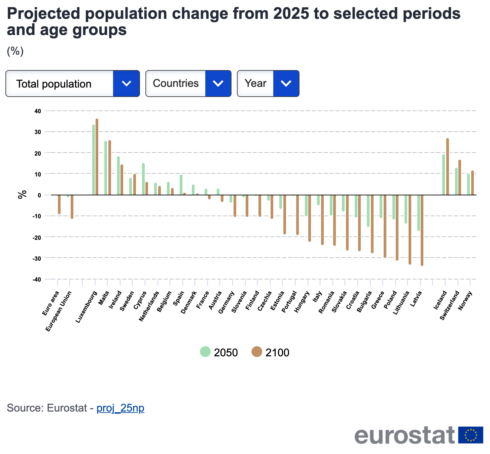
Eurostat’s latest projections put Spain’s growth at just 1.3% between 2025 and 2100, from 49.1 million to 49.8 – modest, but the only positive figure among Europe’s four largest economies.
Italy’s population, by contrast, is set to shrink by 24% over the same period, below that of Spain’s, while Germany will slim down by 11% and France lose 2.5%.

The findings come as something of a shock, given that Spain’s birth rate is among the lowest in Europe, with just 1.29 children per woman.
It is far below the break even rate of 2.1 children, making the population forecast for Spain’s population to actually grow slightly over the next 74 years a head scratcher.
That is, until the reason becomes obvious – almost none of that growth will come from Spanish babies.
Would Spain’s population grow without immigration?
Eurostat’s own analysis makes no bones about it.
Positive net migration is ‘the only factor’ keeping Spain’s population growing at all, Brussels’ data office declared.
“High and persistent positive net migration is the only factor contributing to population growth for those countries that are projected to grow over the time period between 2025 to 2100,” it wrote in its latest population projection report.
In fact, Madrid’s national statistics office (INE) has run the counterfactual itself – strip out current migration projections entirely, and the population plunges 37%, from their given figure of 53 million today to 31.7 million by 2076.
Much lower than either the INE projection 53 million with net migration, or Eurostat’s figure of 49.1 million.
READ MORE: Spain’s PM Pedro Sanchez says ‘no evidence’ of Morocco being involved in Ceuta migrant crisis
How does the rest of Europe compare?
Spain’s position looks even sharper set against the wider Eurostat table, not just the big four economies. Portugal is projected to shrink by 19.3% by 2100, and Greece by 30.1% – both far steeper falls than anything facing Spain.
The steepest declines in the whole bloc belong to the Baltics and Poland – Latvia down 33.9%, Lithuania down 33.4%, Poland down 31.6%.
Only a handful of EU countries are projected to grow at all by 2100, and Spain is the only large one among them – the rest are small, high-income states such as Luxembourg, up 36.4%, Malta, up 26%, Ireland, up 14.6%, and Sweden, up 10%.
What has Pedro Sanchez said on immigration?
Eurostat’s ‘the only factor’ admission is backed up by Spain’s prime minister himself.
Pedro Sanchez, a month into managing the worst migration crisis of his premiership, admitted it during a radio interview on Cadena SER, Spain’s biggest talk-radio network.
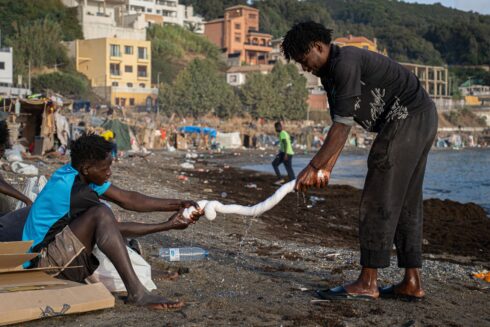
Around 70,000 people crossed into Ceuta, the Spanish enclave on Morocco’s coast, over 30 and 31 July. Around 5,000 remained a month later, of whom 1,200 were unaccompanied minors, Sanchez said.
More than 100 of those who stayed have since been deported for criminal offences, and Sanchez did not shy away from it.
READ MORE: Ceuta crisis latest: Spain pledges €165m emergency package as migrant tensions continue to boil over
“The full force of the law applies to everyone – whoever they are, wherever they’re from, whatever passport they hold,” he said.
In the same breath, though, he rejected the idea that the crisis should define how Spain treats migrants as a whole, and warned against politicians doing exactly that.
It’s also why, he said, Spain cannot simply close its borders.
“We need migrants – the labour force for an economy that is growing four times faster than the eurozone,” he said.
He backed it up with hard stats – 22.5 million people now pay into Spain’s Social Security system, the fund that covers state pensions and healthcare, more than at any point in the country’s history.
‘No turning back,’ says economist ahead of the curve
Josep Oliver has been arguing in favour of net migration to save the Spanish welfare state long before the backlash against it truly started.
The emeritus economics professor at the Autonomous University of Barcelona (UAB) published his first book on Spain’s reliance on migrants back in 2005, when the current wave of arrivals was just beginning.
“Economically, there is no debate. We need immigration – there is no turning back,” he said.
Without migrants, there is no growth, because Spain’s own demographics ‘do not allow it’, he explained.

Between 2017 and 2025, Catalunya alone created around 600,000 new jobs, and 96 to 97% of them went to immigrants, he said.
On Europe’s response to crises like Ceuta over 20 years later, Oliver has not changed his tune.
“We have decided to protect ourselves as if we were a rich neighbourhood with armed people, so that no one can enter,” he said.
“That is short-sighted. We will end up having the problem anyway.”
But don’t immigrants grow old too?
Not every Spanish economist reads the numbers the same way as Oliver.
Joaquin Leguina is a trained economist and demographer, and was the first president of the Community of Madrid, for the Socialists – Pedro Sanchez’s own party.
In a paper published in January by the Instituto Espanol de Estudios Estrategicos, a defence ministry think tank, he argued that immigration cannot fix what is fundamentally broken.
“Immigration can be a palliative – never a solution, because immigrants grow old too,” he wrote.
Research by the Real Instituto Elcano, Spain’s foreign-policy think tank, puts the country’s ageing-related public spending at 20.3% of GDP in 2022, rising to a projected 25.5% by 2050 – a jump of more than five percentage points in less than three decades.

He also took direct aim at the political argument Sanchez and others have made.
“The mantra that ‘nothing happens if Spaniards don’t have children, because immigrants will come’ is fallacious,” he wrote.
Leguina backed the point with a labour-market figure of his own: roughly all of the net new private-sector jobs created in Spain since 2018 have gone to immigrants, he found – meaning employment among Spanish-born workers has been flat or falling even as the headline jobs market boomed.
But there’s a catch
Not every economist agrees the story ends there.
Real Instituto Elcano has tracked where migrant labour actually ends up, and it is overwhelmingly in the country’s lowest-paid work – hospitality, care, construction, delivery.
Elcano’s research puts the pay gap at around €500 a month for workers from lower-income countries, using Social Security contributions as the measure.
This means that those jobs generate less tax revenue and so contribute less to topping up the social security pot than others.
It is roughly the same finding as a joint study by Fedea, a Madrid economic-policy institute, and BBVA Research reported in May.

Rafael Domenech and Florentino Felgueroso found that Spain’s 2025 mass regularisation of undocumented migrants barely moved GDP, while pushing up employers’ costs in the form of social security payments and holding down real wage growth for the rest of the population.
Immigration, in other words, may be keeping Spain’s population buoyant, where Italy’s is set to sink.
But whether it is doing so on fair terms for the people doing the work is a separate question, and one Sanchez was not asked directly.
Put simply, more people may mean a bigger economy but it does not necessarily mean a richer economy, especially under the economic model that Spain seems to be going for.
So is migration good or bad?
Take away the migrants, and Spain does not simply grow more slowly. Its population collapses by 37%, with a projected 21 million people less.
Would that collapse be a disaster?
While many might welcome it – failing technological revolutions in robotics and automation and generalised abundance – it would lead to the breakdown in the country’s social security system.
No more pensions and no more free healthcare without enough workers paying their upkeep.
That is the trade Sanchez, Oliver and Spain’s own statisticians all agree on, however much they disagree on the details – a smaller, older, poorer country, or a bigger, younger, messier one.
READ MORE: Inside Ceuta: thousands of migrant children on the pavement – and thousands more in the hills

But the migration bet buys continuity, not solvency – Spain’s pension deficit is still projected at 6.1 to 8.5% of GDP in 2050, even with migration running at record levels.
And whether the Spanish people want this kind of growth is another question. One that will come into sharper focus in the coming years.
Oliver’s own explanation for crises like Ceuta was never really about relations with Morocco – it was about the continent next door.
“This increase of 3 billion [people, globally, this century] – everything, everything, everything and absolutely everything, will be African,” he said.
Nowhere near enough jobs exist there to absorb it, he said. The real question facing Spain isn’t whether that growth keeps arriving on its doorstep – it will.
It’s whether the country builds the homes, wages and services to make it work – or lets chaotic mass intrusions like Ceuta become the pattern instead of the exception.
Click here to read more Spain News from The Olive Press.