
By Phil Daly
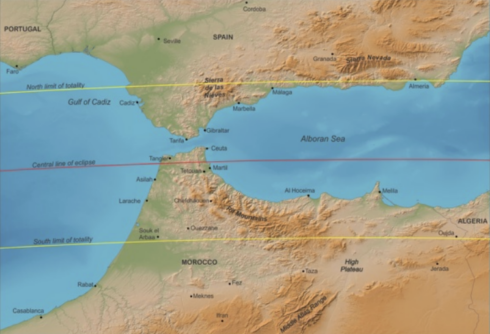
CADIZ will be plunged into total darkness on August 2, 2027, when a total solar eclipse passes directly overhead, placing the province within the 237-kilometre-wide path of totality.
Approximately 89 million people, out of 8.3 billion humans on Earth, will see totality as the eclipse passes over Spain, Morocco, Algeria, Tunisia, Libya, Egypt, Saudi Arabia, Yemen and Somalia.
Indeed, Cadiz and Tangier will see the eclipse make landfall first.
The last total solar eclipse over Cadiz was on December 22, 1870 (Saros cycle 120) and lasted 2 minutes and 8 seconds.
For this eclipse (Saros cycle 136), even though the eclipse umbral velocity will be a staggering 2900 mph, totality will last a shade longer (if you excuse the pun) at 2 minutes and 56 seconds.
You will have to wait until July 17, 2205 to witness such an event directly overhead again and that total eclipse (Saros cycle 149) will last 1 minute and 39 seconds.
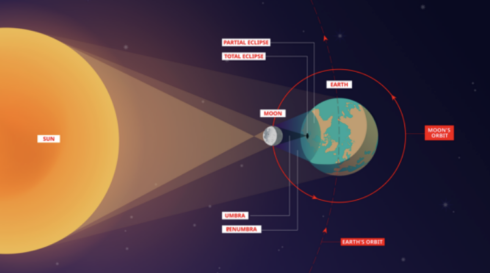
Fundamentally, a solar eclipse forms when the Sun, Moon and Earth line up such that the Moon occults, or blocks out, the Sun.
If the observer on Earth lies within the partial shadow of the Moon – the penumbra – a partial eclipse occurs and we see that the Moon takes a bite out of the Sun but does not completely cover the solar disk.
You may have witnessed this on August 12, 2026 when the partial eclipse over Cadiz lasted 1 hour and 35 minutes and 51 seconds.
Your northern neighbours in Spain, particularly near Bilbao, may have seen a total eclipse at that time.
If the terrestrial observer lies within the full shadow of the Moon, or umbra, one of two types of eclipse can occur: annular or total.
It may seem surprising that the Moon can completely block out the Sun.
After all, the Sun is about 400 times wider than the Moon.
But, by an extraordinary coincidence, it is also roughly 400 times farther away.
As a result, the two appear almost the same size in our sky.
But their apparent sizes are not always identical.
The Moon travels around Earth in an elliptical orbit, so its distance from us changes.
At perigee, its closest point to Earth, the Moon appears larger; at apogee, its most distant point, it appears smaller.
This same effect is behind the so-called ‘supermoon’, when a full Moon occurs close to perigee and appears noticeably larger than when it is farther away.
If the apparent diameter of the Moon is less than that of the Sun, a ring of light remains during the eclipse and this is known as an annular eclipse.
If the Moon’s apparent diameter is larger than the Sun, a total eclipse occurs.
Both total and annular eclipses are preceded and succeeded by partial eclipses.
On August 2, the Sun will have an apparent diameter of about 31 arcminutes and 31 arcseconds, while the Moon will appear slightly larger at 33 arcminutes and 26 arcseconds.
That difference of just 1 arcminute and 55 arcseconds, or 115 arcseconds, is enough for the Moon to completely cover the Sun’s bright disk and produce a total solar eclipse.
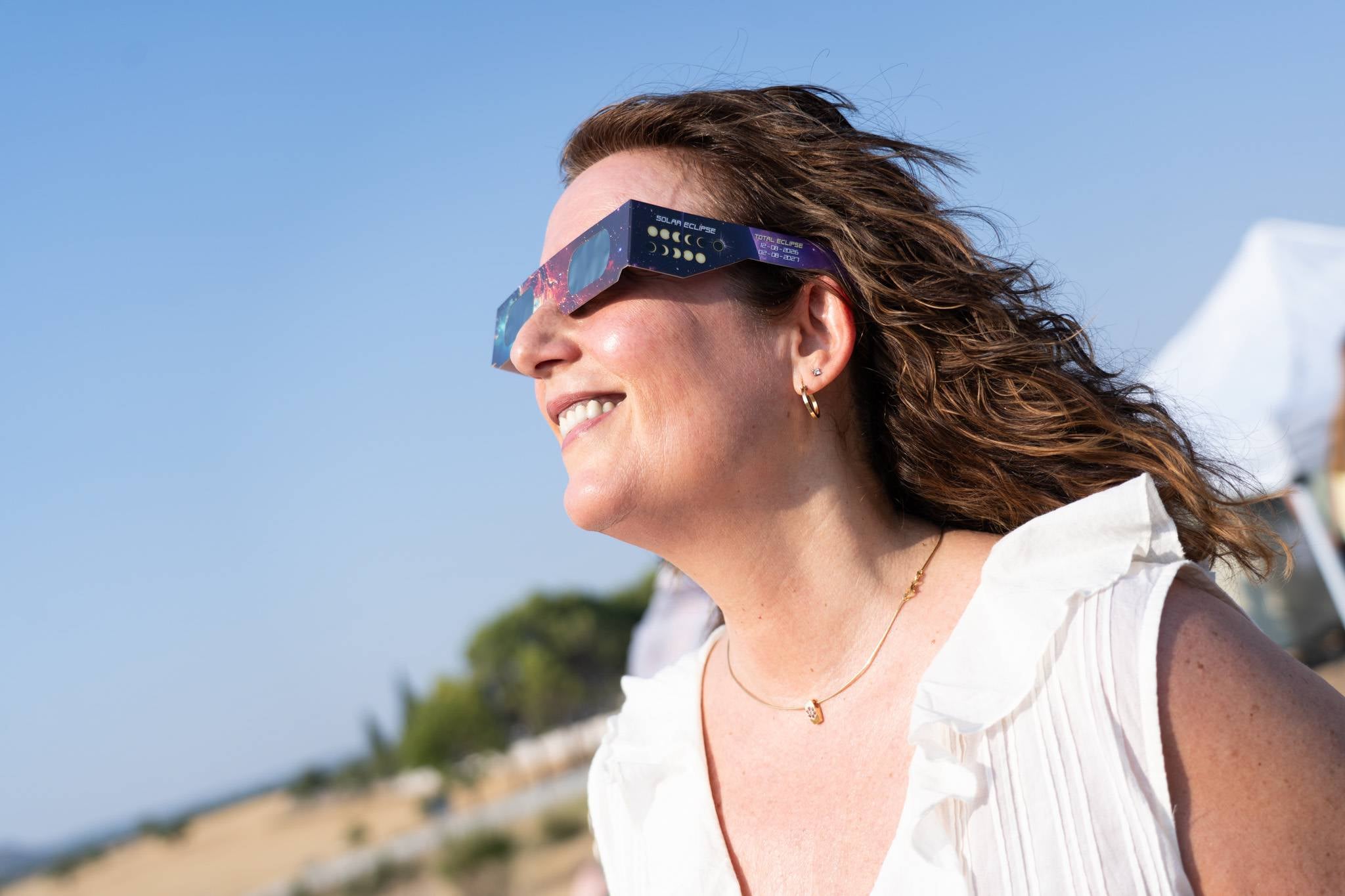
Safety first, though: never view the Sun directly, during any phase of an eclipse except totality.
Wear suitable eye-protection no matter what mode the observation may take: telescope, binoculars, camera or naked eye.
Regular sunglasses just won’t protect you enough.
Permanent eye damage may result if one does not use ISO 12312-2 compliant eclipse glasses for naked eye observing, a certified solar filter for telescopes, binoculars and cameras, or project the image onto a nearby screen or flat ground.
Solar eclipses are a wonderful experience which can be viewed safely with precautions – a good resource for safe observing is Eclipse Safety.
The table below provides current estimates for eclipse timing for Cadiz, Gibraltar, Malaga and Marbella.
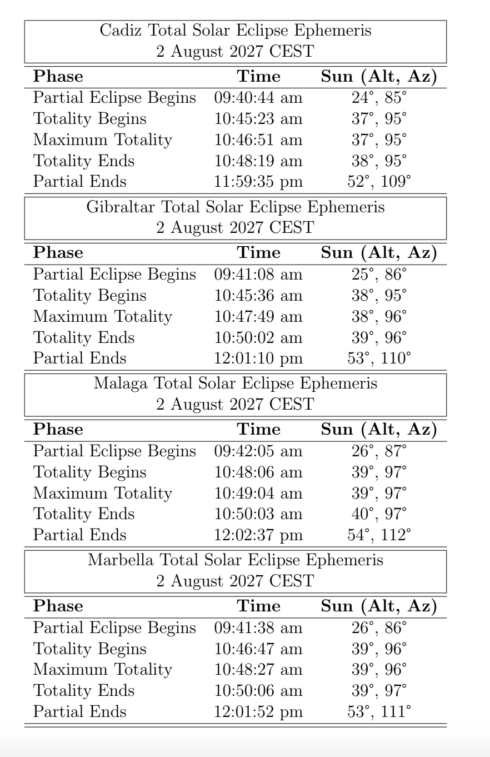
Always check local listings closer to the eclipse date to get accurate timings on the eclipse at your locale.
Remember to fulfill the checklist before the event: eclipse glasses, solar filter for camera, telescope or binoculars, groundsheet (to see ‘shadow bands’), skymap and stop watch.
Happy and safe viewing and see you on 2 August 2027!
Phil Daly BSc (Hons), MSc, is a freelance science and travel writer with a background in scientific research and a passion for explaining complex subjects in an engaging, accessible way.
Click here to read more Travel News from The Olive Press.