

MOROCCO’S recent and unprecedented military build-up has had Spanish military commanders reassessing their assumptions as mainland Andalucia falls within strike range.
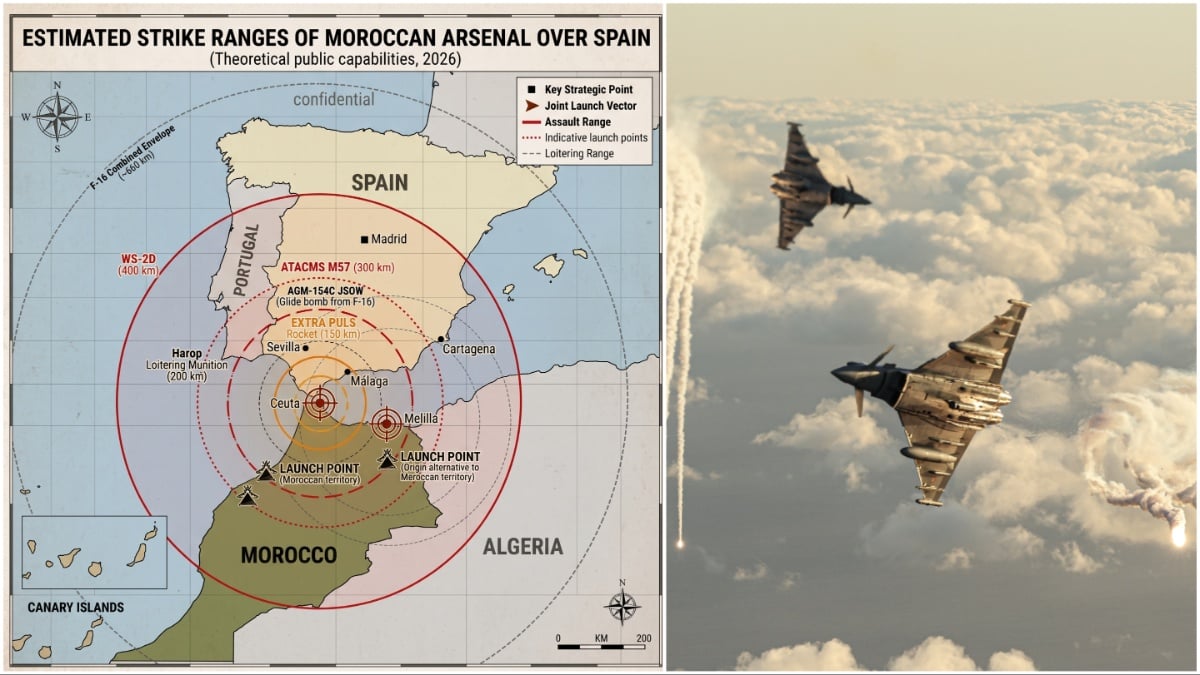
While a ground war is highly unlikely, a new threat map published by defence analysis group GEOPOL 21 reveals Morocco’s newly acquired weapons could reach the Spanish mainland without crossing the border.
It has prompted Spanish generals to warn that, if war broke out, they could disable their southern neighbour within a day through massive superiority in the air.
Tensions have been simmering since late July 2026, when an estimated 80,000 migrants attempted to cross into Ceuta, a Spanish enclave on the North African coast.
The border pressure has forced Spanish military planners to review contingency operations against a Moroccan ground force that vastly outnumbers their own.
Rabat’s Israeli-made EXTRA guided rockets have an operational range of 150km, sweeping across the Strait of Gibraltar and placing the western half of Malaga province in range.
Deeper inland, Sevilla, Cordoba and Granada sit within the 300km theoretical envelope of US-authorised ATACMS ballistic missiles.
Long-range Bayraktar Akinci high-altitude drones boast a mission radius of 1,000km, covering the entire Iberian Peninsula, the Balearics, and the Canary Islands.
Meanwhile, medium-range Bayraktar TB2 drones and Chinese-supplied Wing Loong systems carry line-of-sight flight ceilings of 150 to 300km.
READ MORE: Morocco militarises border with Ceuta amid growing fears of new mass crossing on August 15
Less confirmed are the possible loitering Israeli Harop and Harpy ‘kamikaze’ drones that Morocco may have in its arsenal, which report ranges stretching from 200km to 1,000km.
Locally produced SpyX munitions cover a 50km radius.
There are also unconfirmed reports that Rabat has Chinese WS-2D rockets at its disposal with a range of 400km, theoretically reaching into Extremadura and Castilla-La Mancha.
READ MORE: Spain’s PM Pedro Sanchez says ‘no evidence’ of Morocco being involved in Ceuta migrant crisis
General Francisco Jose Dacoba, former head of the Spanish Institute for Strategic Studies, warned that while Spain maintains an acceptable capability gap today, Moroccan acquisitions are rapidly eroding it.
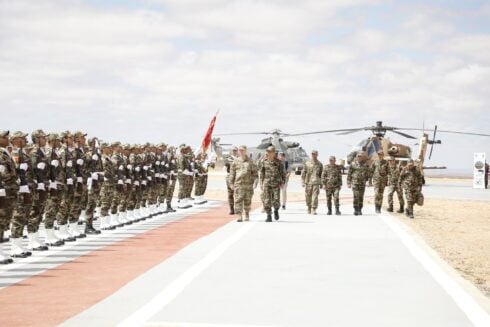
Rabat now commands nearly 400,000 active personnel and 250,000 reservists, dwarfing Spain’s 120,000 active troops and 15,000 civilian reservists.
Morocco’s armour inventory includes more than 900 tanks, featuring American-made M1A2 Abrams, alongside 17,000 armoured vehicles and over 500 self-propelled artillery units.
However, Spanish generals insist an armed invasion remains highly improbable because moving heavy armour requires flatbed transport trailers, visible fuel convoys, and exposed ammunition dumps.
Such a mobilisation would be instantly detected by satellites, triggering a devastating Spanish air campaign designed to eliminate Morocco’s critical infrastructure.
In Ceuta itself, a garrison of 3,000 stationed troops would not fight a border war, but rather lock down critical internal infrastructure, including desalination plants, power substations, hospitals, and the port.
Lieutenant General Francisco Jose Gan Pampols, former director of Spain’s Armed Forces Intelligence Centre, warned that any aggression would be met with total destruction.
He said Spain would immediately target the Maghreb-Europe gas pipeline, undersea high-voltage power cables, oil pipelines, and liquefied natural gas terminals.
“We have the capability to shut off Morocco in 24 hours,” he said, adding that everything that flies would be downed and everything that floats would be sunk.
Spain relies heavily on its qualitative advantage in the air, fielding 461 military aircraft against Morocco’s fleet of 260.
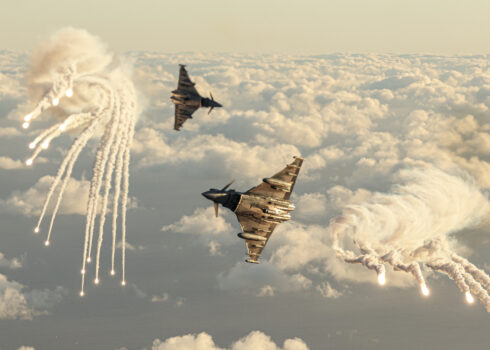
Madrid is currently acquiring 45 new Eurofighter Typhoons to replace its legacy fleet, which would carry bunker-buster cruise missiles like the German-made Taurus KEPD 350.
Morocco’s aviation relies on 84 front-line fighters, including F-16s and Mirage jets, backed by 24 contracted Boeing AH-64 Apache attack helicopters.
At sea, the Spanish navy maintains a decisive edge with five advanced F-100 frigates, upcoming F-110 replacements, and S-80 class submarines.
The Moroccan navy operates a French-built multi-mission frigate and two corvettes, but entirely lacks a submarine capability.
Despite this naval dominance, former fleet commander Admiral Juan Rodriguez Garat cautioned that modern warships struggle to operate near hostile coastlines due to ubiquitous shore-based anti-ship missiles.
Spanish contingency plans place the naval base at Rota, on the Cadiz coast, and the air base at Moron de la Frontera, near Sevilla, at the heart of any logistical resupply operation.
Legal authority to launch military action rests with the Spanish Prime Minister, while the Chief of Defence Staff oversees operations, potentially drawing on the Canary Islands Command for support.
Another factor to muddy the waters is the close cooperation between the Moroccan and US militaries, with the two holding joint exercises as recently as May.
Click here to read more International Affairs News from The Olive Press.









Seriously? Has the Olive Press really got nothing more useful to write about than making up a cock and bull fiction about Morocco attacking Spain with ballistic missiles? Are you now sponsored by Vox and Reform?
It was a quiet news day … AND food for thought!