

THE UN security council has approved a US-backed resolution that would grant Morocco sovereignty over the disputed former Spanish colonial territory of Western Sahara.
Eleven countries, including the UK, voted in favour of the measure, which described genuine autonomy under Moroccan sovereignty as the ‘most feasible solution’ to a decades-long conflict that has led to the deaths of tens of thousands of people.
Three members of the council – Russia, China and Pakistan – abstained on the vote, while Algeria voted against.
The vote sparked jubilant celebrations in Morocco, with King Mohammed VI hailing it as a ‘new and victorious chapter’ that would help to ‘bring this issue to a definitive close’.
Spain was the colonial power in the mineral-rich region from the late 19th century until 1975, when it withdrew under mounting international pressure in the dying days of Francisco Franco’s fascist dictatorship.
However, rather than organising a referendum for the Sahrawi people – an ethnic group native to Western Sahara – Spain signed the Madrid Accords with Morocco and Mauritania.
The agreement effectively transferred administrative control without UN approval and ignored a verdict from the International Court of Justice (ICJ) that those countries had no right to sovereignty over the region.
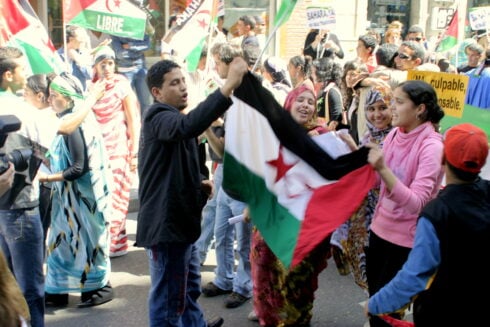
The decision kickstarted the Western Sahara conflict as the Polisario Front, a Sahrawi nationalist movement, unilaterally declared independence and launched a campaign of armed resistance.
Today, approximately 30% of Western Sahara is controlled by the Polisario Front, with the remaining 70% occupied by Morocco.
The UN classifies Western Sahara as a ‘non-self governing territory’, while the UN’s High Commissioner for Human Rights (OHCHR) has not been granted access to the region since 2015, and ‘continues to receive allegations relating to human rights violations including intimidation, surveillance and discrimination against Sahrawi individuals particularly when advocating for self-determination’.
A recent report from Amnesty International said that the ‘authorities continue to restrict dissent and the rights to freedom of association and peaceful assembly in Western Sahara’.
In August, acclaimed British filmmaker Sir Christopher Nolan came under fire from a series of figures, including Spanish actor Javier Bardem, over his decision to shoot part of his latest blockbuster in a Western Saharan city currently under Moroccan occupation.
The Odyssey, a take on Homer’s epic set to hit the big screen next July, was partly filmed in the coastal city of Dakhla, prompting criticism from Sahrawi activists and the organisers of the Western Sahara international film festival, who said the decision was an insult to those forced to live under occupation or go into exile.
Click here to read more Spain News from The Olive Press.