


FAMILIES in Madrid’s lowest-income district are spending more than half of their annual earnings on rent, new data has shown – as experts renew warnings that property prices in Spain are spiralling out of control.
Figures from Idealista and Idilico Realty showed that rents in Puente de Vallecas, in south-west Madrid, averaged nearly €18,000 a year in October.
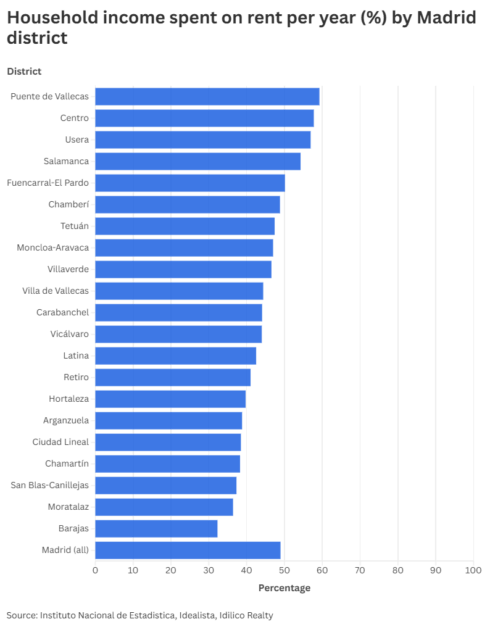
That amounts to around 59% of what local families earn in a year, according to 2023 data from Spain’s Instituto Nacional de Estadistica (INE) – the latest available, published last month and adjusted for inflation by the Olive Press.
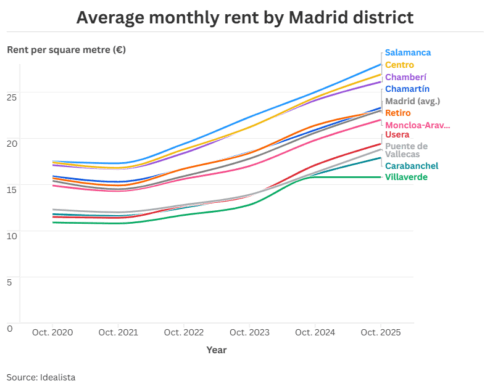
The findings came as monthly rent prices in Madrid reached an all-time high last month, hitting €23 per square metre – an eye-watering 49% surge compared with the same period in 2020.
Puente de Vallecas resident Sara (not her real name), a 38-year-old mother of two, said: “I really do not know how long we can go on like this.”
“We had to move houses last year after we had our second baby. Now we pay €1,400 a month in rent. My husband and I work all day, and yet we are saving no money at all. How are we ever going to afford our own house?”
The family now lives in a two-bedroom apartment on the first-floor of a residential building near Madrid’s ring road, Sara explained.
She added she was considering moving to the suburbs for the sake of her children, who are now aged one and six.
“It is going to be a long commute into work, but maybe that is what is best for the kids. We are already starting to feel crammed here. We see no other solution.”
Rents in Puente de Vallecas have increased an average of 52% since 2020 – a startling surge, rivalled only by Usera’s 68%, that is threatening the livelihood of what was once one of Madrid’s most affordable districts.
Soaring rent costs are also placing significant strain on other neighbourhoods in the city.
Households in central Madrid – where monthly rent averages nearly €27 per square metre – devote 57% of their annual income to rent.
In Usera, that figure stands at 56% – while the capital’s overall average sits at just below 49%.
In some of Madrid’s top-earning districts, the percentage is also high – surpassing 54% in
Barrio Salamanca this year – though households in these neighbourhoods have far higher annual incomes.
For residents of the Barajas district, by contrast, the figure sits at a more comfortable 32%.
After a temporary plateau in 2021, the alarming phenomenon has seen property listings Spain-wide remain on an upward trend for the past four years – with particularly sharp hikes in 2023.
Madrid was among the hardest-hit, but other Spanish cities – including Barcelona and Valencia – were also left reeling from recent surges.
Real estate expert Raul Garcia Molina, of Ysabika Servicios Inmobiliarios, warned the root cause was a dramatic imbalance between supply and demand.
“It does not matter whether you want to buy or rent: demand for real estate right now far outweighs supply,” Garcia said. “Landlords can continue upping the stakes purely because tenants will keep on paying.”
He stressed that today’s situation is very different from the 2008 crisis, when the global property market collapse was driven by an inflated bubble.
“Today, rents are soaring simply because there is a shortage of supply while demand is at an all-time high,” he said.
READ MORE: The data doesn’t lie: Why global funds are massively investing in Spain’s property market
“It is a feedback loop. Homes are selling like hot cakes: anyone can take out a loan, buy property, and rent it out. The mortgage pays for itself and you make extra money on top.”
Garcia added he did not foresee a crash like in 2008, but argued prices could begin to fall gradually once tenants can no longer afford what landlords are charging – provided new homes are built to ease the pressure.
“It does not matter whether it is public housing or private venture. If we free up land to build on and try to meet rising demand, prices will begin to drop,” he said.
Earlier this year, PM Pedro Sanchez’s government set up a new public housing company in a bid to relieve some of the pressure on tenants.
The company has been tasked with building affordable social housing across Spain, and is currently managing around 13,000 properties nationwide – with 17,000 more expected to fall under its remit in the coming years.
READ MORE: Spain’s housing crisis will continue for years because ‘house building is just not profitable’
Sanchez has also announced a new 2026 government programme aimed at boosting housing subsidies for young people, older tenants, and families with children.
In May this year, the PM ordered AirBnB to take down more than 60,000 of its listings across Spain as tensions erupted over the growing number of holiday rentals in some of the country’s major cities – including Madrid.
Earlier this month, left-wing Esquerra Republicana de Catalunya (ERC) proposed a bill to introduce a progressive tax increase on owners of three or more properties – but Parliament voted it down.
During an address in the lower house of Parliament, ERC spokesperson Gabriel Rufian stressed that housing was “the country’s main problem.”
He added: “It now takes up to 59 years of wages to afford a 60-square-metre flat. If bread had risen as much as housing, we would now be talking about a loaf costing around €13.”
Click here to read more Madrid News from The Olive Press.








This information is absolutely wrong the squatting is nothing like the PP is saying they only miss information to the.nation is every day giving by the right wing which want to get the socialist out I lived 20 years in Spain and I know their policies very well
Well you are probably more than right… And we clearly say this is criticism from the PP!
There is no doubt that squatting is a problem in Spain, but I think it is blown out of all proportion. That’s my personal view.