
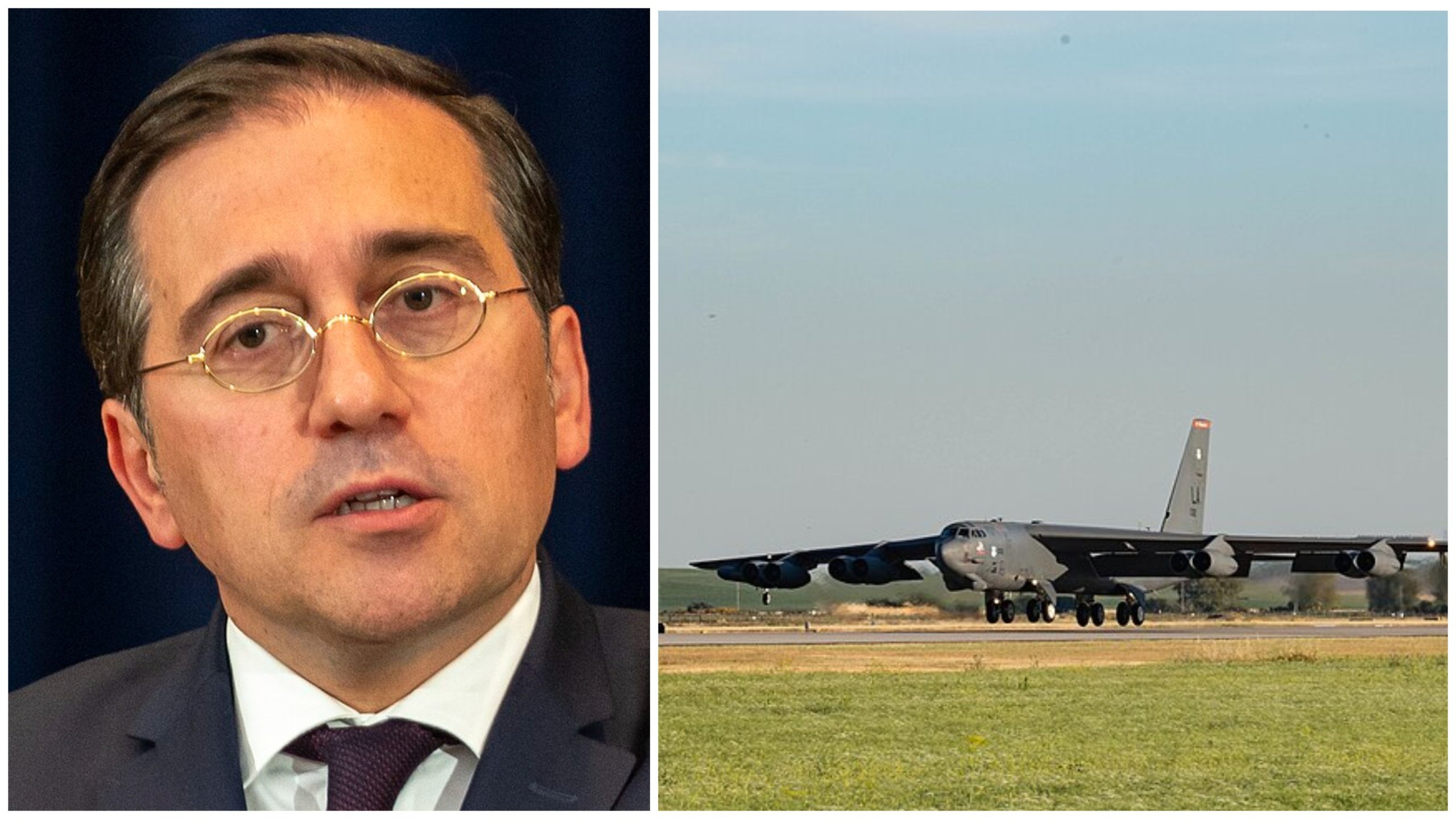
US military planes have left Andalucia after the Spanish government blocked the use of its bases for strikes on Iran.
Flight tracking websites showed fifteen US aircraft departing Rota and Moron, where they were permanently stationed, after foreign minister Jose Manuel Albares said that the bases could not be used for attacks on Iran.
Rota and Moron, in Cadiz and Sevilla province respectively, are jointly operated by the US – but fall entirely under Spain’s sovereignty.
The development came after senior officials, including Albares and prime minister Pedro Sanchez, decried the US-Israeli strikes on Iran as ‘unjustified’ and ‘dangerous.’
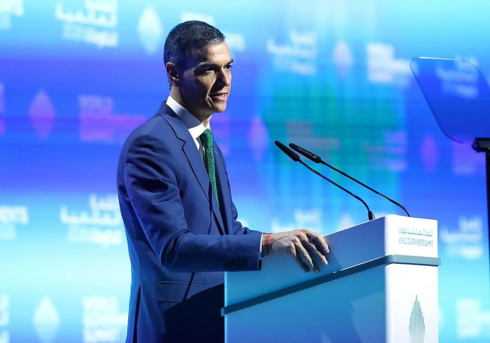
Speaking at the Mobile World Congress in Barcelona on Sunday, Prime Minister Pedro Sanchez called for an ‘immediate de-escalation’ after branding the attack ‘unilateral’ and a ‘breach of international law.’
“It is possible to be against a hateful regime, as Spanish society as a whole is against the Iranian regime, and at the same time be against an unjustified, dangerous military intervention that is outside international law,” Sanchez said.
“One must be against a war that was started without the authorisation of the US Congress or the UN Security Council and, as I said before, violates international law,” he added.
The remarks came after strikes by US-Israeli forces on Saturday killed Iran’s longtime ruler, Ayatollah Khamenei, as well as at least 555 people throughout the country, according to the Iranian NGO Red Crescent.
The conflict quickly spilled over throughout the Middle East, with retaliatory strikes from Tehran targeting Israel, Oman, Qatar, the UAE, Bahrain, Jordan and Cyprus, and reportedly downing several US fighter jets in Kuwait.
Spain was joined by a handful of EU countries – including Ireland, Sweden, Denmark and Slovenia – in criticising the war, while the UK, France, Italy and Germany publicly backed military action against Iran.
According to Spanish government sources, the conflict has created a rift among European nations, with a meeting of EU foreign ministers reportedly grinding to a halt on Sunday amid disagreement over a joint communiqué on the war.
Following the meeting, Albares said: “The role of the European Union must be to call for de-escalation – a return to dialogue, easing of tensions, diplomacy and negotiation – because through violence we will achieve neither stability, nor democracy, nor peace.”
Like Sanchez, Albares also slammed Tehran’s regime over the ‘brutal, inhuman repression against its population,’ but added that the solution could not be ‘unilateral military action.’
In an interview with Euronews, Israel’s foreign minister accused Spain of ‘siding with the tyrants,’ lambasting its foreign policy as ‘incoherent.’
But Albares hit back, batting off the criticism as ‘absurd and ridiculous.’
“Spain has a coherent foreign policy and we are always with democracy,” he said. “And we are doing coherently everywhere: in Gaza, in the Middle East, in Venezuela, in Greenland, in Ukraine.
“Very few countries in the world can say that.”
Separately, Spain’s King Felipe VI warned of the ‘obvious risk of regional escalation’ and the ‘unpredictable consequences’ of the conflict, calling for ‘the utmost restraint in the use of force, respect for the lives of civilians, and the pursuit of a diplomatic solution to the current logic of confrontation.’
But the government also faced pushback over its remarks, with Spain’s right apparently backing the US-Israeli onslaught.
Alberto Nuñez Feijoo, leader of the Partido Popular (PP), said: “The world is a better place when a tyrant falls.
“In Iran, for decades, the ayatollahs have upheld a regime of repression and constant threat. Millions of citizens have suffered persecution, imprisonment and death for defending basic freedoms.”
In a scathing criticism of Sanchez, Feijoo also argued that one can either stand with Washington or with the ayatollahs – not both, and not neither.
“Something is wrong when Hamas, the Houthis and the Iranian regime applaud [Spain’s] government,” he said.
“That is not defending Spain’s interests, but putting them at risk. Let us rise to that responsibility. With freedom or with tyrants.”
US-Israeli forces launched their attack on February 28 after talks with Tehran about the country’s nuclear capabilities fell through the previous week.
US President Donald Trump said Iran ‘could not be allowed’ to pursue nuclear ambitions, adding the war – dubbed ‘Operation Epic Fury’ – would last at least four weeks.
Iranian government sources have claimed the bombings killed hundreds of civilians, including children after a missile struck a school in the south of the country.
Although several of Iran’s military leaders were also killed in the strikes, the regime has since retaliated by launching attacks against US bases and US allies across the Middle East.
Striking social media footage shows bombed-out hotels and buildings in Dubai and Tel Aviv, as well as plumes of smoke billowing from US bases in Qatar and Bahrain.
As Iran’s retaliation widened, unmanned drones also struck an RAF base in Akrotiri, Cyprus, prompting Sir Keir Starmer to evacuate the families of military personnel stationed on the island.
Starmer has since announced that the UK would help the US with ‘defensive action,’ allowing American forces to use its military bases in Cyprus, though the UK had yet to launch strikes at the time of writing.
Meanwhile, Israel has launched a separate military operation against Hezbollah in Lebanon, with strikes in the south of the country killing 31 and injuring 149, according to the Lebanese health ministry.
In Pakistan and Iraq, demonstrations against the bombing campaign turned violent on Sunday. At least 23 protesters were killed in clashes in Pakistan alone, including 10 in Karachi after US consulate guards fired at demonstrators who breached the building’s perimeter.
Thousands of Iranian exiles in other parts of the world, however, took to the streets to celebrate the Ayatollah’s death – including in Spain, the US, Italy and Germany.
Click here to read more International Affairs News from The Olive Press.