

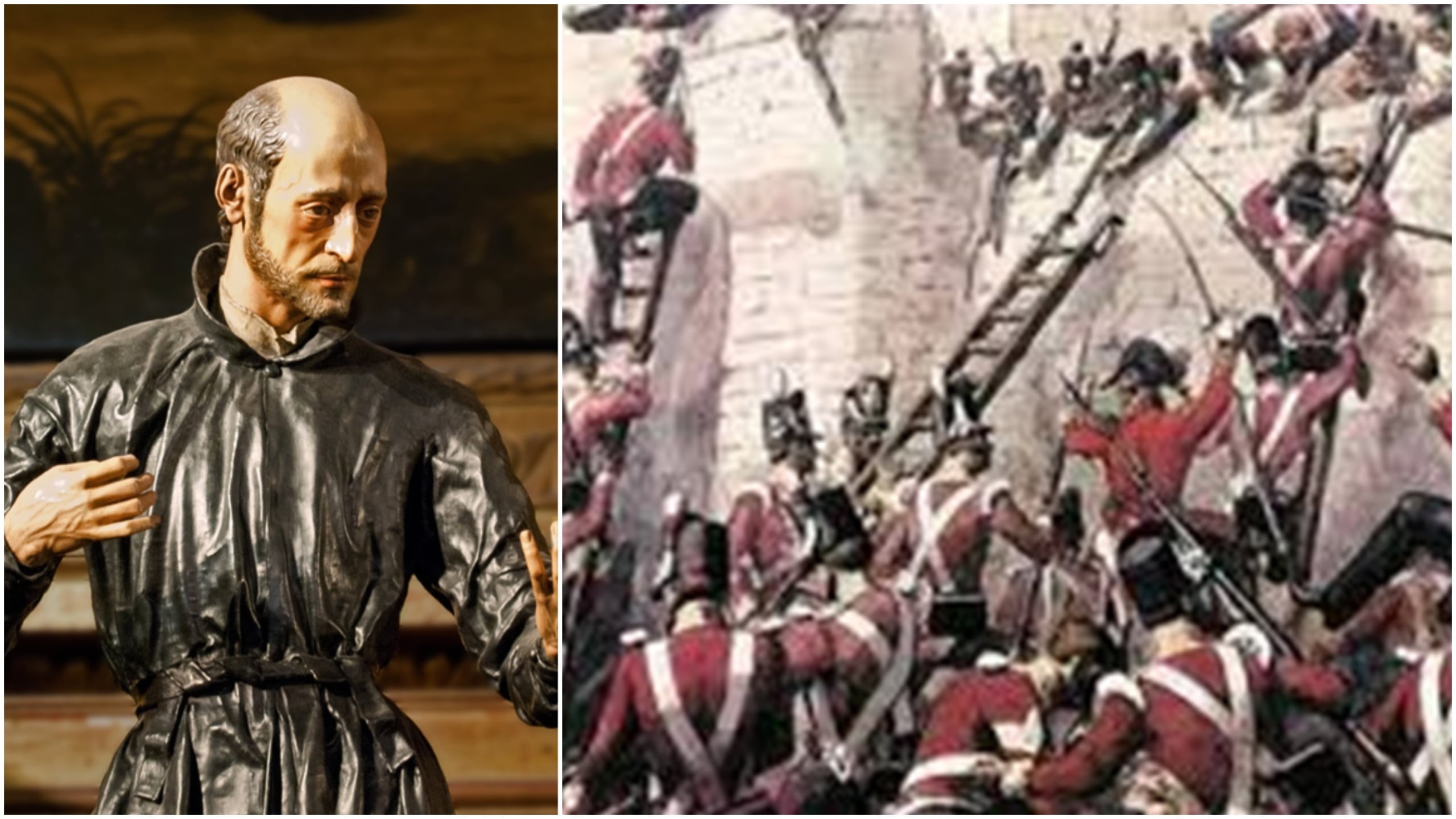
HAVE you ever wondered why those Holy Week processions – such a big feature of Andalucian life – get cancelled at the merest hint of rain?
It is because the ‘stars’, those statues of Christ and Mary carved out of wood, are very old and precious, and rain would severely damage them.
Many of them were carved by Juan Martinez Montañes in the 17th century.
He was so gifted at creating statues from the trunks of olive trees that he was known around Andalucia as the ‘God of wood’.
Born in Jaen on March 16, 1568, it was in Sevilla that he truly made his name.
Visit just about any church in Seville and its environs today, including the Cathedral, and you are likely to see the handiwork of Martinez Montañes.
His objective was realism, and to this end, he often used plaster to get the figure’s skin tone exactly right.
He almost always painted his statues, aiming at total verisimilitude.
His style was called ‘bringing to life’, as after carving the figure, he left it to dry naturally for six months.
Once the wood’s natural moisture was ‘sweated out’, he repeatedly sanded and filled the surface, sometimes taking years to obtain perfect results.
A legend in his own lifetime, Juan was showered with honours.
When King Felipe IV commissioned a statue of himself on horseback, he was advised that equestrian figures are notoriously difficult to model, so he ordered ‘the best’ to do the preparatory work.
Juan was invited to Madrid to carve the king’s likeness in wood, so that the Italian metalworkers would have something to copy.
While he was in Madrid, Juan was honoured by the royal family and he sat for a portrait by court painter Diego Velazquez, a fellow ‘sevillano’, in a rare gesture of respect towards a commoner.
He died in 1649, in his eighties, and his son Alonso followed him as a sculptor.
Centuries later, on March 16, 1812, the British army and its Portuguese allies laid siege to the Spanish city of Badajoz.
The three-week military operation would change the course of world history.
Between 1795 and 1812, the seemingly invincible Napoleon Bonaparte dominated Europe.
In those days, Europe was all that mattered, as the USA was tiny, China was weak and Africa was still in the Stone Age.
French armies defeated everyone, over and over again, and a British force had been driven out of Spain in 1809.
But by 1812, the tide was beginning to turn.
Napoleon tried to occupy Moscow, but Russia’s best weapon, its cold winter, wrecked the Grande Armee and the French were forced to withdraw.
It was at this point that Britain decided to land an army in Spain again.
The new commander was Sir Arthur Wellesley, soon to be renamed the Duke of Wellington.
While Napoleon was making plans to invade England, Wellesley set about driving the French out of the Iberian Peninsula, and Badajoz, on the Portuguese border, was the key.
The battle was very costly in terms of human life.
Essentially, the British crept forward to the city walls for two weeks, extending trenches inch by inch, under withering rifle and cannon fire.
Finally, Wellesley’s men were able to collapse the city walls in three places.
Now the really bloody work began of charging the French defences in a frontal assault.
About 5,000 British soldiers were killed in a few hours of fighting, but the attack was successful and Badajoz surrendered.
The world saw that the French could be beaten in open battle, and Napoleon’s career was downhill from here.
Psychologically, he never recovered from the loss of Badajoz.
In 1813, Sweden, Prussia and other small nations joined the fight against the retreating French.
Napoleon was captured and exiled to the island of Elba, in the Mediterranean.
He escaped and rallied the French army to him, thus beginning the ‘hundred days’ and the Corsican’s attempt to recover what he had lost.
But it was not to be.
The Duke of Wellington’s Badajoz veterans were occupying what is now Belgium.
They confronted the French on an open plain known as ‘Waterloo’, and Napoleon’s glory days were definitively put an end to.
Click here to read more Spain News from The Olive Press.



A great summary. Clear, entertaining and sensible.
Thank you, Brad. I’m glad you liked it.
Michael Coy