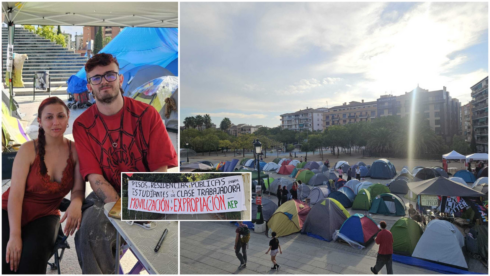


SPAIN’S Council of Ministers has rubber-stamped a government plan worth €7 billion to combat a lack of housing in the country.
The initiative triples government investment in public housing over the next four years.
It guarantees that subsidised housing cannot be reclassified after a few years and also brings aid to younger renters and home buyers.
READ MORE:
- Spain’s housing crisis is a ‘political choice’ to protect wealthy property owners at the expense of younger generations, claims top researcher
- Plush Costa Blanca locale launches urgent survey for struggling residents to tackle housing and rental crisis with fresh subsidised homes
- Spain stands ready to build up to 2.4 million new homes to ease housing crisis, government claims

Housing Minister, Isabel Rodriguez said: “The public is demanding an agreement to address the main problem currently affecting them.”
Increasing rents and housing costs have been a growing problem in Spain’s property market over recent years with a rising population and tourist housing in cities regarded as key factors.
About 40% of the €7 billion will be earmarked for growing the public housing supply, which Spain lacks compared to the European average, while 30% will be set aside for property renovations.
That will include funds for making homes more energy-efficient and building in depopulated parts of the country.
The rest will go toward subsidies, with a focus on young people.
“It is a significant step forward. For the first time in decades, there is a serious budgetary commitment,” said Raluca Budian, associate director of the Observatory for Decent Housing.
Housing costs in Spain rose nearly 13% year-on-year at the end of 2025, according to the EU statistics agency Eurostat.
Spain ranks near the bottom of Organisation for Economic Co-operation and Development countries with public housing for rent, with under 2% of available supply.
The OECD average is 7%. In France, it is 14%, Britain 16% and the Netherlands 34%.
In the past, Spain built housing with public funds that later passed into private ownership.
Once they were sold, they disappeared from the public housing stock.
Click here to read more Property News from The Olive Press.