

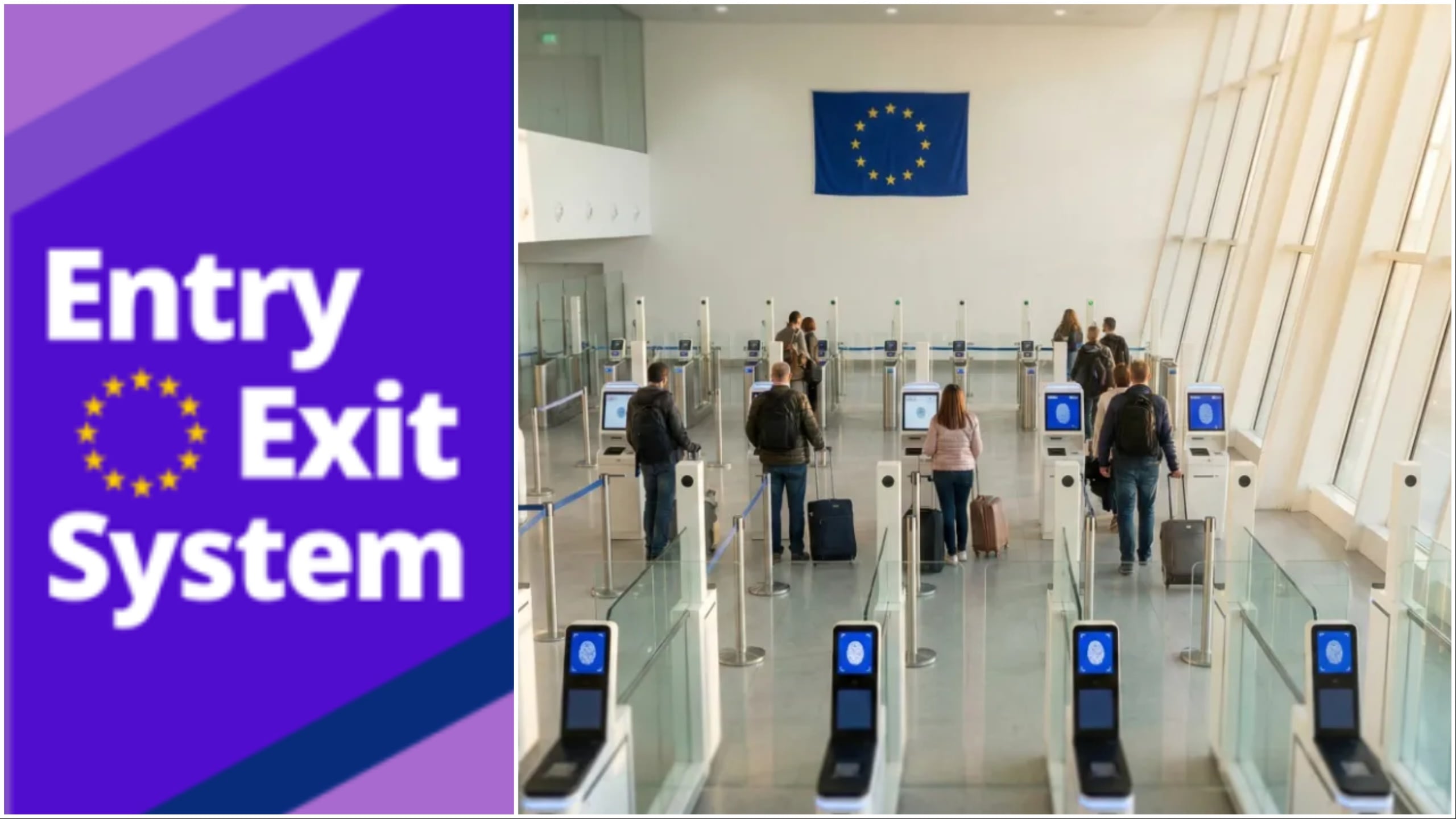
WITH confusion aplenty surrounding the rollout of the EU’s brand-new Entry-Exit System (EES), recent airport experiences from travellers are offering an insight into what future passengers should expect upon their arrival in Spain.
Many of those spending their summer holidays in Spain will have heard their fair share of horror stories surrounding EES, which kicked into gear at all entry points to the Schengen zone on April 10.
Some travellers have missed flights due to long border control queues and, after landing, waited for hours to get their finger prints registered.
While these experiences have been shared across national news outlets, there is less detail on how the EES process actually works and what stages passengers should expect to go through when they arrive in Spanish airports.
READ MORE: Spain silent on EES as Greece, Portugal and Italy relax biometric entry rules for British travellers
Graham Edwards told the Olive Press that he recently flew into Malaga airport, where he ‘finally got to use the new entry system’.
After leaving the plane he ‘instantly’ joined a queue ‘which seemed endless but was in fact relatively short’.
All passengers that were on Edwards’ flight arranged themselves into single file with no members of staff telling them what the queue was for, or who should be in it.
Upon reaching the end of the line, it was revealed that those with EU passports could have skipped past this stage.
Eventually Edwards reached the registration machines, saying that ‘the process of registering literally took seconds’.
READ MORE: Ryanair urges Spain to scrap EES rollout to avoid summer of border queue chaos
Individuals are simply required to place their hand on the fingerprint glass and their passport on the designated space on the machine.
The EES replaces human-controlled passport stamps with facial recognition and fingerprint scans, digitally recording the movements of all passengers.
Following this registration, passengers walked through to passport control where ‘there were three gates: the EU one, a UK one and an e-gate’.
Staff explained that those who had registered themselves on the EES system should head to the e-gate and that the aforementioned taking of finger prints only needs to happen once every three years.
After arriving at the e-gate Edwards just had to present his passport and pop his hand on the fingerprint glass.
Just ‘seconds later’, he was through.
READ MORE: Spanish airports introduce new rules to help families amid EES border queue chaos
For this passenger the process only took about 40 minutes – but others have not had the same luck.
Stuard MacLennan told The Guardian of his arduous journey from Glasgow to Malaga last month, with the Scotsman forced to wait in queues upon arrival in Spain for over two hours with his young children.
Echoing Edwards words, he said that ‘there was no real direction as to where to go’.
“After about half an hour, we were moved into a different line because we had children under the age of 12,” he continued.
“We then queued for two-and-a-half hours before we eventually got to passport control.”
Both the EU route and the EES registration queue join up at passport control in Malaga, according to Edwards, so, as far as he was made aware, those who have already registered or are members of the EU should skip the registration line.
Glenn Russell, a Gibraltar resident, thought that this was the case, too.
He flew into Malaga airport last week and ‘registered on the new EES system without any issues and went through the non-EU e-gates’.
Three days later he went to the airport’s registration area and was told that since he had already registered he could pass straight through to the e-gates.
“That turned out to be a mistake,” he explained.
The system failed to recognise Russell as registered and so he was sent to manual control where the officer informed him that staff had been told to ‘continue stamping passports for Gibraltar residents until at least July, when things should be sorted out’.
Russsell therefore advises that ‘even if you’ve already registered on the EES system, don’t assume it will carry over’.
“Be prepared to register again on arrival, don’t rely solely on what you’re told at the desks and make sure your entry/exit is properly recorded (either stamped or digitally),” he noted.
After making his way out of Malaga airport and arriving at the Gibraltar frontier, Russell then requested an exit from Spain which was ‘done digitally’.
This directly contradicts the experience of Gemma Podesta, who was told that if you have been digitally checked or received a physical stamp at Malaga then you will not require another stamp at the Gibraltar frontier.
“At the moment, it really feels like there’s no consistent process in place,” Russell concluded.
On a similar note, Edwards said: “The lack of information is causing many unnecessary problems and inconveniences to many people.”
Click here to read more Travel News from The Olive Press.








Recent entry and exit intio Las Palmas has been faster than returning home to Manchester.