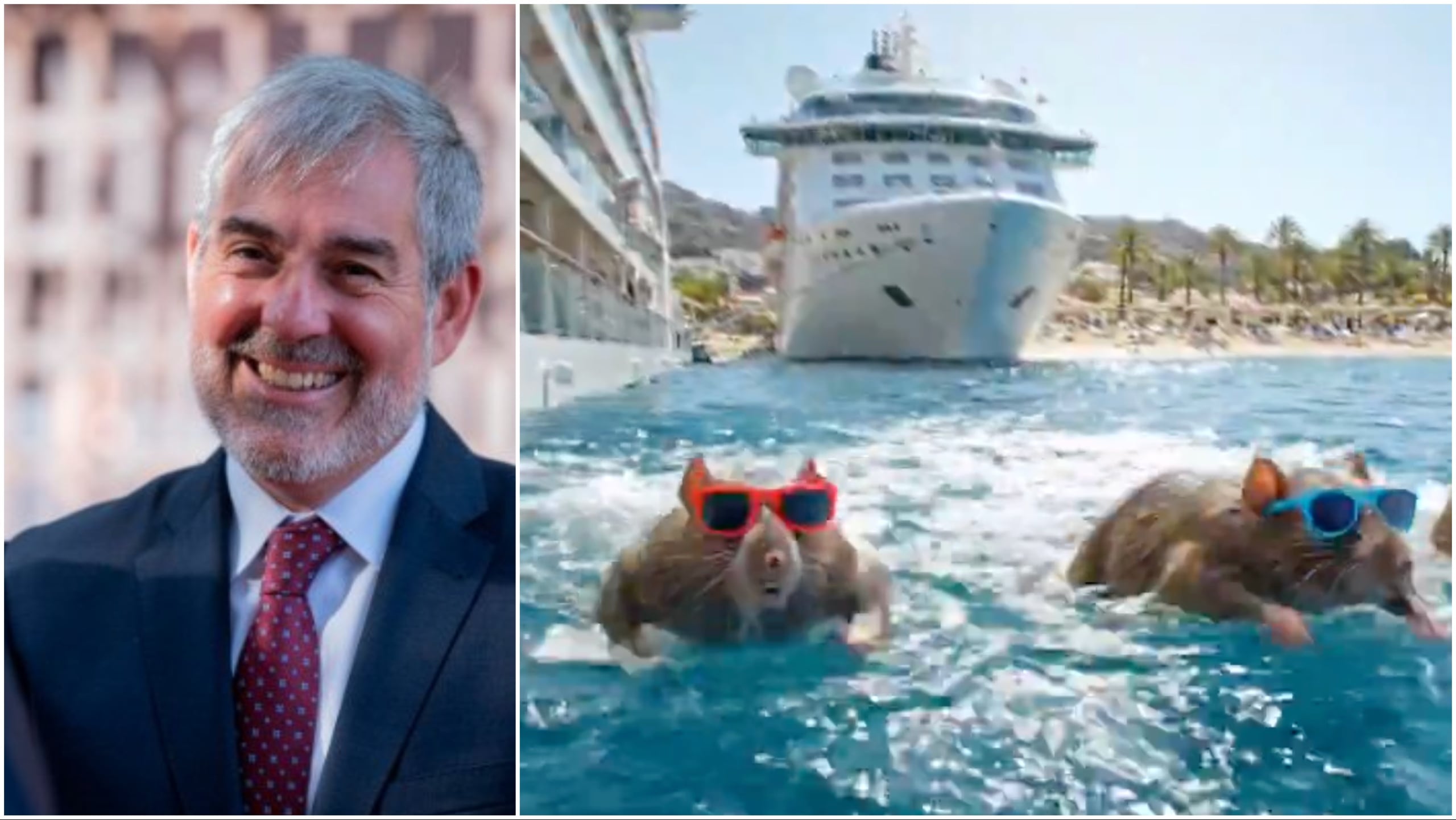
THE president of the Canary Islands has been mocked for sending Spain’s health minister a screenshot of a Google AI response claiming hantavirus rats can swim.
Fernando Clavijo used the claim to try to block the hantavirus-hit cruise ship MV Hondius from docking in Tenerife.
He has since been the subject of various mocking AI videos and memes across Spain after the country’s Health Ministry produced a formal scientific report demolishing every premise of his argument.
Leaked WhatsApp messages between Clavijo and Health Minister Monica Garcia revealed the exchange.
At 17:13 on Saturday May 9, Clavijo sent Garcia a screenshot of a Google AI response that read: “Yes, rats are excellent swimmers and can survive in water for long periods, even up to three days in a row.”
The screenshot — which he used to justify his refusal to allow the Dutch-flagged Hondius to anchor off Granadilla port — included links to YouTube videos that allegedly supported the theory.
It landed at the height of an international evacuation operation supervised by the World Health Organisation, with 147 passengers and crew on board.
Three deaths and six confirmed hantavirus cases had already been linked to the outbreak.
Garcia replied at 22:46 with an official document titled Informe Roedores — Rodent Report.
The report systematically dismantled Clavijo’s claim.
It identified the natural reservoir of the Andes hantavirus as the Patagonian long-tailed mouse (Oligoryzomys longicaudatus) — a nocturnal forest species found only in the Andean woodlands of southern Chile and Argentina.
“It is not a rodent with the capacity to move by swimming from the location of the ship to the coast,” the report stated.
It added that the species is not present in Europe, does not live in port areas, and that no rodents had been detected on the Hondius during onboard inspections by international experts.

The vessel — a modern expedition cruise ship operated by Dutch firm Oceanwide Expeditions — also held a Maritime Health Declaration confirming its hygiene standards and the absence of rodents on board.
The Ministry’s working hypothesis is that several passengers were exposed to the virus during a pre-cruise trip through Chile and Argentina before boarding in Ushuaia on 1 April.
They are then thought to have passed it to other passengers on board.
Despite receiving the report — and having had its contents previewed in person at Granadilla port earlier the same evening — Clavijo continued trying to block the ship.
He later claimed he had received no technical report confirming ‘zero risk’ from Madrid and that passengers disembarked without undergoing a PCR test.
Spain’s Secretary of State for Health, Javier Padilla, publicly ridiculed Clavijo on TV programme laSexta Xplica.
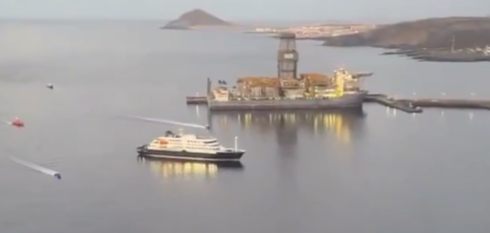
“That idea he had of an infected mouse jumping off a ship to swim 200 metres and climb up the dock to colonise Tenerife is not a risk,” Padilla said.
He demanded Clavijo ‘explain whether this was a brain fart or whether there is any rationality behind this behaviour,’ and accused the Canary Islands president of ‘playing politics to boycott a globally important operation’.
Anonymous Health Ministry sources told laSexta it was ‘irresponsible for a regional president to use disinformation as a political weapon,’ adding that his actions ‘put the population at risk’.
Clavijo has since doubled down. Speaking to media on Sunday, he insisted: “It is not expected that they could colonise us, but it cannot be ruled out.”
Spain’s central government ultimately overruled the Canary Islands government by ministerial order, taking direct control of the operation under WHO supervision.
The Hondius arrived at Granadilla port at around 5:30am on Sunday 10 May.
Disembarkation began at 9:40am, with passengers ferried in small boats to shore wearing full hazmat suits before being driven to Tenerife-Sur airport for repatriation flights.
A total of 94 passengers of 19 nationalities disembarked on the first day — including 20 British nationals.
The British passengers, along with one German national resident in the UK and one Japanese national repatriated at the request of Tokyo, were flown to Arrowe Park Hospital in Wirral, northwest England.
They will be asked to isolate for up to 45 days, according to the UK Health Security Agency.
Spanish nationals were the first off the ship and were flown to a military hospital in Madrid.
The 17 American passengers — plus one British national resident in the US — were flown overnight to the University of Nebraska Medical Center in Omaha.
One of the Americans tested ‘mildly positive’ by PCR for the Andes virus during evacuation, while another was showing mild symptoms.
A woman in Barcelona is also being monitored after contact with a hantavirus case. She remains asymptomatic and her PCR test was negative.
WHO Director-General Tedros Adhanom Ghebreyesus, who supervised the operation in Tenerife, told reporters: “This is not another Covid.
“The risk to the public is low. They shouldn’t be scared, and they shouldn’t panic.”
The Hondius will now sail to Rotterdam with a skeleton crew of 30 for disinfection.
The body of one passenger who died on board remains on the ship for repatriation.
More than 500 cruises a year arrive in Europe from Argentina and Chile, where the natural reservoir of the Andes hantavirus lives.
There has never been a hantavirus outbreak in European territory from these voyages.
Click here to read more Canary Islands News from The Olive Press.