
WELCOME to the latest edition of ‘This Week in Spanish History’ , written by Michael Coy.
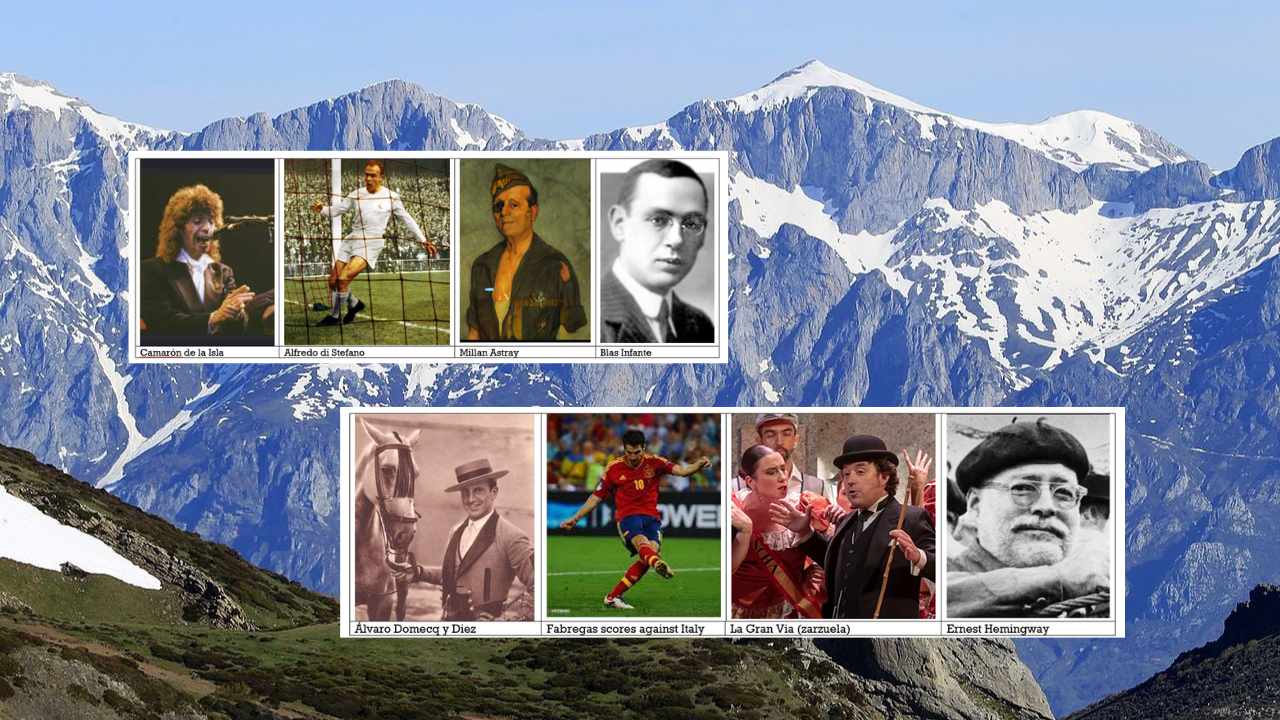
1 JULY, 1917 – ÁLVARO DOMECQ IS BORN
Alvaro Domecq y Diez (not to be confused with his son, Alvaro Domecq Romero) was an aristocrat, wine merchant and horseman who dominated Jerez society throughout the second half of the twentieth century.
His family, and their neighbours, the Gonzalez, cashed in on the British craving for sherry, and grew immensely wealthy on the proceeds.
What is little-known is that Alvaro fought in the Spanish Civil War as a fighter-pilot.
He believed himself to be ‘cursed’: seventeen of his 19 children died in infancy, and four grandchildren were killed in a car crash.
1 JULY, 2012 – SPAIN ARE FOOTBALL’S WORLD AND EURO CHAMPIONS
The Spanish proverb, ‘no hay dos sin tres’ (“you don’t get two without a third”) certainly came true in Kiev in July 2012.
The national football team went into the final tournament of UEFA 2012 as reigning European and World Champions.
They got to the final – but could they beat Italy?
They certainly could! It turned out to be a walk-over. Four goals secured the trophy, and a record that may never be equalled!
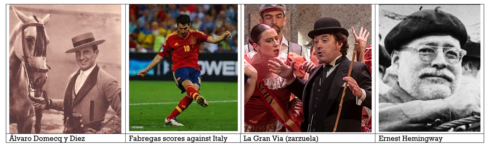
2 JULY, 1886 – ZARZUELA ‘LA GRAN VIA’ PREMIERS
This may be a new art-form to some of our readers.
Zarzuela is a stage musical with a Victorian flavour, a sort of Spanish Gilbert and Sullivan.
You don’t often see it in Andalucia – it’s regarded as a ‘Madrid thing’.
This one – La Gran Via – is one of the best, and most typical, of the genre.
Indeed, itis the only zarzuela to have ‘broken out’ of Spain, having been performed to applause in Paris and Vienna.
2 JULY, 1961 – HEMINGWAY COMMITS SUICIDE
Ernest Hemingway did a lot for Spain.
He lived here, more or less permanently, between 1928 and 1937, and then again in the late 1950s.
His books taught the world about Spanish customs and pastimes, and he established some sincere and lifelong friendships.
On the downside, he displayed suicidal tendencies (his father had killed himself) and during his last ‘tour’ of Spain he was clearly failing, and usually drunk.
Diminishing physical powers seem to have prompted a deep depression.
He shot himself in Idaho, just as the ‘running of the bulls’ was getting under way in Pamplona.
2 JULY, 1992 – CAMARON DIES
Jose Monje Cruz will always be known to the world as ‘Camarón de la Isla’, the legendary flamenco singer.
Indeed, Camaron and his accompanying guitarist, Paco de Lucia, are the ones who revived flamenco and made it ‘cool’.
Anyone who wants to claim flamenco authenticity must be of gypsy ethnicity, and a native of San Fernando (just outside Cadiz, and known as ‘La Isla’).
Camaron ticked all the boxes. A heavy smoker and drug-user, he was only 41 years old when his life drew to its close.
4 JULY, 1926 – ALFREDO DI STEFANO IS BORN
There are few footballers who have earned a following such as ‘the blonde arrow’, Alfredo di Stefano, enjoyed.
He was born in Argentina, but became a Spanish citizen. It was in 1953 that he signed for Real Madrid, just in time to create a sensation.
Post-war football was about to go European. Real Madrid won the Champions League (the European Cup, as it was then known) every single year for the first five seasons it was played.
The inspiration, indeed the very symbol of that team, was Alfredo di Stefano.

5 JULY, 1879 – MILLAN ASTRAY IS BORN
If you mention Jose Millan Astray to any Spaniard, you will have his catchphrase quoted back at you – “¡A mi, la Legión!”
Millan Astray is an example of a kind of Spanish machismo that no longer exists.
A soldier with a mystic sense of patriotism, he was wounded grievously – losing an arm and an eye, and being shot in the chest and legs many times.
In the 1920s he formed a ‘special forces’ unit, known today as the Spanish Legion, the spearhead of the nation’s army.
5 JULY, 1885 – BLAS INFANTE IS BORN
Blas Infante was as different from Millan Astray as it’s possible to get.
From Casares, near Malaga, he was a patriot who wanted recognition for Andalucia.
In the years around the First World War, he campaigned tirelessly for the region’s rights.
He composed an Andalucian anthem (still sung on 28 February), and the current green-and-white flag was his design.
Franco’s followers considered him an enemy of Fascism, and murdered him in Sevilla in 1936.
Click here to read more Spain News from The Olive Press.