

Welcome to the second edition of our latest series, ‘This Week in Spanish History, written by Michael Coy
25 JUNE, 1852 – ANTONI GAUDI BORN
Neoclassicism was the style of art and architecture which dominated the Western World from about the year 1700 well into the twentieth century.
It derived its tenets from ancient Greek and Roman ideas.
Modernism, the movement which Spain (especially Catalunya) gave the world, was a reaction to Neoclassicism.
Its leading light was Antoni Gaudi, designer of La Sagrada Familia.
Ironically, the architect who hated straight lines lost his life in 1926 when he tried (unsuccessfully) to cross the tracks in front of a Barcelona tram.
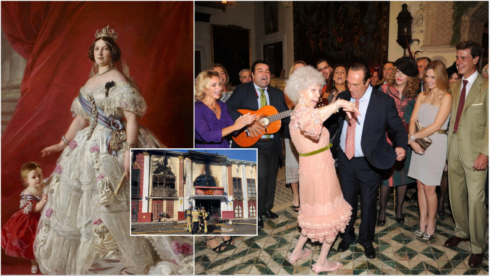
25 JUNE, 1870 – QUEEN ISABELLA ABDICATES
Queen Isabella, they say, liked big, muscular Scotsmen.
She employed plenty in her Imperial Guard. Metal belt buckles were ordered, with the legend, “Guardia Imperial de Reina Isabella”.
She was told that the number of letters had to be reduced, so she settled for ‘GuIRI’.
As the ‘royal jocks’ strutted around Sevilla, flashing their special buckles, they earned a new nickname – ‘guiris’.
Still quite young (40) when she lost the throne, Isabella lived another 35 years in exile in Paris.
READ MORE: Last laugh? Spain’s newspaper cartoons face an uncertain future in the digital age

25 JUNE, 1983 – THE GARROTTE IS ABOLISHED
This method of execution consists of a high-backed wooden chair, with a circular metal band.
The metal band has a prominent dimple, and can be tightened by means of a lever behind the chair.
Victims are killed by having the band placed around their necks and tightened. Death occurs either by strangulation, or the ‘dimple’ snapping the spinal column.
By 1983 Spain was trying to shake off its dark past, so the death sentence – and the garrotte – had to go.
26 JUNE, 1975 – OPUS DEI FOUNDER DIES
Josemaria Escriva de Balaguer was a Catholic priest.
His life and work are best understood in the context of Francoism.
In 1928 (as Franco was coming to prominence in the Spanish army) Escriva launched Opus Dei, a pro-Fascist organisation which operated within the Church.
But the movement’s ideas – such as the secondary role of women in society – were increasingly at variance with the views of most Spaniards.
Opus Dei’s fortunes declined as the Dictatorship faded, and both Franco and Escriva died in the same year.
26 JUNE, 2023 – ‘VERGIL’ AMPHORA FOUND
Three years ago, in an archaeological dig near Cordoba, something unusual was discovered.
We all know the giant shadow Shakespeare casts over British culture. Vergil, the Latin poet, was an even bigger phenomenon in imperial Rome.
His Aeneid tells the story of Rome’s founding. His earlier work, the Georgics, explains the agricultural world to Rome’s city-dwellers.
An amphora (clay olive-oil jar) was dug out of the Andalucian soil which is inscribed with lines from the Georgics (200AD)
27 JUNE, 1957 – SEAT 600 GOES ON SALE
Anglo-saxons tend to associate ‘cool’ driving with big cars, a lot of horsepower and an open road.
That has never been the way of the Latin races. In Madrid or Milan, the idea is to have a small, nippy vehicle which can weave in and out of urban traffic.
On 27 June, 1957, SEAT put its ‘600’ on sale. This tiny car with a motor-bike engine (a shameless rip-off of the Italian Fiat 600) was an instant winner.
READ MORE: Getting to know Antoni Gaudi: The Catalan architect’s masterpieces you’ve probably NEVER heard of
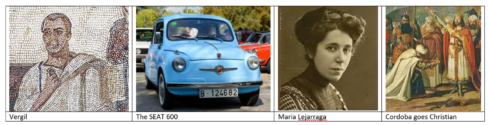
28 JUNE, 1974 – MARIA LEJARRAGA DIES
Maria Lejarraga was one of those people who can make a success of whatever they attempt.
She was born in the Rioja district and from an early age showed signs of high intelligence.
By the era of the First World War, tiring of teaching languages, she decided to write musicals, and penned some big hits.
Later, as a politician, feminism was her big passion.
There was no room for her ideas in the Spain of the 1930s, so she moved to Switzerland.
Back in Spain in the 1970s, she saw her beliefs triumph. Maria was 100 years old when she died.
29 JUNE, 1236 – CHRISTIANS CAPTURE CORDOBA
When King Ferdinand III took control of Cordoba on 12 June 1236, it was a very big deal for the whole world.
The city on the Guadalquivir River had been the ‘Rome’ of Islam for centuries.
In those days, there were Muslim popes (known as ‘caliphs’), and Cordoba is where they ruled.
But now it was a Christian city. Imagine the party they’re going to have, ten years from now, when they celebrate Cordoba’s 800th birthday!
Click here to read more Spain News from The Olive Press.