


ITALY has threatened to suspend the Schengen Agreement with Spain after tens of thousands of migrants poured into Ceuta yesterday and overnight.
Similar pressure has seen hundreds slip into Spain’s neighbouring African exclave of Meliaa overnight, forcing its border shut.
Ceuta and Melilla are two autonomous Spanish cities on Africa’s Mediterranean coast, both bordering Morocco, and both are now under the same pressure that has defined this week’s crisis.

Around 400 people got into Melilla overnight, Melilla president Juan Jose Imbroda said, after crossing by land and sea at several points along the perimeter at once.
The Beni Enzar crossing, the only official border post between Melilla and Morocco, has been shut since 10pm on Thursday, with no reopening time given.
Police sources said stones were thrown, a bus was set alight and shots were fired at the Melilla border overnight, in the worst night on this frontier since May 2021.
READ MORE: Fourth body pulled from the sea off the Costa del Sol – as Ceuta border crisis sees dozens drown
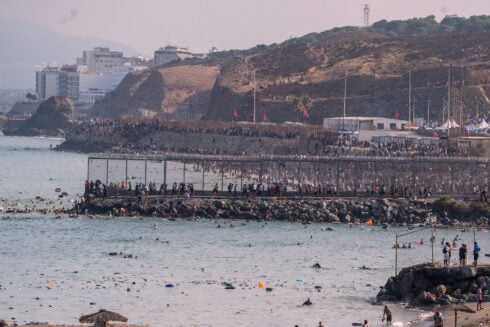
In Ceuta, the death toll from Thursday’s crossings has risen to 18, after the Guardia Civil recovered 15 bodies through Thursday afternoon and Salvamento Maritimo found the rest at first light this morning.
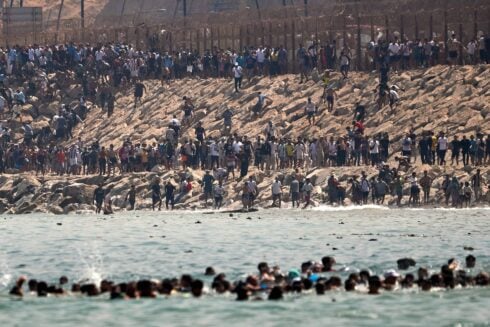
Police sources told Spanish daily El Diario that Thursday’s irregular crossings into Ceuta alone may have topped 10,000, though Ceuta president Juan Jesus Vivas has separately put the figure above 20,000.
The Guardia Civil’s own officers’ union, AUGC, said its members faced an impossible task.
“There are not enough guardias civiles to stop this human tide,” AUGC said in a statement. “We are asking the impossible of them.”
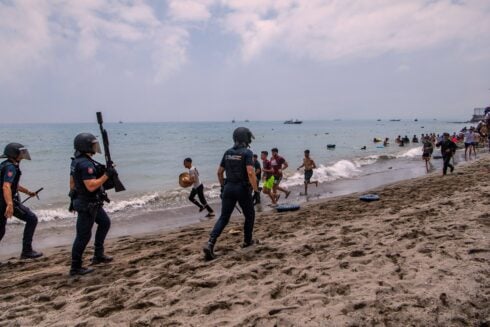
Prime Minister Pedro Sanchez is due in Ceuta today, alongside interior minister Fernando Grande-Marlaska, to meet Guardia Civil, Policia Nacional and Red Cross officials at the Tarajal crossing before a midday meeting with Ceuta’s regional government.
The two are expected to give a joint statement to the press this afternoon.
The White House has separately accused Spain of embracing a ‘destructive philosophy’ that has fuelled the crisis.
“Spain and other countries that have adopted this destructive philosophy should rectify immediately or risk their own disappearance,” White House spokeswoman Ana Kelly said.
Italian prime minister Giorgia Meloni went further, saying Italy was ready to act.
“Italy will not stand by and watch,” Meloni said. “We are prepared to intervene with extraordinary measures to defend our borders and the safety of our citizens, including the suspension of the Schengen Area with Spain.”
Foreign minister Antonio Tajani went further still, accusing Spain of granting ‘Spanish, and therefore European, citizenship’ to more than 500,000 undocumented migrants, and calling the policy ‘profoundly wrong’ and a driver of human trafficking.
Spain’s regularisation scheme actually grants residency and the right to work, not citizenship, a distinction Tajani did not draw.
Spanish foreign minister Jose Manuel Albares hit back, calling Tajani’s remarks ‘improper’ for the foreign minister of ‘a partner and friendly country’ from which Spain expected ‘European solidarity, not partisan demagoguery.’
Albares said he had summoned Italy’s ambassador to Madrid for Friday.
The Schengen Area is the passport-free travel zone covering 29 European countries, including Spain and Italy, that lets people cross most internal EU borders without routine checks.
A formal suspension targeting Spain alone would be a rare and drastic step, reintroducing document checks at the Italian border and disrupting travel between the two countries for residents and tourists alike, though Rome has not said how or when such a measure could actually take effect.
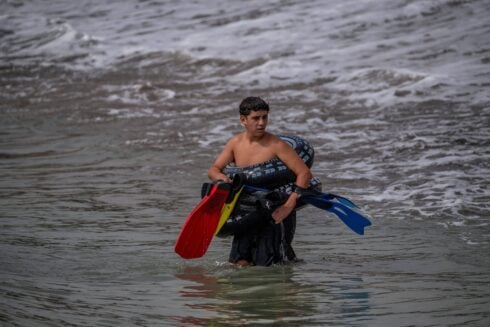
The current wave follows a Spanish Supreme Court ruling on July 8 that stopped border guards sending back migrants who swim into Ceuta or Melilla immediately, unlike those who scale the land fence and can still be turned back on the spot.
Anyone who swims in must now go through the full deportation process, which can take months and opens a route to claiming asylum, and police unions say smuggling networks are exploiting the change to sell crossings.
The Beni Enzar crossing remains shut, with no reopening time given.
Click here to read more Spain News from The Olive Press.