SPAIN and Morocco have agreed to speed up the return of thousands of people who have stormed into Ceuta over the past 24 hours.
The Spanish government said Morocco is cooperating ‘loyally and permanently’ with Spain, actively intervening to stop many more people from reaching the exclave.
Interior Minister Fernando Grande-Marlaska will travel to Ceuta on Friday, and the two countries have committed to reviewing and speeding up procedures to hand back everyone who entered Spain illegally, according to a joint statement.
The government’s description of Morocco as a loyal partner contradicts recent claims from Spanish police unions accusing Moroccan authorities of passivity, and even complicity, in the surge.
Neither government specified how many people would be returned, or when, after thousands streamed into Ceuta uncontrolled around midday today.
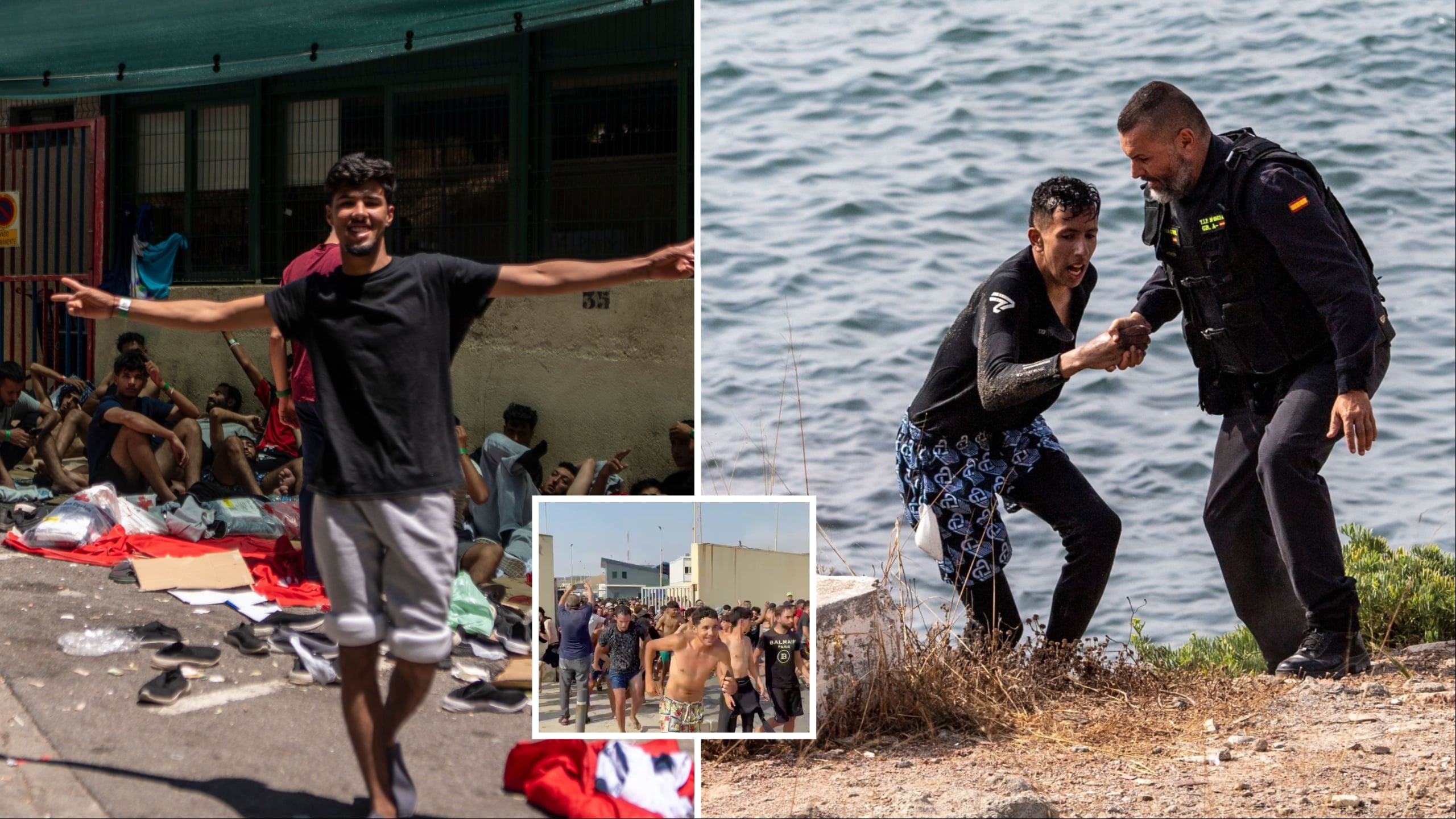
Guardia Civil officers and emergency crews were overwhelmed by midday on Thursday and could only attend to the injured, according to El Pais.
The surge has dwarfed the 1,500 to 2,000 arrivals recorded over the previous ten days, a figure that suddenly looked minor by comparison.
Witnesses described people arriving soaking wet and jubilant, hugging each other, kissing the tarmac and throwing their flip-flops in the air as they reached Spanish soil.
The decision to deploy the army marks a sharp escalation from the unified command Ceuta’s president, Juan Jesus Vivas, had asked Madrid to take charge of only a day earlier.
Ceuta’s temporary migrant reception centre has been full for days, its doors closed to new arrivals.
Rubbish trucks were called in this morning as the site approached what El Pais described as a hygiene crisis, with a single water tap left for people to wash.
Guardia Civil officers had gathered and processed hundreds of migrants overnight at El Tarajal, the border crossing point between Ceuta and Morocco, releasing them before midday, only for far larger numbers to arrive behind them.
Some officials have blamed a Supreme Court ruling that stopped migrants who swim into Ceuta from being sent back to Morocco immediately.
Migrants interviewed by El Pais said they had never heard of the ruling.
Under the ruling, handed down on July 8, only migrants who cross by scaling the border fence can still be turned back on the spot; anyone who swims in must go through the standard deportation process instead, which can take months.
Migrant support organisations put the death toll along Ceuta’s coast at more than 30 so far this year, which said the figure did not yet include bodies from the latest waves of arrivals.
Vivas issued a public statement urging calm, telling residents that Ceuta had faced crises like this before and had always endured them with fortitude.
The regional predisent made the call for a national emergency after warning that arrivals by sea now amount to 2% of the exclave’s entire population in just ten days.
Between 1,500 and 2,000 people had swum into Ceuta over that period, he said, a proportion he compared to a million people arriving in mainland Spain by sea over the same window.

The emergency shelter set up for migrant minors is now running at 2,400% over its ordinary capacity, according to Vivas.
More people are currently sleeping outside Ceuta’s temporary reception centre for adult migrants than inside it, a facility built to hold 512 people.
Vivas described the situation as ‘an absolute humanitarian and social emergency’ and said only a single chain of command over the Guardia Civil and other state security forces could bring it under control.
A national emergency is not a specific legal status under Spanish law, and Vivas is not invoking a formal constitutional mechanism; his request amounts to a political demand for Madrid to take direct charge of the response, rather than leaving Ceuta’s regional government to coordinate separately with national policing.
READ MORE: Three bodies wash up on beaches along the Costa del Sol wearing wetsuits and flippers

Vivas said 60 bodies have been recovered from the sea over the past month as people have attempted the crossing.
It comes as three bodies washed up along the shores of the Costa del Sol yesterday. The victims were dressed in snorkels and flippers but had no ID on them.
The current surge follows a Spanish Supreme Court ruling that ended the automatic return to Morocco of migrants intercepted while swimming into Ceuta and Melilla.
Under the ruling, only migrants who cross by scaling the land border fence can be turned back immediately.
Anyone who swims in must now go through the standard deportation process instead, which can take months and gives them the chance to apply for asylum.
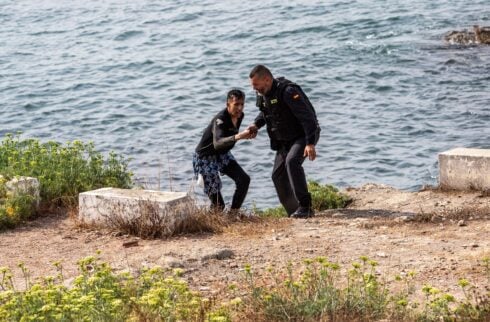
The Olive Press reported on July 27 that four people had died and around 20 were feared missing after a single weekend crossing attempt near Castillejos, a Moroccan coastal town facing Ceuta across the border.
Guardia Civil sources linked that surge to the same Supreme Court ruling at the time.
Spain’s Interior Ministry classifies almost all of Ceuta’s arrivals this year as having come by land, even though witnesses describe people swimming ashore most nights.
Ministry figures show 2,826 irregular land entries in Ceuta between January 1 and July 15, up 149% on the 1,133 recorded in the same period of 2025, while officially logging zero arrivals by sea all year.
The Guardia Civil’s own officers’ union, the AUGC, has publicly disputed that classification, arguing most of those people are in fact swimmers being intercepted on the coast rather than migrants scaling the fence.

“If this isn’t corrected, in a month we’ll be back where we were in May 2021,” Vivas said, referring to a previous mass-arrival crisis when thousands of people crossed into Ceuta within days after Morocco eased its border controls amid a diplomatic row with Spain.
Guardia Civil sources believe Morocco may have once again quietly eased its own coastal vigilance, this time since Prime Minister Pedro Sanchez visited Algeria on July 20, ten days before the current wave of crossings began.
The visit secured a bigger gas supply deal with Algeria and capped the repair of a relationship that collapsed in 2022, when Spain backed Morocco’s claim to sovereignty over Western Sahara and Algeria tore up its decades-old friendship treaty with Madrid in response.
Morocco has used migration as leverage against Spain before.
In May 2021 it eased border controls and let thousands of people cross into Ceuta within days, widely seen at the time as retaliation for Spain admitting a Western Sahara independence leader to hospital without consulting Rabat.
Even now, Guardia Civil sources say Moroccan patrol boats are still cooperating in sea rescues, suggesting a calculated easing of pressure rather than a simple hands-off approach.
Click here to read more Spain News from The Olive Press.