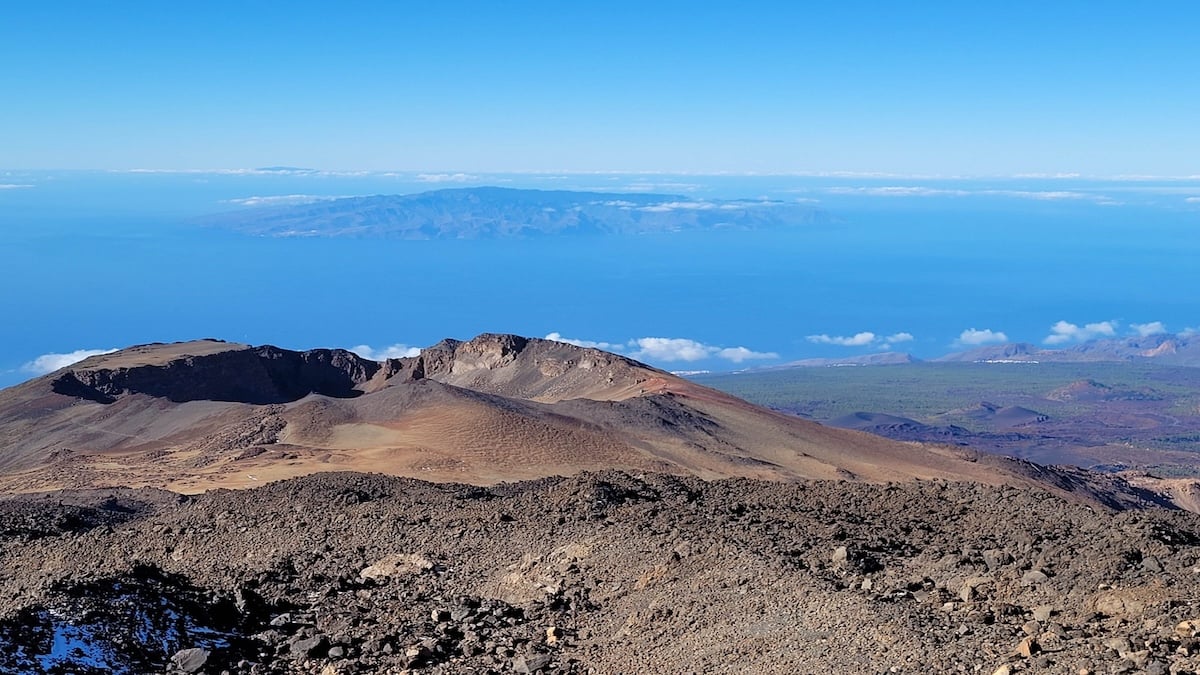
SCIENTISTS have built the first three-dimensional map of the magma system deep beneath Tenerife, pinpointing four zones where the rock may be partially molten.
The study, led by Involcan, the Canary Islands’ Volcanological Institute, and published in the journal Scientific Reports, offers the clearest picture yet of what lies beneath the island’s volcanic system.
Researchers analysed more than 785 waves from distant earthquakes worldwide, recorded between 2017 and 2024 by the Canary Islands Seismic Network, to build a 3D model of the island’s crust and upper mantle reaching down to 50km.
Those waves slow down depending on the rock they pass through, letting the team identify four zones of unusually slow-moving waves, a sign of heat or partially molten rock, sitting beneath a rigid ocean crust roughly 10km thick.
The clearest of the four sits in the northwest of Tenerife, where Involcan says seismic waves travel at ‘exceptionally low’ speeds, and the study’s thermodynamic modelling suggests up to 79% of the rock there could be molten.
Nemesio Perez, Involcan’s scientific coordinator and one of the study’s authors, said much of the earthquake activity Tenerife has recorded since 2016 clusters directly above or around the edges of that same anomaly.
He said the team believes this reflects magma, gas and other fluids gradually building up and moving through the deep crust.
“The probability of an eruption remains low,” Perez said.
He said the finding does not change Tenerife’s eruption risk assessment, and that scientists would expect a clear set of warning signs, such as shallower earthquakes, a sustained rise in volcanic gases, rapid ground deformation or larger tremors, before treating an eruption as close, none of which have appeared.
The study follows a swarm of 15 small earthquakes recorded off Tenerife’s north coast between August 26 and 27, the strongest a magnitude 3.6 tremor felt in La Laguna and Tacoronte, two towns near the island’s north coast.
Spain’s National Geographic Institute (IGN) said that swarm appears tectonic in origin and unrelated to the volcanic unrest further west.
Tenerife has recorded anomalous volcano-seismic activity since February, including swarms of hundreds of small hybrid tremors, which combine long resonant shaking with sharper jolts often linked to gas or fluid movement underground, and the Olive Press reported at the time on quake swarms beneath Mount Teide that also stopped short of signalling an eruption.
A similar Involcan study in 2024 found an even larger magma anomaly beneath La Palma’s Cumbre Vieja volcano, which independent research later confirmed matched the two magma chambers that fed its destructive 2021 eruption.
Involcan says the same three-dimensional method will now be extended to El Hierro, Gran Canaria and Lanzarote.
Click here to read more Tenerife News from The Olive Press.